


Page 1260 - Hall et al (2015) Principles of Critical Care-McGraw-Hill
P. 1260
CHAPTER 92: Acute Leukemia  867


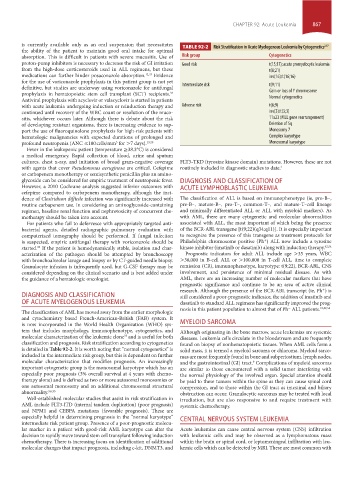
                    is currently available only as an oral suspension that necessitates     TABLE 92-2    Risk Stratification in Acute Myelogenous Leukemia by Cytogenetics 2,57
                    the ability of the patient to maintain good oral intake for optimal
                    absorption. This is difficult in patients with severe mucositis. Use of   Risk group  Cytogenetics
                    proton-pump inhibitors is necessary to decrease the risk of GI irritation   Good risk  t(15;17); acute promyelocytic leukemia
                    from the high-dose corticosteroids used in ALL regimens, but these                  t(8;21)
                    medications can further hinder posaconazole absorption. 12,33  Evidence             inv(16)/t(16;16)
                    for the use of voriconazole prophylaxis in this patient group is not yet
                    definitive, but studies are underway using voriconazole for antifungal   Intermediate risk  t(9;11)
                    prophylaxis in hematopoietic stem cell transplant (SCT) recipients.                 Gain or loss of Y chromosome
                                                                      33
                    Antiviral prophylaxis with acyclovir or valacyclovir is started in patients         Normal cytogenetics
                    with acute leukemia undergoing induction or reinduction therapy and   Adverse risk  t(6;9)
                    continued until recovery of the WBC count or resolution of the muco-                inv(3)/t(3;3)
                    sitis, whichever occurs later. Although there is debate about the risk              11a23 (MLL gene rearrangement)
                    of developing resistant organisms, there is increasing evidence to sup-             Deletion of 5q
                    port the use of fluoroquinolone prophylaxis for high-risk patients with             Monosomy 7
                    hematologic malignancies with expected durations of prolonged and                   Complex karyotype
                    profound neutropenia (ANC ≤100 cells/mm  for >7 days). 13,20                        Monosomal karyotype
                                                    3
                     Fever in the leukopenic patient (temperature ≥38.3°C) is considered
                    a medical emergency. Rapid collection of blood, urine and sputum
                    cultures, chest x-ray, and initiation of broad gram-negative coverage   FLT3-TKD (tyrosine kinase domain) mutations. However, these are not
                    with agents that cover Pseudomonas aeruginosa are critical. Cefepime   routinely included in diagnostic studies to date. 3
                    or carbapenem monotherapy or semisynthetic penicillin plus an amino-
                    glycoside can be considered for empiric treatment of neutropenic fever.  DIAGNOSIS AND CLASSIFICATION OF
                    However, a 2010 Cochrane analysis suggested inferior outcomes with   ACUTE LYMPHOBLASTIC LEUKEMIA
                    cefepime compared  to carbapenem monotherapy, although the  inci-
                    dence of Clostridium difficile infection was significantly increased with   The classification of ALL is based on immunophenotype (ie, pro-B–,
                    routine carbapenem use. In considering an aminoglycoside-containing   pre-B–, mature-B–, pro-T–, common-T–, and mature-T–cell lineage
                    regimen, baseline renal function and nephrotoxicity of concurrent che-  and minimally differentiated ALL or ALL with myeloid markers). As
                    motherapy should be taken into account.               with AML, there are many cytogenetic and molecular abnormalities
                     For patients who fail to defervesce with appropriately targeted anti-  associated with ALL, the most important of which being the presence
                    bacterial agents, detailed radiographic pulmonary evaluation with   of the BCR-ABL transgene [t(9;22)(q34;q11)]. It is especially important
                    computerized tomography should be performed. If fungal infection   to recognize the presence of this transgene as treatment protocols for
                    is suspected, empiric antifungal therapy with voriconazole should be   Philadelphia chromosome positive (Ph ) ALL now include a tyrosine
                                                                                                      +
                    started.  If the patient is hemodynamically stable, isolation and char-  kinase inhibitor (imatinib or dasatinib) along with induction therapy. 42,54
                         33
                    acterization of the pathogen should be attempted by bronchoscopy   Prognostic  indicators  for  adult  ALL  include  age  >35  years,  WBC
                    with bronchoalveolar lavage and biopsy or by CT-guided needle biopsy.   >30,000 in B-cell ALL or  >100,000 in T-cell ALL, time to complete
                    Granulocyte infusion is infrequently used, but G-CSF therapy may be   remission (CR), immunophenotype, karyotype: t(9;22), BCR-ABL, CNS
                    considered depending on the clinical scenario and is best added under   involvement, and persistence of minimal residual disease. As with
                    the guidance of a hematologic oncologist.             AML, there are an increasing number of molecular markers that have
                                                                          prognostic significance and continue to be an area of active clinical
                                                                          research. Although the presence of the BCR-ABL transcript (ie, Ph ) is
                                                                                                                          +
                    DIAGNOSIS AND CLASSIFICATION                          still  considered a poor-prognostic indicator, the addition of imatinib and
                    OF ACUTE MYELOGENOUS LEUKEMIA                         dasatinib to standard ALL regimens has significantly improved the prog-
                                                                          nosis in this patient population to almost that of Ph  ALL patients. 18,42,54
                                                                                                              −
                    The classification of AML has moved away from the earlier morphologic
                    and cytochemistry based French-American-British (FAB) system. It
                    is now incorporated in the World Health Organization (WHO) sys-  MYELOID SARCOMA
                    tem that includes morphology, immunophenotype, cytogenetics, and   Although originating in the bone marrow, acute leukemias are systemic
                    molecular characterization of the leukemic clone  and is useful for both   diseases. Leukemia cells circulate in the bloodstream and are frequently
                                                       35
                    classification and prognosis. Risk stratification according to cytogenetics   found on biopsy of nonhematopoietic tissues. When AML cells form a
                    is detailed in Table 92-2. It is worth noting that “normal cytogenetics” is   solid mass, it is termed a myeloid sarcoma or chloroma. Myeloid sarco-
                    included in the intermediate risk group, but this is dependent on further   mas are most frequently found in bone and subperiostium, lymph nodes,
                    molecular  characterization  that  modifies  prognosis.  An  increasingly   and the gastrointestinal (GI) tract.  Complications of myeloid sarcomas
                                                                                                  9
                    important cytogenetic group is the monosomal karyotype which has an   are similar to those encountered with a solid  tumor interfering with
                    especially poor prognosis (3% overall survival at 4 years with chemo-  the normal physiology of the involved organ. Special attention should
                    therapy alone) and is defined as two or more autosomal monosomies or   be paid to these tumors within the spine as they can cause spinal cord
                    one autosomal monosomy and an additional chromosomal structural   compression, and to those within the GI tract as intestinal and biliary
                    abnormality. 3,6,35                                   obstruction can occur. Granulocytic sarcomas may be treated with local
                     Well-established molecular studies that assist in risk stratification in   irradiation, but are also responsive to and require treatment with
                    AML include FLT3-ITD (internal tandem duplication) (poor prognosis)     systemic chemotherapy.
                    and NPM1 and CEBPA mutations (favorable prognosis). These are
                    especially helpful in determining prognosis in the “normal karyotype”   CENTRAL NERVOUS SYSTEM LEUKEMIA
                    intermediate risk patient group. Presence of a poor-prognostic molecu-
                    lar marker in a patient with good-risk AML karyotype can alter the   Acute leukemias can cause central nervous system (CNS) infiltration
                    decision to rapidly move toward stem cell transplant following induction   with leukemic cells and may be observed as a lymphomatous mass
                    chemotherapy. There is increasing focus on identification of additional   within the brain or spinal cord, or leptomeningeal infiltration with leu-
                    molecular changes that impact prognosis, including c-kit, DNMT3, and   kemic cells which can be detected by MRI. These are most common with


            section07.indd   867                                                                                       1/21/2015   7:42:54 AM

