


Page 1272 - Hall et al (2015) Principles of Critical Care-McGraw-Hill
P. 1272
CHAPTER 93: Oncologic Emergencies  879


                    and mortality is as high as 40% to 60%. 102,103,115  Certain chromosomal   SVCS are due to lung cancer and lymphoma; 50% are due to nonsmall cell
                    mutations in AML and ALL are thought to be associated to higher white   lung carcinoma (NSCLC), 25% due to small cell lung carcinoma (SCLC),
                    blood cell (WBC) counts and higher risk for leukostasis. 102,114  and 10% due to non-Hodgkin lymphoma. 122,123  Once SVCS is present in the
                     Hyperviscosity, secondary to elevated WBC counts, was thought to be the   setting of malignancy, life expectancy is only 2 to 9 months. 123
                    main factor in the physiopathology of leukostasis. However, in vitro stud-  Most common findings on physical examination in patients with
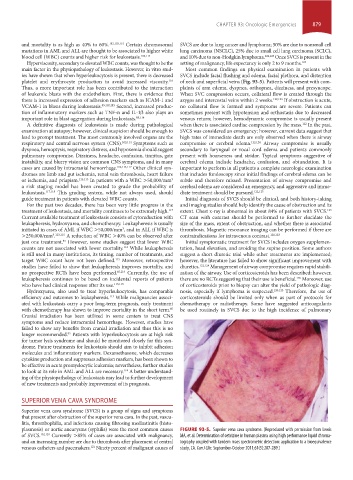
                    ies have shown that when hyperleukocytosis is present, there is decreased   SVCS include facial flushing and edema, facial plethora, and distention
                    platelet  and  erythrocyte  production  to  avoid  increased  viscosity.     of neck and superficial veins (Fig. 93-5). Patients will present with com-
                                                                      116
                    Thus, a more important role has been contributed to the interaction   plaints of arm edema, dyspnea, orthopnea, dizziness, and presyncope.
                    of  leukemic  blasts  with  the  endothelium.  First,  there  is  evidence  that   When SVC compression occurs, collateral flow is created through the
                    there is increased expression of adhesion markers such as ICAM-1 and   azygos and intercostal veins within 2 weeks. 122,123  If obstruction is acute,
                    VCAM-1 in blasts during leukostasis. 85,102,115  Second, increased produc-  no collateral flow is formed and symptoms are severe. Patients can
                    tion of inflammatory markers such as TNF-α and IL-1β also plays an   sometimes present with hypotension and orthostasis due to decreased
                    important role in blast aggregation during leukostasis. 85,114  venous return; however, hemodynamic compromise is usually present
                     A definitive diagnosis of leukostasis is made during pathological   when there is associated cardiac compression by the mass.  In the past,
                                                                                                                   122
                    examination at autopsy; however, clinical suspicion should be enough to   SVCS was considered an emergency; however, current data suggest that
                    lead to prompt treatment. The most commonly involved organs are the   high rates of immediate death are only observed when there is airway
                    respiratory and central nervous system (CNS). 102,114  Symptoms such as   compromise or cerebral edema. 122,124  Airway compromise is usually
                    dyspnea, hemoptysis, respiratory distress, and hypoxemia should suggest   secondary to laryngeal or vocal cord edema and patients commonly
                    pulmonary compromise. Dizziness, headache, confusion, tinnitus, gate   present with hoarseness and stridor. Typical symptoms suggestive of
                    instability, and blurry vision are common CNS symptoms, and in many   cerebral edema include headache, confusion, and obtundation. It is
                    cases are caused by intracranial hemorrhage. 102,114,117  Other clinical syn-  important to perform in all patients a complete neurologic examination
                    dromes are limb and gut ischemia, renal vein thrombosis, heart failure   that includes fundoscopy since initial findings of cerebral edema can be
                    or ischemia, and priapism. 114,115  In patients with a WBC >50,000/mm    subtle and therefore missed. Presentation of airway compromise and
                                                                       3
                    a risk staging model has been created to grade the probability of    cerebral edema are considered an emergency, and aggressive and imme-
                    leukostasis. 117,118  This grading system, while not always used, should   diate treatment should be pursued. 122,125
                    guide treatment in patients with elevated WBC counts.  Initial diagnosis of SVCS should be clinical, and both history-taking
                     For the past two decades, there has been very little progress in the   and imaging studies should help identify the cause of obstruction and its
                    treatment of leukostasis, and mortality continues to be extremely high.    extent. Chest x-ray is abnormal in about 84% of patients with SVCS.
                                                                                                                            123
                                                                      117
                    Current available treatment of leukostasis consists of cytoreduction with   CT scan with contrast should be performed to further elucidate the
                    leukapheresis, hydroxyurea, and chemotherapy. Leukapheresis is usually   size of the mass, extent of obstruction, and whether there is associated
                    initiated in cases of AML if WBC >50,000/mm , and in ALL if WBC is   thrombosis. Magnetic resonance imaging can be performed if there are
                                                      3
                    >250,000/mm . 3 113,115  A reduction of WBC >40% can be observed after   contraindications for intravenous contrast. 120,123
                    just one treatment.  However, some studies suggest that lower WBC   Initial symptomatic treatment for SVCS includes oxygen supplemen-
                                  85
                    counts are not associated with lower mortality.  While leukapheresis   tation, head elevation, and avoiding the supine position. Some authors
                                                      114
                    is still used in many institutions, its timing, number of treatments, and   suggest a short diuretic trial while other treatments are implemented;
                    target  WBC  count  have  not  been  defined.   Moreover,  retrospective   however, the literature has failed to show significant improvement with
                                                    115
                    studies have failed to show that leukapheresis improves mortality, and   diuretics. 122,124  Management of airway compromise requires rapid stabili-
                    no prospective RCTs have been performed. 85,119  Currently, the use of   zation of the airway. Use of corticosteroids has been described; however,
                    leukapheresis  continues  to  be  based  on  incidental  reports  of  patients   there are no RCTs suggesting that their use is beneficial.  Moreover, use
                                                                                                                 126
                    who have had clinical response after its use. 113,115  of corticosteroids prior to biopsy can alter the yield of pathologic diag-
                     Hydroxyurea, also used to treat  hyperleukocytosis, has comparable   nosis, especially if lymphoma is suspected. 120,123  Therefore, the use of
                    efficiency and outcomes to leukapheresis.  While malignancies associ-  corticosteroids should be limited only when as part of protocols for
                                                  113
                    ated with leukostasis carry a poor long-term prognosis, early treatment   chemotherapy or radiotherapy. Some have suggested anticoagulants
                    with chemotherapy has shown to improve mortality in the short term.    be used routinely in SVCS due to the high incidence of pulmonary
                                                                      85
                    Cranial irradiation has been utilized in some centers to treat CNS
                    symptoms and reduce intracranial hemorrhage. However, studies have
                    failed to show any benefits from cranial irradiation and thus this is no
                    longer  recommended.  Patients with hyperleukocytosis are at high risk
                                   85
                    for tumor lysis syndrome and should be monitored closely for this syn-
                    drome. Future treatments for leukostasis should aim to inhibit adhesion
                    molecules and inflammatory markers. Dexamethasone, which decreases
                    cytokine production and suppresses adhesion markers, has been shown to
                    be effective in acute promyelocytic leukemia; nevertheless, further studies
                    to look at its role in AML and ALL are necessary.  A better understand-
                                                      114
                    ing of the physiopathology of leukostasis may lead to further development
                    of new treatments and probably improvement of its prognosis.
                    SUPERIOR VENA CAVA SYNDROME
                    Superior vena cava syndrome (SVCS) is a group of signs and symptoms
                    that present after obstruction of the superior vena cava. In the past, vascu-
                    litis, thrombophilia, and infections causing fibrosing mediastinitis (histo-
                    plasmosis) or aortic aneurysms (syphilis) were the most  common causes   FIGURE 93-5.  Superior vena cava syndrome. (Reproduced with permission from Lewis
                    of SVCS. 102,120  Currently >85% of cases are associated with malignancy,   MA, et al. Determination of cetirizine in human plasma using high performance liquid chroma-
                    and an increasing number are due to thrombosis after placement of central   tography coupled with tandem mass spectrometric detection: application to a bioequivalence
                    venous catheters and pacemakers.  Ninety percent of  malignant causes of   study, CA. Can J Clin. September-October 2011;61(5):287-289.)
                                           121


            section07.indd   879                                                                                       1/21/2015   7:43:01 AM

