


Page 1273 - Hall et al (2015) Principles of Critical Care-McGraw-Hill
P. 1273
880     PART 7: Hematologic and Oncologic Disorders


                   embolism in this population. 127,128  However, bleeding complications are   are mesotheliomas.  Pericardial effusions due to malignancy are
                                                                                      102
                 high, and current data do not suggest improved outcomes when using     associated with a poor prognosis; only 45% of patients survive at
                 routine anticoagulation. 123                          6 months decreasing to 10% to 26% at 1 year. 132,133  The worst outcomes
                   The use of intravascular stents for SVCS treatment has increased   have been associated with patients with lung cancer, especially adeno-
                 significantly since the early 1980s.  Stenting improves symptoms in the   carcinoma, in whom survival is less than 3 months after pericardial effu-
                                          129
                 first 24 to 72 hours, making it the treatment of choice for patients with   sions are diagnosed. 132,134  On the contrary, patients with lymphoma have
                 severe SVCS. 126,129  Multiple studies have shown stenting to be efficient,   a better prognosis with survival of up to 3 years. 134,135  Other prognostic
                 safe, and cost-effective. 126,129,130  Complications such as stent migration,   factors associated with higher mortality are positive fluid cytology, no
                 pericardial tamponade, and PE have been reported in less than 8% of   response to chemotherapy, and advanced malignancy. 132,136
                 cases.  Moreover, stenosis of stents has been reported to be less than   The most common symptoms associated with cardiac tamponade are
                     129
                 7%. 129,130  Prolonged use of anticoagulants to avoid stent thrombosis is   dyspnea, chest discomfort, and chest pain. Beck triad, consisting of pulsus
                 still controversial and some authors have observed that dipyridamole   paradoxus, distant heart sounds, and jugular venous distention (JVD),
                 may be enough to avoid this complication. 130         was first described in the 1930s. However, JVD, hypotension, and muffled
                   As described earlier, only in cases of cerebral edema and airway   heart sounds have been only described in 54%, 28%, and 22% of cases,
                 compromise should treatment for SVCS be initiated urgently and   respectively.  Chest x-ray reveals an enlarged cardiac silhouette in about
                                                                                137
                 without a diagnosis. Even after stent placement, final treatment for   70% of cases.  Electrocardiographic signs consistent with pericardial
                                                                                 137
                 SVCS should be guided by the therapy for the malignancy. Initiating   effusion and tamponade can vary, but the most specific are low voltage, PR
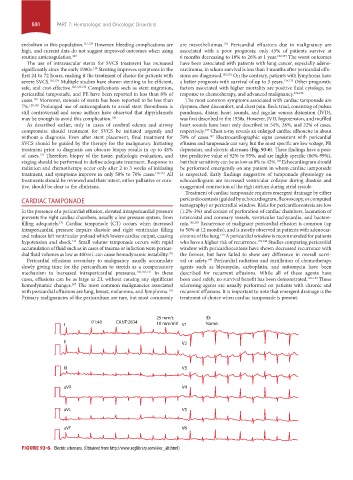
                 treatment prior to diagnosis can obscure biopsy results in up to 48%   depression, and electric alternans (Fig. 93-6). These findings have a posi-
                 of cases.  Therefore, biopsy of the tissue, pathologic evaluation, and   tive predictive value of 92% to 95%, and are highly specific (86%-99%),
                       123
                 staging should be performed to define adequate treatment. Response to   but their sensitivity can be as low as 8% to 42%.  Echocardiogram should
                                                                                                        138
                 radiation and chemotherapy occur only after 2 to 3 weeks of initiating   be performed emergently on any patient in whom cardiac tamponade
                 treatment, and symptoms improve in only 50% to 70% cases. 120,123  All   is  suspected.  Early  findings  suggestive  of  tamponade  physiology  on
                 treatments should be reviewed and their intent, either palliative or cura-  echocardiogram are  increased ventricular  collapse during diastole and
                 tive, should be clear to the clinicians.              exaggerated contraction of the right atrium during atrial systole.
                                                                         Treatment of cardiac tamponade requires emergent drainage by either
                 CARDIAC TAMPONADE                                     pericardiocentesis (guided by echocardiogram, fluoroscopy, or computed
                                                                       tomography) or pericardial window. Risks for pericardiocentesis are low
                 In the presence of a pericardial effusion, elevated intrapericardial pressure   (1.2%-3%) and consist of perforation of cardiac chambers, laceration of
                 prevents the right cardiac chambers, usually a low pressure system, from   intercostal and coronary vessels, ventricular tachycardia, and bactere-
                 filling adequately.  Cardiac tamponade (CT) occurs when increased   mia. 136,139  Recurrence of malignant pericardial effusion is  common (up
                              131
                 intrapericardial  pressure  impairs  diastole  and  right  ventricular  filling   to 50% at 12 months), and is mostly observed in patients with adenocar-
                 and reduces left ventricular preload which lowers cardiac output, causing   cinoma of the lung.  A pericardial window is recommended for patients
                                                                                     139
                 hypotension and shock.  Small volume tamponade occurs with rapid   who have a higher risk of recurrence. 139,140  Studies comparing pericardial
                                  131
                 accumulation of fluid such as in cases of trauma or infection were pericar-  window with pericardiocentesis have shown decreased recurrence with
                 dial fluid volumes as low as 400 mL can cause hemodynamic instability. 102  the former, but have failed to show any difference in overall survi-
                   Pericardial  effusions  secondary  to  malignancy  usually accumulate   val  or  safety.  Pericardial radiation and  instillation of chemotherapy
                                                                                 140
                 slowly giving time for the pericardium to stretch as a compensatory   agents such as bleomycin, carboplatin, and mitomycin have been
                 mechanism to increased intrapericardial pressures. 102,103,131  In these   described for recurrent effusions. While all of these agents have
                 cases, effusions can be as large as 2 L without causing any significant   been used safely, no survival benefit has been demonstrated. 141-144  These
                 hemodynamic changes.  The most common malignancies associated   sclerosing agents are usually performed on patients with chronic and
                                  103
                 with pericardial effusions are lung, breast, melanoma, and lymphoma.    recurrent effusions. It is important to note that emergent drainage is the
                                                                   102
                 Primary malignancies of the pericardium are rare, but most  commonly   treatment of choice when cardiac tamponade is present.

                                                               25 mm/s          ID:
                                         01:40   CANT:2834
                                I                              10 mm/mV  V1     Name:

                                II                                      V2


                                III                                     V3


                                aVR                                     V4


                                aVL                                     V5


                                aVF                                     V6


                 FIGURE 93-6.  Electric alternans. (Obtained from http://www.ecglibrary.com/elec_alt.html)


            section07.indd   880                                                                                       1/21/2015   7:43:02 AM

