


Page 1296 - Hall et al (2015) Principles of Critical Care-McGraw-Hill
P. 1296
CHAPTER 96: Sickle Cell Disease  903


                                                           Complications of sickle cell disease
                                      Chronic complications                                Acute complications
                                                    Retinopathy                Stroke, meningitis
                                                                                                        Post-hyphema
                                                                                                        glaucoma, retinal
                          Anemia, leukocytosis
                                                    Obstructive sleep apnea                             infarction
                                                    Pulmonary hypertension                                  Acute
                         Indirect                                                                           Chest
                         hyperbilirubinemia                                                                 Syndrome
                                                         Cardiomegaly
                         Isosthenuria,                                        Sickle
                         chronic                          Functional          hepatopathy
                         renal failure                    asplenia


                                                                                                         Splenic sequestration,
                                                                                                         splenic infarction
                                                                                    Papillary
                                                                                    necrosis
                                                       Avascular
                                                       necrosis                                           Cholelithiasis
                              Delayed                                             Priapism
                              puberty

                                                                           Bone marrow
                                                                           infarction,
                                                                           osteomyelitis


                                                            Skin ulcers


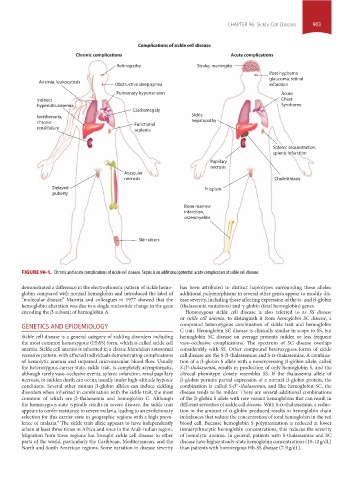
                    FIGURE 96-1.  Chronic and acute complications of sickle cell disease. Sepsis is an additional potential acute complication of sickle cell disease.

                    demonstrated a difference in the electrophoretic pattern of sickle hemo-  has been attributed to distinct haplotypes surrounding these alleles;
                    globin compared with normal hemoglobin and introduced the label of   additional polymorphisms in several other genes appear to modify dis-
                    “molecular disease.” Marotta and colleagues in 1977 showed that the   ease severity, including those affecting expression of the α- and β-globin
                    hemoglobin alteration was due to a single nucleotide change in the gene   (thalassemia mutations) and γ-globin (fetal hemoglobin) genes.
                    encoding the β subunit of hemoglobin A.                Homozygous sickle cell disease is also referred to as  SS disease
                                                                          or  sickle cell anemia, to distinguish it from  hemoglobin SC disease, a
                    GENETICS AND EPIDEMIOLOGY                               compound heterozygous combination of sickle trait and hemoglobin
                                                                          C trait. Hemoglobin SC disease is clinically similar in scope to SS, but
                    Sickle cell disease is a general category of sickling disorders including   hemoglobin SC disease on average presents milder or less frequent
                    the most common homozygous (HbSS) form, which is called sickle cell   vaso-occlusive complications. The spectrum of SC disease overlaps
                    anemia. Sickle cell anemia is inherited in a classic Mendelian autosomal   considerably with SS. Other compound heterozygous forms of sickle
                    recessive pattern, with affected individuals demonstrating complications   cell disease are the S-β-thalassemias and S-α-thalassemias. A combina-
                    of hemolytic anemia and impaired microvascular blood flow. Usually   tion of a β-globin S allele with a nonexpressing β-globin allele, called
                    the heterozygous carrier state, sickle trait, is completely asymptomatic,   S-β -thalassemia, results in production of only hemoglobin S, and the
                                                                            0
                    although rarely vaso-occlusive events, splenic infarction, renal papillary   clinical phenotype closely resembles SS. If the thalassemia allele of
                    necrosis, or sudden death can occur, usually under high-altitude hypoxic   β-globin permits partial expression of a normal β-globin protein, the
                    conditions. Several other mutant  β-globin alleles can induce sickling   combination is called  S-β -thalassemia, and like hemoglobin SC, the
                                                                                             +
                    disorders when inherited in combination with the sickle trait, the most   disease tends to be milder. There are several additional combinations
                    common of which are  β-thalassemia and hemoglobin C. Although   of the β-globin S allele with rare variant hemoglobins that can result in
                    the homozygous state typically results in severe disease, the sickle trait   different severities of sickle cell disease. With S-α-thalassemias, a reduc-
                    appears to confer resistance to severe malaria, leading to an evolutionary   tion in the amount of α-globin produced results in hemoglobin chain
                    selection for this carrier state in geographic regions with a high preva-  imbalances that reduce the concentration of total hemoglobin in the red
                    lence of malaria.  The sickle trait allele appears to have independently   blood cell. Because hemoglobin S polymerization is reduced at lower
                                7
                    arisen at least three times in Africa and once in the Arab-Indian region.   intraerythrocytic hemoglobin concentrations, this reduces the severity
                    Migration from these regions has brought sickle cell disease to other   of hemolytic  anemia. In general, patients with S-thalassemias and SC
                    parts of the world, particularly the Caribbean, Mediterranean, and the   disease have higher steady-state hemoglobin concentrations (10-12 g/dL)
                    North and South American regions. Some variation in disease severity   than patients with homozygous Hb-SS disease (7-9 g/dL).


            section07.indd   903                                                                                       1/21/2015   7:43:17 AM

