


Page 1297 - Hall et al (2015) Principles of Critical Care-McGraw-Hill
P. 1297
904     PART 7: Hematologic and Oncologic Disorders


                 PATHOPHYSIOLOGY                                         Steady-state sickle cell disease is characterized by intense inflamma-
                                                                       tion that accelerates during VOC, likely secondary to nearly constant
                 The single nucleotide mutation in the sixth codon of the β-globin gene   tissue ischemia-reperfusion. This is illustrated by frequent fever during
                 changes the corresponding amino acid in β-globin from valine to glu-  VOC and the ACS and by increased leukocyte, platelet, and endothe-
                 tamic acid. This induces a conformational change in the hemoglobin   lial cell activation, with increased circulating mediators and markers
                 tetramer that renders it susceptible to polymerization with deoxygen-  of  oxidant  stress  and  inflammation.  Examples  of  these  inflammatory
                 ation in hypoxic, hyperosmolar, or acidic regions of the circulation.   markers include elevated levels of C-reactive protein, cytokines (tumor
                 The rod-like polymer bundles distort the red cell membrane into the   necrosis factor α, interleukin 1β, and granulocyte-macrophage colony-
                 characteristic sickle shape. Intracellular hemoglobin S polymerization   stimulating factor), chemokines (interleukin 8), integrins (α β ), selec-
                                                                                                                     1
                                                                                                                   4
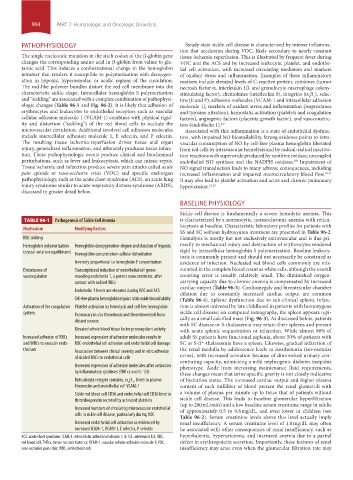
                 and “sickling” are associated with a complex combination of pathophysi-  tins (E and P), adhesion molecules (VCAM-1 and intracellular adhesion
                 ologic changes (Table 96-1 and Fig. 96-2). It is likely that adhesion of   molecule 1), markers of oxidant stress and inflammation (isoprostanes
                 erythrocytes and leukocytes to endothelial receptors such as vascular   and tyrosine nitration), hemostatic activation (platelets and coagulation
                 cellular adhesion molecule 1 (VCAM-1) combines with physical rigid-  factors), angiogenic factors (placenta growth factor), and vasoconstric-
                 ity and distortion (“sickling”) of the red blood cells to occlude the   tors (endothelin 1). 4,5
                 microvascular circulation. Additional involved cell adhesion molecules   Associated with this inflammation is a state of endothelial dysfunc-
                 include  intercellular  adhesion  molecule  1,  E  selectin,  and  P  selectin.   tion, with impaired NO bioavailability. Strong evidence points to intra-
                 The resulting tissue ischemia-reperfusion drives tissue and organ   vascular consumption of NO by cell-free plasma hemoglobin liberated
                 injury, generalized inflammation, and ultimately produces tissue infarc-  from red cells by intravascular hemolysis and by radical-radical inactiva-
                 tion. These pathophysiologic events produce clinical and biochemical   tion reactions with superoxide produced by xanthine oxidase, uncoupled
                   perturbations, such as fever and leukocytosis, which can mimic sepsis.   endothelial NO synthase and the NADPH oxidases.  Impairment of
                                                                                                              8,9
                 Tissue ischemia and infarction produce severe pain attacks called acute   NO signal transduction leads to many adverse consequences, including
                 pain episode or  vaso-occlusive crisis (VOC) and specific end-organ   increased inflammation and impaired microcirculatory blood flow. 10,11
                 pathophysiology, such as the acute chest syndrome (ACS), an acute lung   It may also lead to platelet activation and acute and chronic pulmonary
                 injury syndrome similar to acute respiratory distress syndrome (ARDS),   hypertension. 12,13
                 discussed in greater detail below.

                                                                       BASELINE PHYSIOLOGY
                                                                       Sickle cell disease is fundamentally a severe hemolytic anemia. This
                   TABLE 96-1    Pathogenesis of Sickle Cell Anemia    is characterized by a normocytic, normochromic anemia with reticu-
                                                                       locytosis at baseline. Characteristic laboratory profiles for patients with
                  Mechanism        Modifying Factors
                                                                       SS and SC without hydroxyurea treatment are presented in Table 96-2.
                  RBC sickling                                         Hemolysis is mostly but not exclusively extravascular and is due pri-
                    Hemoglobin polymerization  Hemoglobin deoxygenation-degree and duration of hypoxia  marily to mechanical injury and destruction of erythrocytes rendered
                  (crystal-solution equilibrium)  Hemoglobin concentration-cellular dehydration  rigid by intracellular hemoglobin S polymerization. Baseline leukocy-
                                                                       tosis is commonly present and should not necessarily be construed as
                                   Inversely proportional to hemoglobin F concentration  evidence of infection. Nucleated red blood cells commonly are mis-
                  Disturbance of   Transcriptional induction of endothelial cell genes   counted in the complete blood count as white cells, although the overall
                    vasoregulation    encoding endothelin 1, a potent vasoconstrictor, after   counting error is usually relatively small. The diminished oxygen-
                                   contact with sickled RBCs           carrying capacity due to chronic anemia is compensated by increased
                                                                       cardiac output (Table 96-3). Cardiomegaly and biventricular chamber
                                   Endothelin 1 levels are elevated during VOC and ACS
                                                                       dilation due to constantly increased cardiac output are common
                                   Cell-free plasma hemoglobin impairs nitric oxide bioavailability  (Table 96-4). Splenic dysfunction due to sub-clinical splenic infarc-
                    Activation of the coagulation  Platelet activation by hemolysis and cell free hemoglobin  tion is almost universal by late childhood in patients with homozygous
                  system           Pulmonary in situ thrombosis and thromboemboli from   sickle cell disease; on computed tomography, the spleen appears typi-
                                   distant sources                     cally as a small calcified mass (Fig. 96-3). As discussed below, patients
                                                                       with SC disease or S-thalassemia may retain their spleens and present
                                   Elevated whole blood tissue factor procoagulant activity  with acute splenic sequestration or infarction. While almost 98% of
                    Increased adhesion of RBCs   Increased expression of adhesion molecules results in    adult SS patients have functional asplenia, about 50% of patients with
                  and WBCs to vascular endo-  RBC-endothelial cell adhesion and endothelial cell damage  SC or S-β -thalassemia have a spleen. Likewise, gradual infarction of
                                                                               +
                  thelium          Association between clinical severity and in vitro adhesion   the renal medulla by adolescence leads to isosthenuria (iso-osmolar
                                   of sickled RBCs to endothelial cells  urine), with increased urination because of  diminished urinary con-
                                                                       centrating capacity, mimicking a mild nephrogenic diabetes insipidus
                                   Increased expression of adhesion molecules after activation   phenotype. Aside from increasing maintenance fluid requirements,
                                   by inflammatory cytokines (TNF α and IL-1β)  these changes mean that urine specific gravity is not closely indicative
                                   Reticulocyte integrin complex, α β , binds to plasma   of hydration status. The increased cardiac output and higher plasma
                                                      4
                                                       1
                                     fibronectin and endothelial cell VCAM-1  content of each milliliter of blood present the renal glomeruli with
                                   Sickle red blood cell CD36 and endothelial cell CD36 bind to   a volume of plasma per minute up to twice that of patients without
                                   thrombospondin secreted by activated platelets  sickle cell disease. This leads to baseline glomerular hyperfiltration
                                                                       (up to 200 mL/min) and a low baseline serum creatinine range in adults
                                   Increased numbers of circulating microvascular endothelial   of approximately 0.5 to 0.6 mg/dL, and even lower in children (see
                                   cells in sickle cell disease, particularly during VOC
                                                                       Table 96-2). Serum creatinine levels above this level actually imply
                                   Increased endothelial cell activation as evidenced by   renal insufficiency. A serum creatinine level of 1.0 mg/dL may often
                                   increased ICAM-1, VCAM-1, E selectin, P selectin  be associated with other consequences of renal insufficiency, such as
                 ACS, acute chest syndrome; ICAM-1, intercellular adhesion molecule 1; IL-1β, interleukin 1β; RBC,   hyperkalemia, hyperuricemia, and increased anemia due to a partial
                 red blood cell; TNFα, tumor necrosis factor α; VCAM-1, vascular cellular adhesion molecule 1; VOC,   defect in erythropoietin secretion. Importantly, these features of renal
                   vaso-occlusive pain crisis; WBC, white blood cell.  insufficiency may arise even when the glomerular filtration rate may


            section07.indd   904                                                                                       1/21/2015   7:43:17 AM

