


Page 1298 - Hall et al (2015) Principles of Critical Care-McGraw-Hill
P. 1298
CHAPTER 96: Sickle Cell Disease  905


                                Pre-capillary arteriole            Capillary                             Post-capillary venule
                                  Intra-erythrocytic hemoglobin S        Erythrocyte dehydration and polymer accumulation
                                  polymerization and hemolysis           ischemia-reperfusion-injury/infarction
                                                           Smooth
                                                           muscle
                                                           cells
                                                                                                       4   1
                                          ET-1  Endothelial
                                              cells
                                        Hb   NO•     Erythrocyte
                                                                                               Monocyte
                                                 –
                           Blood   Arg  NO•     O 2
                           vessel
                                             XO                                                  VCAM-1
                                     NOS                                                                         Platelets


                           Vascular instability due to:      Pre-capillary vascular obstruction  Inflammation-induced adhesion of sickle
                           Inactivation of NO• and induction of  due to rigid erythrocytes  erythrocytes, leukocytes and platelet-monocyte
                           Endothelin-1 by cell free hemoglobin                         aggregates mediated through VCAM-1 and
                           Inactivation of NO• by superoxide                            other adhesion molecules
                           generated by xanthine oxidase
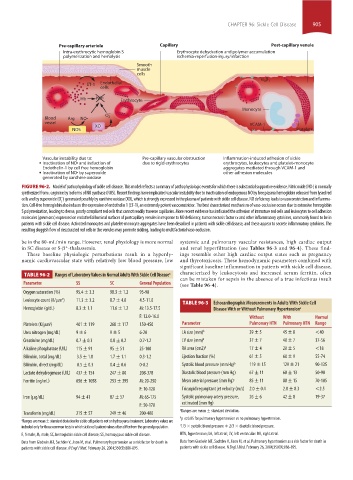
                    FIGURE 96-2.  Model of pathophysiology of sickle cell disease. This model reflects a summary of pathophysiologic events for which there is substantial supportive evidence. Nitric oxide (NO·) is normally
                    synthesized from l-arginine by isoforms of NO synthase (NOS). Recent findings have implicated vascular instability due to inactivation of endogenous NO by free plasma hemoglobin released from lysed red
                                 −
                    cells and by superoxide (O ) generated possibly by xanthine oxidase (XO), which is strongly expressed in the plasma of patients with sickle cell disease. NO deficiency leads to vasoconstriction and inflamma-
                                 2
                    tion. Cell-free hemoglobin also induces the expression of endothelin 1 (ET-1), an extremely potent vasoconstrictor. The best characterized mechanism of vaso-occlusion occurs due to extensive hemoglobin
                    S polymerization, leading to dense, poorly compliant red cells that cannot readily traverse capillaries. More recent evidence has indicated the adhesion of immature red cells and leukocytes to cell adhesion
                    molecules (green arcs) expressed on endothelial luminal surfaces of postcapillary venules in response to NO deficiency, tumor necrosis factor α and other inflammatory cytokines, commonly found to be in
                    patients with sickle cell disease. Activated monocytes and platelet-monocyte aggregates have been described in patients with sickle cell disease, and these appear to secrete inflammatory cytokines. The
                    resulting sluggish flow of desaturated red cells in the venules may promote sickling, leading to multifactorial vaso-occlusion.
                    be in the 80-mL/min range. However, renal physiology is more normal   systemic and pulmonary vascular resistances, high cardiac output
                    in SC disease or S-β -thalassemia.                    and renal hyperfiltration (see  Tables  96-3 and  96-4). These find-
                                   +
                     These baseline  physiologic perturbations result in a hyperdy-  ings resemble other high cardiac output states such as pregnancy
                    namic cardiovascular state with relatively low blood pressure, low   and thyrotoxicosis. These hemodynamic parameters combined with
                                                                          significant baseline inflammation in patients with sickle cell disease,
                      TABLE 96-2    Ranges of Laboratory Values in Normal Adults With Sickle Cell Disease a  characterized by leukocytosis and increased serum ferritin, often
                                                                          can be mistaken for sepsis in the absence of a true infectious insult
                    Parameter         SS          SC        General Population  (see Table 96-4).
                    Oxygen saturation (%)  95.4 ± 3.3  98.3 ± 1.2  95-98
                    Leukocyte count (K/µm ) 3  11.3 ± 3.2  8.7 ± 4.0  4.5-11.0
                                                                            TABLE 96-3     Echocardiographic Measurements in Adults With Sickle Cell
                    Hemoglobin (g/dL)  8.3 ± 1.1  11.6 ± 1.2  M: 13.5-17.5           Disease With or Without Pulmonary Hypertension a
                                                            F: 12.0-16.0                         Without     With       Normal
                    Platelets (K/µm ) 3  401 ± 119  268 ± 117  150-450    Parameter              Pulmonary HTN  Pulmonary HTN Range
                    Urea nitrogen (mg/dL)  9 ± 6  9 ± 5     6-20          LA size (mm) b         39 ± 5      45 ± 8     <40
                    Creatinine (mg/dL)  0.7 ± 0.3  0.8 ± 0.2  0.7-1.2     LV size (mm) b         37 ± 7      40 ± 7     37-56
                    Alkaline phosphatase (U/L)  115 ± 91  95 ± 51  25-100  RA area (cm2) b       17 ± 4      20 ± 5     <18
                    Bilirubin, total (mg/dL)  3.5 ± 1.8  1.7 ± 1.1  0.3-1.2  Ejection fraction (%)  61 ± 5   60 ± 9     55-74
                    Bilirubin, direct (mg/dL)   0.5 ± 0.3  0.4 ± 0.6  0-0.2  Systolic blood pressure (mm Hg) b  119 ± 15  129 ± 21  90-135
                    Lactate dehydrogenase (U/L)  437 ± 154  247 ± 80  208-378  Diastolic blood pressure (mm Hg)  67 ± 11  68 ± 13  50-90
                    Ferritin (ng/mL)  656 ± 1058  253 ± 395  M: 20-250    Mean arterial pressure (mm Hg) c  85 ± 11  88 ± 15  70-105
                                                            F: 10-120     Tricuspid regurgitant jet velocity (m/s) 2.0 ± 0.4  2.8 ± 0.3  <2.5
                    Iron (µg/dL)      94 ± 41     87 ± 57   M: 65-175     Systolic pulmonary artery pressure,    26 ± 6  42 ± 8  19-37
                                                            F: 50-170     estimated (mm Hg)
                                                                          a Ranges are mean ± standard deviation.
                    Transferrin (mg/dL)  215 ± 57  249 ± 46  200-400
                                                                          b p ≤0.05 for pulmonary hypertension vs no pulmonary hypertension.
                    a Ranges are mean ± standard deviation for sickle cell patients not on hydroxyurea treatment. Laboratory values are
                    included only for those common tests in which sickle cell patient values often differ from the general population.  c 1/3 × systolic blood pressure + 2/3 × diastolic blood pressure.
                    F, female; M, male; SC, hemoglobin sickle cell disease; SS, homozygous sickle cell disease.  HTN, hypertension; LA, left atrial; LV, left ventricular: RA, right atrial.
                    Data from Gladwin MT, Sachdev V, Jison M, et al. Pulmonary hypertension as a risk factor for death in   Data from Gladwin MT, Sachdev V, Jison M, et al. Pulmonary hypertension as a risk factor for death in
                    patients with sickle cell disease. N Engl J Med. February 26, 2004;350(9):886-895.  patients with sickle cell disease. N Engl J Med. February 26, 2004;350(9):886-895.


            section07.indd   905                                                                                       1/21/2015   7:43:20 AM

