


Page 1307 - Hall et al (2015) Principles of Critical Care-McGraw-Hill
P. 1307
914     PART 7: Hematologic and Oncologic Disorders

                                                                           ■
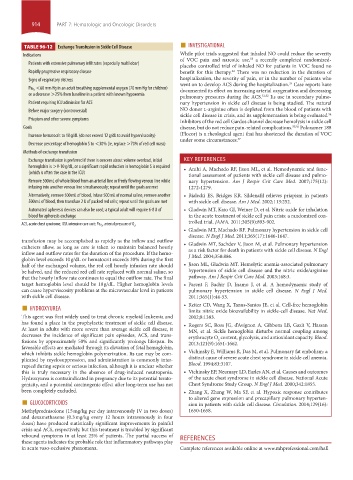
                   TABLE 96-12    Exchange Transfusion in Sickle Cell Disease  INVESTIGATIONAL
                  Indications                                          While pilot trials suggested that inhaled NO could reduce the severity
                                                                       of VOC  pain and narcotic use,  a recently completed randomized-
                                                                                               53
                    Patients with extensive pulmonary infiltrates (especially multilobar)  placebo controlled trial of inhaled NO for patients in VOC found no
                    Rapidly progressive respiratory disease            benefit for this therapy.  There was no reduction in the duration of
                                                                                         24
                    Signs of respiratory distress                      hospitalization, the severity of pain, or in the number of patients who
                                                                       went on to develop ACS during the hospitalization.  Case reports have
                                                                                                            24
                       <60 mm Hg in an adult breathing supplemental oxygen (70 mm Hg for children)
                     Pa O 2                                            documented its effect on increasing arterial oxygenation and decreasing
                    or a decrease >25% from baseline in a patient with known hypoxemia
                                                                       pulmonary pressures during the ACS. 31,32  Its use in secondary pulmo-
                    Patient requiring ICU admission for ACS            nary hypertension in sickle cell disease is being studied. The natural
                    Before major surgery (controversial)               NO donor l-arginine often is depleted from the blood of patients with
                                                                       sickle cell disease in crisis, and its supplementation is being evaluated.
                                                                                                                          54
                    Priapism and other severe symptoms                 Inhibitors of the red cell Gardos channel decrease hemolysis in sickle cell
                  Goals                                                disease, but do not reduce pain-related complications. 55,56  Poloxamer 188
                    Increase hematocrit to 10 g/dL (do not exceed 12 g/dL to avoid hyperviscosity)  (Flocor) is a rheological agent that has shortened the duration of VOC
                                                                       under some circumstances. 57
                    Decrease percentage of hemoglobin S to <30% (ie, replace >70% of red cell mass)
                  Methods of exchange transfusion
                     Exchange transfusion is preferred if there is concern about volume overload, initial   KEY REFERENCES
                    hemoglobin is >9-10 g/dL, or a significant rapid reduction in hemoglobin S is required     • Anthi A, Machado RF, Jison ML, et al. Hemodynamic and func-
                    (which is often the case in the ICU)                  tional assessment of patients with sickle cell disease and pulmo-
                     Remove 500 mL of whole blood from an arterial line or freely flowing venous line while   nary hypertension.  Am J Respir Crit Care Med. 2007;175(12):
                    infusing into another venous line simultaneously; repeat until the goals are met  1272-1279.
                     Alternatively, remove 500 mL of blood, infuse 500 mL of normal saline, remove another     • Bialecki ES, Bridges KR. Sildenafil relieves priapism in  patients
                    500 mL of blood, then transfuse 2 U of packed red cells; repeat until the goals are met  with sickle cell disease. Am J Med. 2002;113:252.
                     Automated apheresis devices can also be used; a typical adult will require 6-8 U of     • Gladwin MT, Kato GJ, Weiner D, et al. Nitric oxide for inhalation
                    blood for apheresis exchange                          in the acute treatment of sickle cell pain crisis: a randomized con-
                                                                          trolled trial. JAMA. 2011;305(9):893-902.
                                             , arterial pressure of O .
                 ACS, acute chest syndrome; ICU, intensive care unit; PaO 2  2
                                                                           • Gladwin MT, Machado RF. Pulmonary hypertension in sickle cell
                                                                          disease. N Engl J Med. 2011;365(17):1646-1647.
                 transfusion may be accomplished as rapidly as the inflow and outflow
                 catheters allow, as long as care is taken to maintain balanced hourly     • Gladwin MT, Sachdev V, Jison M, et al. Pulmonary hypertension
                                                                          as a risk factor for death in patients with sickle cell disease. N Engl
                 inflow and outflow rates for the duration of the procedure. If the hemo-
                 globin level exceeds 10 g/dL or hematocrit exceeds 30% during the first   J Med. 2004;350:886.
                 half of the exchanged volume, the red cell hourly infusion rate should     • Jison ML, Gladwin MT. Hemolytic anemia-associated pulmonary
                 be halved, and the reduced red cell rate replaced with normal saline, so   hypertension of sickle cell disease and the nitric oxide/arginine
                 that the hourly inflow rate continues to equal the outflow rate. The final   pathway. Am J Respir Crit Care Med. 2003;168:3.
                 target hemoglobin level should be 10 g/dL. Higher hemoglobin levels     • Parent F, Bachir D, Inamo J, et al. A hemodynamic study of
                 can cause hyperviscosity problems at the microvascular level in patients   pulmonary hypertension in sickle cell disease.  N Engl J Med.
                 with sickle cell disease.                                2011;365(1):44-53.
                     ■  HYDROXYUREA                                        • Reiter CD, Wang X, Tanus-Santos JE, et al. Cell-free hemoglobin

                 This agent was first widely used to treat chronic myeloid leukemia and   limits nitric oxide bioavailability in sickle-cell disease. Nat Med.
                                                                          2002;8:1383.
                 has found a place in the prophylactic treatment of sickle cell disease.     • Rogers SC, Ross JG, d’Avignon A, Gibbons LB, Gazit V, Hassan
                 At least in adults with more severe than average sickle cell disease, it   MN, et  al. Sickle hemoglobin disturbs  normal coupling among
                 decreases the incidence of significant pain episodes, ACS, and trans-  erythrocyte O  content, glycolysis, and antioxidant capacity. Blood.
                                                                                    2
                 fusions by approximately 50% and significantly prolongs lifespan. Its   2013;121(9):1651-1662.
                 favorable effects are mediated through its elevation of fetal hemoglobin,
                 which inhibits sickle hemoglobin polymerization. Its use may be com-    • Vichinsky E, Williams R, Das M, et al. Pulmonary fat embolism: a
                 plicated by myelosuppression, and administration is commonly inter-  distinct cause of severe acute chest syndrome in sickle cell anemia.
                 rupted during sepsis or serious infection, although it is unclear whether   Blood. 1994;83:3107.
                 this is truly necessary in the absence of drug-induced neutropenia.     • Vichinsky EP, Neumayr LD, Earles AN, et al. Causes and outcomes
                 Hydroxyurea is contraindicated in pregnancy due to its potential terato-  of the acute chest syndrome in sickle cell disease. National Acute
                 genicity, and a potential carcinogenic effect after long-term use has not   Chest Syndrome Study Group. N Engl J Med. 2000;342:1855.
                 been completely excluded.                                 • Zhang X, Zhang W, Ma SF, et al. Hypoxic response contributes
                     ■  GLUCOCORTICOIDS                                   to altered gene expression and precapillary pulmonary hyperten-
                                                                          sion in patients with sickle cell disease. Circulation. 2014;129(16):
                 Methylprednisolone (15 mg/kg per day intravenously IV in two doses)   1650-1658.
                 and dexamethasone (0.3 mg/kg every 12 hours intravenously in four
                 doses) have produced statistically significant improvements in painful
                 crisis and ACS, respectively, but this treatment is troubled by significant
                 rebound symptoms in at least 25% of patients. The partial success of   REFERENCES
                 these agents indicates the probable role that inflammatory pathways play
                 in acute vaso-occlusive phenomena.                    Complete references available online at www.mhprofessional.com/hall


            section07.indd   914                                                                                       1/21/2015   7:43:27 AM

