


Page 1304 - Hall et al (2015) Principles of Critical Care-McGraw-Hill
P. 1304
CHAPTER 96: Sickle Cell Disease  911


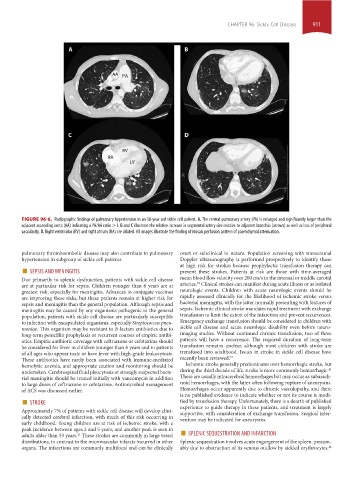
                    FIGURE 96-6.  Radiographic findings of pulmonary hypertension in an 18-year-old sickle cell patient. A. The central pulmonary artery (PA) is enlarged and significantly larger than the
                    adjacent ascending aorta (AA) indicating a PA/AA ratio >1. B and C illustrate the relative increase in segmental artery size relative to adjacent bronchus (arrows) as well as loss of peripheral
                    vascularity. D. Right ventricular (RV) and right atrium (RA) are dilated. All images illustrate the finding of mosaic perfusion pattern of parenchymal attenuation.


                    pulmonary thromboembolic disease may also contribute to pulmonary   overt or subclinical in nature. Population screening with transcranial
                    hypertension in subgroup of sickle cell patients.     Doppler ultrasonography is performed prospectively to identify those
                        ■  SEPSIS AND MENINGITIS                          at high risk for strokes because prophylactic transfusion therapy can
                                                                          prevent these strokes. Patients at risk are those with time-averaged
                    Due primarily to splenic dysfunction, patients with sickle cell disease   mean blood flow velocity over 200 cm/s in the internal or middle carotid
                                                                               42
                    are at particular risk for sepsis. Children younger than 6 years are at   arteries.  Clinical strokes can manifest during acute illness or as isolated
                    greatest risk, especially for meningitis. Advances in conjugate vaccines   neurologic events. Children with acute neurologic events should be
                    are improving these risks, but these patients remain at higher risk for   rapidly assessed clinically for the likelihood of ischemic stroke versus
                    sepsis and meningitis than the general population. Although sepsis and   bacterial meningitis, with the latter normally presenting with features of
                    meningitis may be caused by any organisms pathogenic in the general   sepsis. Ischemic clinical stroke mandates rapid treatment with exchange
                    population, patients with sickle cell disease are particularly susceptible   transfusion to limit the extent of the infarction and prevent recurrences.
                    to infection with encapsulated organisms, especially Streptococcus pneu-  Emergency exchange transfusion should be considered in children with
                    moniae. This organism may be resistant to β-lactam antibiotics due to   sickle cell disease and acute neurologic disability even before neuro-
                    long-term penicillin prophylaxis or recurrent courses of empiric antibi-  imaging studies. Without continued chronic transfusion, two of three
                    otics. Empiric antibiotic coverage with ceftriaxone or cefotaxime should   patients will have a recurrence. The required duration of long-term
                    be considered for fever in children younger than 6 years and in patients   transfusion remains unclear, although most children with stroke are
                    of all ages who appear toxic or have fever with high-grade leukocytosis.   transfused into adulthood. Issues in stroke in sickle cell disease have
                    These antibiotics have rarely been associated with immune-mediated   recently been reviewed. 43
                    hemolytic anemia, and appropriate caution and monitoring should be   Ischemic stroke generally predominates over hemorrhagic stroke, but
                                                                                                                            41
                    undertaken. Cerebrospinal fluid pleocytosis or strongly suspected bacte-  during the third decade of life, stroke is more commonly hemorrhagic.
                    rial meningitis should be treated initially with vancomycin in addition   These are usually intracerebral hemorrhages but may occur as subarach-
                    to large doses of ceftriaxone or cefotaxime. Antimicrobial management   noid hemorrhages, with the latter often following rupture of aneurysms.
                    of ACS was discussed earlier.                         Hemorrhages occur apparently due to chronic vasculopathy, and there
                        ■  STROKE                                         fied by transfusion therapy. Unfortunately, there is a dearth of published
                                                                          is no published evidence to indicate whether or not its course is modi-
                    Approximately 7% of patients with sickle cell disease will develop clini-  experience to guide therapy in these patients, and treatment is largely
                                                                          supportive, with consideration of exchange transfusion. Surgical inter-
                    cally detected cerebral infarction, with much of this risk occurring in   vention may be indicated for aneurysms.
                    early childhood. Young children are at risk of ischemic stroke, with a
                    adults older than 53 years.  These strokes are commonly in large vessel   ■  SPLENIC SEQUESTRATION AND INFARCTION
                    peak incidence between ages 2 and 5 years, and another peak is seen in
                                       41
                    distributions, in contrast to the microvascular infarcts incurred in other   Splenic sequestration involves acute engorgement of the spleen, presum-
                    organs. The infarctions are commonly multifocal and can be clinically   ably due to obstruction of its venous outflow by sickled erythrocytes.
                                                                                                                            44


            section07.indd   911                                                                                       1/21/2015   7:43:26 AM

