


Page 1303 - Hall et al (2015) Principles of Critical Care-McGraw-Hill
P. 1303
910     PART 7: Hematologic and Oncologic Disorders


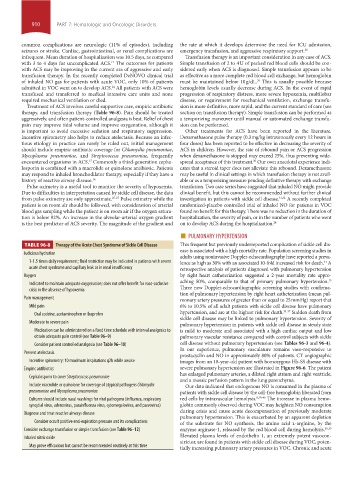
                 common complications are neurologic (11% of episodes), including   the rate at which it develops determine the need for ICU admission,
                 seizures or stroke. Cardiac, gastrointestinal, or renal  complications are   emergency transfusion, and aggressive respiratory support. 28
                 infrequent. Mean duration of hospitalization was 10.5 days, as compared   Transfusion therapy is an important consideration in any case of ACS.
                 with 3 to 4 days for uncomplicated ACS.  The outcomes for patients   Simple transfusion of 2 to 4 U of packed red blood cells should be con-
                                                17
                 with ACS may be improving in the current era of aggressive and early   sidered early when ACS is diagnosed. Simple transfusion appears to be
                 transfusion therapy. In the recently completed DeNOVO clinical trial   as effective as a more complete red blood cell exchange, but hemoglobin
                 of inhaled NO gas for patients with acute VOC, only 10% of patients   must be maintained below 10 g/dL.  This is usually possible because
                                                                                                 29
                 admitted in VOC went on to develop ACS.  All patients with ACS were   hemoglobin levels usually decrease during ACS. In the event of rapid
                                                24
                 transfused and transferred to medical intensive care units and none   progression of respiratory distress, more severe hypoxemia, multilobar
                 required mechanical ventilation or died.              disease, or requirement for mechanical ventilation, exchange transfu-
                   Treatment of ACS involves careful supportive care, empiric antibiotic   sion is more definitive, more rapid, and the current standard of care (see
                 therapy, and transfusion therapy (Table 96-8). Pain should be treated   section on transfusion therapy). Simple transfusion can be performed as
                 aggressively, and often patient-controlled analgesia is best. Relief of chest   a temporizing maneuver until manual or automated exchange transfu-
                 pain may improve tidal volume and improve oxygenation, although it   sion can be performed.
                 is important to avoid excessive sedation and respiratory suppression.   Other  treatments  for  ACS  have  been  reported  in  the  literature.
                 Incentive spirometry also helps to reduce atelectasis. Because an infec-  Dexamethasone pulse therapy (0.3 mg/kg intravenously every 12 hours in
                 tious etiology in practice can rarely be ruled out, initial management   four doses) has been reported to be effective in decreasing the severity of
                 should include empiric antibiotic coverage for Chlamydia pneumoniae,   ACS in children. However, the rate of rebound pain or ACS progression
                 Mycoplasma pneumoniae, and  Streptococcus pneumoniae, frequently   when dexamethasone is stopped may exceed 25%, thus preventing wide-
                 encountered organisms in ACS.  Commonly a third-generation cepha-  spread acceptance of this treatment.  Our own anecdotal experience indi-
                                                                                                30
                                        17
                 losporin is combined with a macrolide or quinolone antibiotic. Patients   cates that a steroid taper does not alleviate this rebound. Dexamethasone
                 may respond to inhaled bronchodilator therapy, especially if they have a   may be useful in clinical settings in which transfusion therapy is not avail-
                 history of reactive airway disease. 16                able or as a temporizing measure pending definitive therapy with exchange
                   Pulse oximetry is a useful tool to monitor the severity of hypoxemia.   transfusion. Two case series have suggested that inhaled NO might provide
                 Due to difficulties in interpretation caused by sickle cell disease, the data   clinical benefit, but this cannot be recommended without further clinical
                 from pulse oximetry are only approximate. 25-27  Pulse oximetry while the   investigation in patients with sickle cell disease. 31,32  A recently completed
                 patient is on room air should be followed, with consideration of arterial   randomized-placebo controlled trial of inhaled NO for patients in VOC
                 blood gas sampling while the patient is on room air if the oxygen satura-  found no benefit for this therapy. There was no reduction in the duration of
                 tion is below 92%. An increase in the alveolar-arterial oxygen gradient   hospitalization, the severity of pain, or in the number of patients who went
                 is the best predictor of ACS severity. The magnitude of the gradient and   on to develop ACS during the hospitalization. 24
                                                                           ■  PULMONARY HYPERTENSION


                   TABLE 96-8    Therapy of the Acute Chest Syndrome of Sickle Cell Disease  This frequent but previously underreported complication of sickle cell dis-
                                                                       ease is associated with a high mortality rate. Population screening studies in
                  Judicious hydration
                                                                       adults using noninvasive Doppler-echocardiography have reported a preva-
                     1-1.5 times daily requirement; fluid restriction may be indicated in patients with severe   lence as high as 30% with an associated 10-fold increased risk for death.  A
                                                                                                                        33
                    acute chest syndrome and capillary leak or in renal insufficiency  retrospective analysis of patients diagnosed with pulmonary hypertension
                  Oxygen                                               by right heart catheterization suggested a 2-year mortality rate appro-
                                                                       aching 50%, comparable to that of primary pulmonary hypertension.
                                                                                                                          15
                     Indicated to maintain adequate oxygenation; does not offer benefit for vaso-occlusive
                    crisis in the absence of hypoxemia                 Three new Doppler-echocardiographic screening studies with confirma-
                                                                       tion of pulmonary hypertension by right heart catheterization (mean pul-
                  Pain management                                      monary artery pressures of greater than or equal to 25 mm Hg) report that
                    Mild pain                                          6% to 10.5% of all adult patients with sickle cell disease have pulmonary
                      Oral codeine, acetaminophen or ibuprofen         hypertension, and are at the highest risk for death. 34-37  Sudden death from
                                                                       sickle cell disease may be linked to pulmonary hypertension. Severity of
                    Moderate to severe pain
                                                                       pulmonary hypertension in patients with sickle cell disease in steady state
                       Medication can be administered on a fixed time schedule with interval analgesics to   is mild to moderate and associated with a high cardiac output and low
                      obtain adequate pain control (see Table 96–9)    pulmonary vascular resistance compared with control subjects with sickle
                      Consider patient controlled analgesia (see Table 96–10)  cell disease without pulmonary hypertension (see Tables 96-3 and 96-4).
                                                                       In our experience, pulmonary vasculature remains vaso-responsive to
                  Prevent atelectasis
                                                                       prostacyclin and NO in approximately 80% of patients. CT angiographic
                    Incentive spirometry: 10 maximum inspirations q2h while awake  images from an 18-year-old patient with homozygous Hb-SS disease with
                  Empiric antibiotics                                  severe pulmonary hypertension are illustrated in Figure 96-6. The patient
                                                                       has enlarged pulmonary arteries, a dilated right atrium and right ventricle,
                    Cephalosporin to cover Streptococcus pneumoniae
                                                                       and a mosaic perfusion pattern in the lung parenchyma.
                     Include macrolide or quinolone for coverage of atypical pathogens Chlamydia    Our data indicated that endogenous NO is consumed in the plasma of
                    pneumoniae and Mycoplasma pneumoniae               patients with sickle cell disease by the cell-free hemoglobin liberated from
                     Cultures should include nasal washings for viral pathogens (influenza, respiratory    red cells by intravascular hemolysis. 8,38-40  The increase in plasma hemo-
                    syncytial virus, adenovirus, parainfluenza virus, cytomegalovirus, and parvovirus)  globin commonly observed during VOC may heighten NO consumption
                                                                       during crisis and cause acute decompensation of previously moderate
                  Diagnose and treat reactive airways disease
                                                                       pulmonary hypertension. This is exacerbated by an apparent depletion
                      Consider occult positive end-expiration pressure and its complications  of the substrate for NO synthesis, the amino acid  l-arginine, by the
                  Consider exchange transfusion or simple transfusion (see Table 96–12)  enzyme arginase-1, released by the red blood cell during hemolysis. 38,39
                  Inhaled nitric oxide                                 Elevated plasma levels of endothelin 1, an extremely potent vasocon-
                                                                       strictor, are found in patients with sickle cell disease during VOC, poten-
                    May prove efficacious but cannot be recommended routinely at this time
                                                                       tially increasing pulmonary artery pressures in VOC. Chronic and acute


            section07.indd   910                                                                                       1/21/2015   7:43:25 AM

