


Page 1302 - Hall et al (2015) Principles of Critical Care-McGraw-Hill
P. 1302
CHAPTER 96: Sickle Cell Disease  909


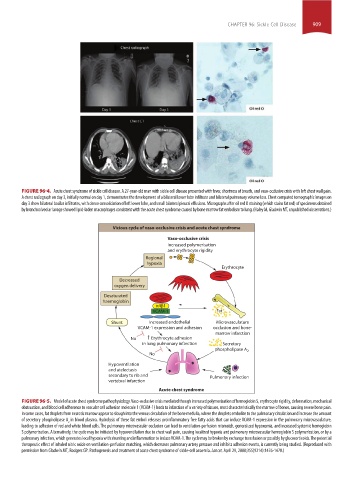
                    FIGURE 96-4.  Acute chest syndrome of sickle cell disease. A 27-year-old man with sickle cell disease presented with fever, shortness of breath, and vaso-occlusive crisis with left chest wall pain.
                    A chest radiograph on day 3, initially normal on day 1, demonstrates the development of a bilateral lower lobe infiltrate and bilateral pulmonary volume loss. Chest computed tomographic images on
                    day 3 show bilateral basilar infiltrates, with dense consolidation of left lower lobe, and small bilateral pleural effusions. Micrographs after oil red O staining (which stains fat red) of specimens obtained
                    by bronchoalveolar lavage showed lipid-laden macrophages consistent with the acute chest syndrome caused by bone marrow fat embolism to lung. (Haley M, Gladwin MT, unpublished observations.)


                                                   Vicious cycle of vaso-occlusive crisis and acute chest syndrome

                                                                     Vaso-occlusive crisis
                                                                     Increased polymerisation
                                                                     and erythrocyte rigidity
                                                              Regional
                                                              hypoxia
                                                                                        Erythrocyte

                                                     Decreased
                                                   oxygen delivery
                                                Desaturated
                                               haemoglobin
                                                                  4 1
                                                                VCAM-1                Fat

                                                  Shunt        Increased endothelial  Microvasculature
                                                           VCAM-1 expression and adhesion  occlusion and bone-
                                                                                      marrow infarction
                                                         No     Erythrocyte adhesion
                                                             in lung pulmonary infarction  Secretory
                                                                                     phospholipase A 2
                                                               No
                                                 Hypoventilation
                                                 and atelectasis
                                                 secondary to rib and               Pulmonary infection
                                                 vertebral infarction
                                                                  Acute chest syndrome
                    FIGURE 96-5.  Model of acute chest syndrome pathophysiology. Vaso-occlusive crisis mediated though increased polymerization of hemoglobin S, erythrocyte rigidity, deformation, mechanical
                    obstruction, and blood cell adherence to vascular cell adhesion molecule 1 (VCAM-1) leads to infarction of a variety of tissues, most characteristically the marrow of bones, causing severe bone pain.
                    In some cases, fat droplets from necrotic marrow appear to slough into the venous circulation of the bone medulla, where the droplets embolize to the pulmonary circulation and increase the amount
                    of secretory phospholipase A  in blood plasma. Hydrolysis of these fat emboli releases proinflammatory free fatty acids that can induce VCAM-1 expression in the pulmonary microvasculature,
                                   2
                    leading to adhesion of red and white blood cells. The pulmonary microvascular occlusion can lead to ventilation-perfusion mismatch, generalized hypoxemia, and increased systemic hemoglobin
                    S polymerization. Alternatively, the cycle may be initiated by hypoventilation due to chest wall pain, causing localized hypoxia and pulmonary microvascular hemoglobin S polymerization, or by a
                    pulmonary infection, which generates local hypoxia with shunting and inflammation to induce VCAM-1. The cycle may be broken by exchange transfusion or possibly by glucocorticoids. The potential
                    therapeutic effect of inhaled nitric oxide on ventilation-perfusion matching, which decreases pulmonary artery pressure and inhibits adhesion events, is currently being studied. (Reproduced with
                    permission from Gladwin MT, Rodgers GP. Pathogenesis and treatment of acute chest syndrome of sickle-cell anaemia. Lancet. April 29, 2000;355(9214):1476-1478.)


            section07.indd   909                                                                                       1/21/2015   7:43:24 AM

