


Page 1415 - Hall et al (2015) Principles of Critical Care-McGraw-Hill
P. 1415
988     PART 8: Renal and Metabolic Disorders


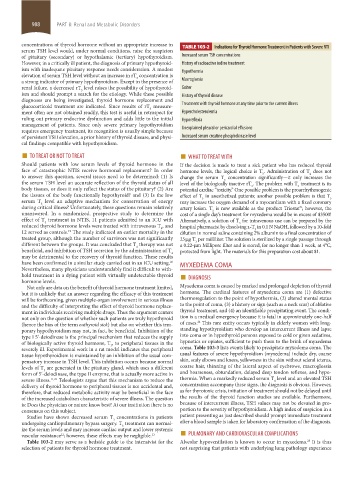
                 concentrations of thyroid hormone without an appropriate increase in     TABLE 103-2    Indications for Thyroid Hormone Treatment in Patients with Severe NTI
                 serum TSH level would, under normal conditions, raise the suspicion
                 of pituitary (secondary) or hypothalamic (tertiary) hypothyroidism.   Increased serum TSH concentrations
                 However, in a critically ill patient, the diagnosis of primary hypothyroid-  History of radioactive iodine treatment
                 ism with inadequate pituitary response needs consideration. A modest   Hypothermia
                 elevation of serum TSH level without an increase in rT  concentration is
                                                        3
                 a strong indicator of primary hypothyroidism. Except in the presence of   Macroglossia
                 renal failure, a decreased rT  level raises the possibility of hypothyroid-  Goiter
                                     3
                 ism and should prompt a search for the etiology. While these possible   History of thyroid disease
                 diagnoses  are  being  investigated,  thyroid  hormone  replacement  and
                 glucocorticoid treatment are indicated. Since results of rT  measure-  Treatment with thyroid hormone at any time prior to the current illness
                                                             3
                 ment often are not obtained readily, this test is useful in retrospect for   Hypercholesterolemia
                 ruling out primary endocrine dysfunction and adds little to the initial   Hyporeflexia
                 management of patients. Since only severe primary hypothyroidism
                 requires emergency treatment, its recognition is usually simple because   Unexplained pleural or pericardial effusions
                 of persistent TSH elevation, a prior history of thyroid disease, and physi-  Increased serum creatine phosphokinase level
                 cal findings compatible with hypothyroidism.
                     ■  TO TREAT OR NOT TO TREAT                           ■  WHAT TO TREAT WITH


                 Should patients with low serum levels of thyroid hormone in the   If the decision is made to treat a sick patient who has reduced thyroid
                 face of catastrophic NTIS receive hormonal replacement? In order   hormone  levels,  the  logical  choice  is  T .  Administration  of T   does  not
                                                                                                   3
                                                                                                                   4
                 to answer this question, several issues need to be determined: (1) Is   change  the  serum  T   concentration  significantly—it  only  increases  the
                                                                                      3
                 the serum TSH level an accurate reflection of the thyroid status of all   level of the biologically inactive rT . The problem with T  treatment is its
                                                                                                3
                                                                                                               3
                 body tissues, or does it only reflect the status of the pituitary? (2) Are     potential cardiac “toxicity.” One possible problem is the proarrhythmogenic
                 the tissues of the body functionally hypothyroid? and (3) Is the low   effect of T  in anesthetized patients; another possible problem is that T
                                                                               3
                                                                                                                          3
                 serum T  level an adaptive mechanism for conservation of energy   may increase the oxygen demand of a myocardium with a fixed coronary
                        3
                 during critical illness? Unfortunately, these questions remain relatively   artery lesion. T  is now available as the product Triostat™; however, the
                                                                                  3
                 unanswered. In a randomized, prospective study to determine the   cost of a single day’s treatment for myxedema would be in excess of $3500!
                 effect of T  treatment in NTIS, 11 patients admitted to an ICU with   Alternatively, a solution of T  for intravenous use can be prepared by the
                         4
                                                                                           3
                 reduced thyroid hormone levels were treated with intravenous T , and   hospital pharmacist by dissolving l-T  in 0.1 N NaOH, followed by a 10-fold
                                                                 4
                                                                                                 3
                 12 served as controls.  The study indicated an earlier mortality in the   dilution in normal saline containing 2% albumin to a final concentration of
                                 19
                 treated group, although the number of survivors was not significantly   25 µg T  per milliliter. The solution is sterilized by a single passage through
                                                                            3
                 different between the groups. It was concluded that T  therapy was not   a 0.22-µm Millipore filter and is stored, for no longer than 1 week, at 4°C,
                                                        4
                 beneficial, and inhibition of TSH secretion by the administration of T    protected from light. The materials for this preparation cost about $1.
                                                                    4
                 may be detrimental to the recovery of thyroid function. These results
                 have been confirmed in a similar study carried out in an ICU setting.    MYXEDEMA COMA
                                                                    20
                 Nevertheless, many physicians understandably find it difficult to with-
                 hold treatment in a dying patient with virtually undetectable thyroid     ■  DIAGNOSIS
                 hormone levels.
                   Not only are data on the benefit of thyroid hormone treatment limited,   Myxedema coma is caused by marked and prolonged depletion of thyroid
                 but it is unlikely that an answer regarding the efficacy of this treatment   hormone. The cardinal features of myxedema coma are (1) defective
                 will be forthcoming, given multiple-organ involvement in serious illness   thermoregulation to the point of hypothermia, (2) altered mental status
                 and the difficulty of interpreting the effect of thyroid hormone replace-  to the point of coma, (3) a history or sign (such as a neck scar) of ablative
                 ment in individuals receiving multiple drugs. Thus the argument centers   thyroid treatment, and (4) an identifiable precipitating event. The condi-
                 not only on the question of whether such patients are truly hypothyroid   tion is a medical emergency because it is fatal in approximately one-half
                                                                             24
                 (hence the bias of the term euthyroid sick) but also on whether this tem-  of cases.  This rare entity occurs typically in elderly women with long-
                 porary hypothyroidism may not, in fact, be beneficial. Inhibition of the   standing hypothyroidism who develop an intercurrent illness and lapse
                 type I 5′-deiodinase is the principal mechanism that reduces the supply   into coma or in hypothyroid persons exposed to cold or given sedatives,
                 of biologically active thyroid hormone, T , to peripheral tissues in the   hypnotics or opiates, sufficient to push them to the brink of myxedema
                                                3
                 severely ill. Experimental work in a rat model indicates that peripheral   coma. Table 103-3 lists events likely to precipitate myxedema coma. The
                 tissue hypothyroidism is maintained by an inhibition of the usual com-  usual features of severe hypothyroidism (myxedema) include dry, coarse
                 pensatory increase in TSH level. This inhibition occurs because normal   skin, scaly elbows and knees, yellowness in the skin without scleral icterus,
                 levels of T  are generated in the pituitary gland, which uses a different   coarse hair, thinning of the lateral aspect of eyebrows, macroglossia
                         3
                 form of 5′-deiodinase, the type II enzyme, that is actually more active in   and hoarseness, obtundation, delayed deep tendon reflexes, and hypo-
                 severe illness. 11,21  Teleologists argue that this mechanism to reduce the   thermia. When a markedly reduced serum T  level and an elevated TSH
                                                                                                       4
                 delivery of thyroid hormone to peripheral tissues is not accidental and,   concentration accompany these signs, the diagnosis is obvious. However,
                 therefore, that reduced metabolic activity may be beneficial in the face   as for thyrotoxic crisis, initiation of treatment should not be delayed until
                 of the increased catabolism characteristic of severe illness. The question   the results of the  thyroid function  studies are available. Furthermore,
                 is: Does the physician or nature know best? At our institution there is no   because of intercurrent illness, TSH values may not be elevated in pro-
                 consensus on this subject.                            portion to the severity of hypothyroidism. A high index of suspicion in a
                   Studies have shown decreased serum T  concentrations in patients   patient presenting as just described should prompt immediate treatment
                                                3
                 undergoing cardiopulmonary bypass surgery. T  treatment can normal-  after a blood sample is taken for laboratory confirmation of the diagnosis.
                                                   3
                 ize the serum levels and may increase cardiac output and lower systemic     ■
                 vascular resistance ; however, these effects may be negligible. 23  PULMONARY AND CARDIOVASCULAR COMPLICATIONS
                               22
                   Table 103-2 may serve as a bedside guide to the intensivist for the   Alveolar hypoventilation is known to occur in myxedema.  It is thus
                                                                                                                   25
                 selection of patients for thyroid hormone treatment.  not surprising that patients with underlying lung pathology experience
            section08.indd   988                                                                                       1/14/2015   8:28:35 AM

