


Page 1411 - Hall et al (2015) Principles of Critical Care-McGraw-Hill
P. 1411
984     PART 8: Renal and Metabolic Disorders


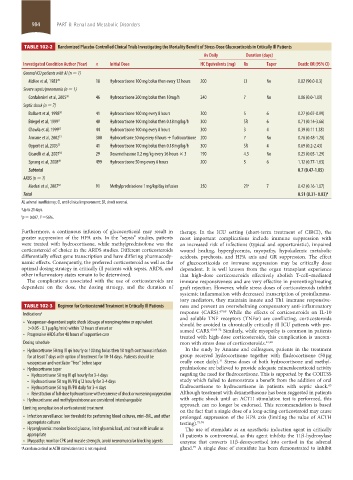
                   TABLE 102-2    Randomized Placebo-Controlled Clinical Trials Investigating the Mortality Benefit of Stress-Dose Glucocorticoids in Critically Ill Patients
                                                                               Av Daily       Duration (days)
                  Investigated Condition Author (Year)  n  Initial Dose       HC Equivalents (mg)  Rx  Taper   Death: OR (95% CI)
                  General ICU patients with AI (n = 1)
                    McKee et al, 1983 29   18  Hydrocortisone 100 mg bolus then every 12 hours  200  CI  No    0.02 (90.0-0.3)
                  Severe sepsis/pneumonia (n = 1)
                    Confalonieri et al, 2005 30  46  Hydrocortisone 200 mg bolus then 10mg/h  240  7  No       0.06 (0.0-1.09)
                  Septic shock (n = 7)
                    Bollaert et al, 1998 50  41  Hydrocortisone 100 mg every 8 hours  300    5       6         0.27 (0.07-0.99)
                    Briegel et al, 1999 51  40  Hydrocortisone 100 mg bolus then 0.18 mg/kg/h  300  SR  6      0.71 (0.14-3.66)
                    Chawla et al, 1999 52  44  Hydrocortisone 100 mg every 8 hours  300      3       4         0.39 (0.11 1.38)
                    Annane et al, 2002 31  300  Hydrocortisone 50 mg every 6 hours + fludrocortisone 200  7  No  0.76 (0.48-1.20)
                    Oppert et al, 2005 53  41  Hydrocortisone 100 mg bolus then 0.18 mg/kg/h  300  SR  4       0.69 (0.2-2.43)
                    Cicarelli et al, 2007 54  29  Dexamethasone 0.2 mg/kg every 36 hours × 3  190  4.5  No     0.25 (0.05-1.29)
                    Sprung et al, 2008 49  499  Hydrocortisone 50 mg every 6 hours  200      5       6         1.12 (0.77-1.63)
                    Subtotal                                                                                   0.7 (0.47-1.05)
                  ARDS (n = 1)
                    Meduri et al, 2007 32  91  Methylprednisolone 1 mg/kg/day infusion  350  21 a    7         0.42 (0.16-1.07)
                  Total                                                                                        0.51 (0.31- 0.83) b
                 AI, adrenal insufficiency; CI, until clinical improvement; SR, shock reversal.
                 a Up to 21 days.
                 b p = 0.007, I  =56%.
                        2
                 Furthermore, a continuous infusion of glucocorticoid may result in   therapy.  In  the  ICU  setting  (short-term  treatment  of  CIRCI),  the
                 greater  suppression of the HPA axis. In the  “sepsis” studies,  patients   most  important complications include  immune  suppression  with
                 were treated with hydrocortisone, while methylprednisolone was the   an increased risk of infections (typical and opportunistic), impaired
                 corticosteroid of choice in the ARDS studies. Different corticosteroids   wound healing, hyperglycemia, myopathy, hypokalemic metabolic
                 differentially effect gene transcription and have differing pharmacody-  acidosis, psychosis, and HPA axis and GR suppression. The effect
                 namic effects. Consequently, the preferred corticosteroid as well as the   of glucocorticoids on immune suppression may be critically dose
                 optimal dosing strategy in critically ill patients with sepsis, ARDS, and   dependent. It is well known from the organ transplant experience
                 other inflammatory states remain to be determined.    that high-dose corticosteroids effectively abolish T-cell–mediated
                   The complications associated with the use of corticosteroids are   immune responsiveness and are very effective in preventing/treating
                 dependent  on  the  dose,  the  dosing  strategy,  and  the  duration  of   graft rejection. However, while stress doses of corticosteroids inhibit
                                                                       systemic inflammation with decreased transcription of proinflamma-
                                                                       tory mediators, they maintain innate and Th1 immune responsive-
                   TABLE 102-3    Regimen for Corticosteroid Treatment in Critically Ill Patients  ness and prevent an overwhelming compensatory anti-inflammatory
                  Indications a                                        response (CARS). 67,68  While the effects of corticosteroids on IL-10
                                                                       and soluble TNF receptors (TNFsr) are conflicting,   corticosteroids
                  •  Vasopressor-dependent septic shock (dosage of norepinephrine or equivalent    should be avoided in chronically critically ill ICU patients with pre-
                   >0.05 - 0.1 µg/kg/min) within 12 hours of onset or  sumed CARS. 67,69-72  Similarly, while myopathy is common in patients
                  •  Progressive ARDS after 48 hours of supportive care
                                                                       treated with high-dose corticosteroids, this complication is uncom-
                  Dosing schedule                                      mon with stress dose of corticosteroids. 27,28
                  •  Hydrocortisone 50 mg IV q6 hourly or 100 mg bolus then 10 mg/h continuous infusion   In the study by Annane and colleagues,  patients in  the treatment
                   for at least 7 days with option of treatment for 10-14 days. Patients should be    group received hydrocortisone together with fludrocortisone (50 µg
                                                                                     31
                   vasopressor and  ventilator “free” before taper     orally once daily).  Stress doses of both hydrocortisone and methyl-
                  •  Hydrocortisone taper                              prednisolone are believed to provide adequate mineralocorticoid activity
                   •  Hydrocortisone 50 mg IV q8 hourly for 3-4 days   negating the need for fludrocortisone. This is supported by the COIITSS
                   •  Hydrocortisone 50 mg IV/PO q12 hourly for 3-4 days  study which failed to demonstrate a benefit from the addition of oral
                                                                                                                          65
                   •  Hydrocortisone 50 mg IV/PO daily for 3-4 days    fludrocortisone to hydrocortisone in patients with septic shock.
                   •  Reinstitution of full-dose hydrocortisone with recurrence of shock or worsening oxygenation  Although treatment with dexamethasone has been suggested in patients
                  •  Hydrocortisone and methylprednisone are considered interchangeable  with septic shock until an ACTH stimulation test is performed, this
                                                                       approach can no longer be endorsed. This recommendation is based
                  Limiting complication of corticosteroid treatment    on the fact that a single dose of a long-acting corticosteroid may cause
                  •  Infection surveillance: low threshold for performing blood cultures, mini-BAL, and other   prolonged  suppression  of  the  HPA  axis  (limiting  the  value  of  ACTH
                     appropriate cultures                              testing). 73,74
                  •  Hyperglycemia: monitor blood glucose, limit glycemic load, and treat with insulin as   The use of etomidate as an anesthetic induction agent in critically
                   appropriate                                         ill patients is controversial, as this agent inhibits the 11β-hydroxylase
                  •  Myopathy: monitor CPK and muscle strength, avoid neuromuscular blocking agents  enzyme that converts 11β-deoxycortisol into cortisol in the adrenal
                                                                            75
                 a A random cortisol or ACTH stimulation test is not required.  gland.  A single dose of etomidate has been demonstrated to inhibit


            section08.indd   984                                                                                       1/14/2015   8:28:33 AM

