


Page 1414 - Hall et al (2015) Principles of Critical Care-McGraw-Hill
P. 1414
CHAPTER 103: Thyroid Disease 987
form usually is seen in patients with primary hypothyroidism who then 5-triiodothyronine (T ) or removal of the iodine from the inner or
3
develop some intercurrent illness; it develops over several weeks and tyrosyl ring (5 position), yielding 3,3′, 5′-triiodothyronine (reverse
culminates in myxedema coma. Equally challenging are the thyroid T [rT ]). T is the active form of the hormone, whereas rT has no
3
3
3
3
function abnormalities seen in patients with concurrent severe illness biologic activity. The same enzyme that removes iodine from the 5′
and the assessment of the thyroid hormone status at the tissue level. position of the T molecule is also responsible for deiodination of the
4
5′ iodine from rT . Therefore, reduction in the 5′-deiodinase activity,
3
EvALUATION OF THYROID FUNCTION IN PATIENTS which is invariably associated with severe illness and malnutrition,
WITH SEvERE NONTHYROIDAL ILLNESS not only reduces the serum T level but also increases that of rT . 3
3
The deiodinases are selenium-containing enzymes and dependent
SYNDROME (NTIS) on selenium to function. In critical illness, it has been reported that
■ DEFINITION OF NONTHYROIDAL ILLNESS SYNDROME selenium levels have a negative correlation with the APACHE II scores
6
Virtually all critically ill patients have reduced serum levels of triiodo- and patients with a score >15 had a marked decrease in selenium levels.
Several pharmaconutrition studies have suggested that selenium supple-
thyronine (T ), and approximately 30% to 50% also have low levels of mentation may improve outcomes from critical illness. 7
3
thyroxine (T ), both associated with normal or low serum TSH values.
1
4
This phenomenon has been termed low T syndrome, nonthyroidal ill- Thyroid Physiology in the Brain in NTIS: The nature of perturbations of
3
ness (NTI), or euthyroid sick syndrome. Each of these descriptive terms the hypothalamic-pituitary-thyroid axis in critically ill patients is begin-
assumes a priori that such patients are euthyroid despite reduced thyroid ning to be understood. The basal TSH values in serum of humans with
hormone levels. The condition is not limited to acute illness. Patients NTIS can be normal or low, but the response of TSH to TRH usually is
2
with chronic hepatic or renal failure, calorie deprivation, and a variety attenuated. Stress and malnutrition may be partly responsible. In rats,
of other illnesses present similar thyroid hormone profiles. Serum con- starvation reduces hypothalamic messenger ribonucleic acid (mRNA)
2
8
centrations of both T and T are also decreased following nonthyroid for TRH, reduces portal serum TRH, and lowers pituitary TSH content.
3
4
surgical procedures. In patients with a T value of less than 3.0 µg/dL, Furthermore, low TRH mRNA has been documented in the paraven-
3
4
9
the mortality rate is 68% to 84%, indicating that a low T concentration tricular nuclei of patients with NTIS. One therefore would predict that
4
4
without a corresponding increase in TSH is a marker for a high risk of if diminished TRH is, at least in part, contributing to NTIS and the low
death in the critically ill population. Critical illness results in a profound thyroid hormone levels, then treatment with TRH should increase the
change in set point of the hypothalamic-pituitary-thyroid axis and per- TSH and therefore increase the thyroid hormone levels. In fact, Van den
10
turbs local levels of thyroid hormone available to various tissues due to Berghe and colleagues have demonstrated that administration of TRH
differential metabolism. To understand this phenomenon and develop a to patients with NTIS leads to increase in serum TSH, T , and T levels.
5
4
3
rational basis for treatment, it is useful to review the thyroid physiology, Critically ill patients who eventually will recover from their illness have,
with emphasis on processes occurring in NTI. as a rule, less impairment of the TSH response to TRH. The mechanism
■ THYROID HORMONE PHYSIOLOGY IN CRITICAL ILLNESS (FIG. 103-1) for the reduced TRH production in NTIS is unknown but may be related
to cytokines or glucocorticoids. These factors probably are responsible
Metabolism of Thyroid Hormone in Peripheral Tissues: Ninety percent for suppression not only of TRH but also of other hypothalamic factors
of the hormone secreted by the thyroid gland is T , the remainder that may be decreased in NTIS, such as corticotropin-releasing hormone
4
being T . Thyroid hormone is metabolized in peripheral tissues by and gonadotropin-releasing hormone.
3
stepwise monodeiodination until the molecule is completely stripped The preceding, however, does not rule out an effect of NTIS directly
of iodine. This process uses specific enzymes called deiodinases. on the pituitary. For example, why is serum TSH not elevated when the
91
The deiodination of T can take one of two pathways—removal of the thyroid hormone levels are low? There is experimental evidence that
4
iodine from the outer or phenolic ring (5 position), resulting in 3,3′, the pituitary may be “euthyroid” owing to increased pituitary conversion
of T to T , unlike other tissues. 11
3
4
In addition, drugs commonly administered to ICU patients have
inhibitory effects on the hypothalamic and pituitary function. Dopamine
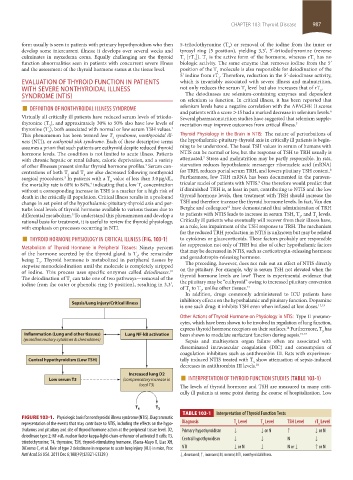
Sepsis/Lung injury/Critical illness
is one such drug; it inhibits TSH even when infused at low doses. 12,13
Other Actions of Thyroid Hormone on Physiology in NTIS: Type II pneumo-
cytes, which have been shown to be involved in regulation of lung function,
express thyroid hormone receptors on their surfaces. Furthermore, T has
14
3
Inflammation (Lung and other tissues) Lung NF-kB activation been shown to modulate surfactant function during sepsis. 15-17
(proinflammatory cytokines & chemokines) Sepsis and multisystem organ failure often are associated with
disseminated intravascular coagulation (DIC) and consumption of
coagulation inhibitors such as antithrombin III. Rats with experimen-
Central hypothyroidism (Low TSH) tally induced NTIS treated with T show attenuation of sepsis-induced
3
decreases in antithrombin III levels. 18
Increased lung D2 ■
Low serum T3 (compensatory increase in INTERPRETATION OF THYROID FUNCTION STUDIES (TABLE 103-1)
local T3) The levels of thyroid hormone and TSH are measured in many criti-
cally ill patients at some point during the course of hospitalization. Low
T 4 T 3
TABLE 103-1 Interpretation of Thyroid Function Tests
FIGURE 103-1. Physiologic basis for nonthyroidal illness syndrome (NTIS). Diagrammatic
representation of the events that may contribute to NTIS, including the effects on the hypo- Diagnosis T Level T Level TSH Level rT Level
3
4
3
thalamus and pituitary and site of thyroid hormone action at the peripheral tissue level. D2, Primary hypothyroidism ↓ ↓ or N ↑ ↓ or N
deiodinase type 2; NF-κB, nuclear factor kappa-light-chain-enhancer of activated B cells; T3, Central hypothyroidism ↓ ↓ N ↓
triiodothyronine; T4, thyroxine; TSH, thyroid-stimulating hormone. (Barca-Mayo O, Liao XH,
DiCosmo C, et al. Role of type 2 deiodinase in response to acute lung injury (ALI) in mice, Proc NTI ↓ or N ↓ N or ↓ ↑ or N
Natl Acad Sci USA. 2011 Dec 6;108(49):E1321-E1329.) ↓, decreased; ↑, increased; N, normal; NTI, nonthyroidal illness.
section08.indd 987 1/14/2015 8:28:35 AM

