


Page 1496 - Hall et al (2015) Principles of Critical Care-McGraw-Hill
P. 1496
CHAPTER 108: Acute Pancreatitis  1035

                        ■  PANCREATIC AND PERIPANCREATIC COLLECTIONS

                    The recent Atlanta classification has led to a major change in the clas-   Stomach
                    sification of the pancreatic and peripancreatic fluid collections based
                    on the presence or absence and duration of solid material in these
                    collections.  The four types of fluid collections as a sequel of acute pan-
                            4
                    creatitis include acute fluid collection (AFC), pancreatic pseudocyst (PP)
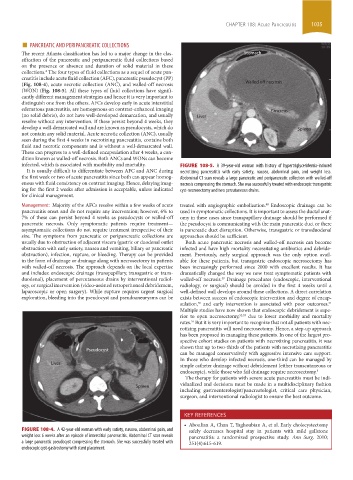
                    (Fig. 108-4), acute necrotic collection (ANC), and walled-off necrosis      Walled off necrosis
                    (WON) (Fig. 108-5). All these types of fluid collections have signifi-
                    cantly different management strategies and hence it is very important to
                    distinguish one from the others. AFCs develop early in acute interstitial
                    edematous pancreatitis, are homogenous on contrast-enhanced imaging                 Pancreas
                    (no solid debris), do not have well-developed demarcation, and usually   Liver
                    resolve without any intervention. If these persist beyond 4 weeks, they
                    develop a well-demarcated wall and are known as pseudocysts, which do                         Spleen
                    not contain any solid material. Acute necrotic collection (ANC), usually
                    seen during the first 4 weeks in necrotizing pancreatitis, contains both
                    fluid and necrotic components and is without a well-demarcated wall.
                    These can progress to a well-defined encapsulation after 4 weeks, a con-
                    dition known as walled-off necrosis. Both ANCs and WONs can become
                    infected, which is associated with morbidity and mortality.  FIGURE 108-5.  A 39-year-old woman with history of hypertriglyceridemia-induced
                     It is usually difficult to differentiate between AFC and ANC during     necrotizing pancreatitis with early satiety, nausea, abdominal pain, and weight loss.
                    the first week or two of acute pancreatitis since both can appear homog-  Abdominal CT scan reveals a large pancreatic and peripancreatic collection with walled-off
                    enous with fluid consistency on contrast imaging. Hence, delaying imag-  necrosis compressing the stomach. She was successfully treated with endoscopic transgastric
                    ing for the first 2 weeks after admission is acceptable, unless indicated   cyst-necrosectomy and two percutaneous drains.
                    for clinical management.

                    Management:  Majority of the AFCs resolve within a few weeks of acute   treated with angiographic embolization.  Endoscopic drainage can be
                                                                                                       48
                    pancreatitis onset and do not require any intervention; however, 6% to   used in symptomatic collections. It is important to assess the ductal anat-
                    7% of these can persist beyond 4 weeks as pseudocysts or walled-off   omy in these cases since transpapillary drainage should be performed if
                    pancreatic necrosis. Only symptomatic patients require treatment—  the pseudocyst is communicating with the main pancreatic duct or there
                    asymptomatic collections do not require treatment irrespective of their   is pancreatic duct disruption. Otherwise, transgastric or transduodenal
                    size. The symptoms from pancreatic or peripancreatic collections are   approaches should be sufficient.
                    usually due to obstruction of adjacent viscera (gastric or duodenal outlet   Both  acute  pancreatic  necrosis  and  walled-off  necrosis  can  become
                    obstruction with early satiety, nausea and vomiting, biliary or pancreatic   infected and have high mortality necessitating antibiotics and debride-
                    obstruction), infection, rupture, or bleeding. Therapy can be provided   ment.  Previously,  early surgical approach was the only  option avail-
                    in the form of drainage or drainage along with necrosectomy in patients   able for these patients, but transgastric endoscopic necrosectomy has
                    with walled-off necrosis. The approach depends on the local expertise   been increasingly performed since 2000 with excellent results. It has
                    and includes: endoscopic drainage (transpapillary, transgastric or trans-  dramatically changed the way we now treat symptomatic patients with
                    duodenal), placement of percutaneous drains by interventional radiol-  walled-off  necrosis.   Drainage  procedures  (endoscopic,  interventional
                                                                                        49
                    ogy, or surgical intervention (video-assisted retroperitoneal debridement,   radiology, or surgical) should be avoided in the first 4 weeks until a
                    laparoscopic or open surgery). While rupture requires urgent surgical   well-defined wall develops around these collections. A direct correlation
                    exploration, bleeding into the pseudocyst and  pseudoaneurysms can be   exists between success of endoscopic intervention and degree of encap-
                                                                          sulation,  and early intervention is associated with poor outcomes.
                                                                                                                            51
                                                                                50
                                                                          Multiple studies have now shown that endoscopic debridement is supe-
                                                                          rior to open necrosectomy, 52,53  due to lower morbidity and mortality
                                                                          rates.  But it is very important to recognize that not all patients with nec-
                                                                             54
                                                                          rotizing pancreatitis will need necrosectomy. Hence, a step-up approach
                                                                          has been proposed in managing these patients. In one of the largest pro-
                                                                          spective cohort studies on patients with necrotizing pancreatitis, it was
                                                                          shown that up to two-thirds of the patients with necrotizing pancreatitis
                                          Pseudocyst
                                                                          can be managed conservatively with aggressive intensive care support.
                                                                          In those who develop infected necrosis, one-third can be managed by
                              Liver
                                                                          simple catheter drainage without debridement (either transcutaneous or
                                                                          endoscopic), while those who fail drainage require necrosectomy. 3
                                                                           The therapy for patients with severe acute pancreatitis must be indi-
                                                                          vidualized and decisions must be made in a multidisciplinary fashion
                                                           Spleen
                                                                          including gastroenterologist/pancreatologist, critical care physician,
                                                                          surgeon, and interventional radiologist to ensure the best outcome.

                                                                           KEY REFERENCES
                                                                              • Aboulian A, Chan T, Yaghoubian A, et al. Early cholecystectomy
                    FIGURE 108-4.  A 42-year-old woman with early satiety, nausea, abdominal pain, and   safely decreases hospital stay in patients with mild gallstone
                    weight loss 6 weeks after an episode of interstitial pancreatitis. Abdominal CT scan reveals   pancreatitis: a randomized prospective study.  Ann Surg. 2010;
                    a large pancreatic pseudocyst compressing the stomach. She was successfully treated with   251(4):615-619.
                    endoscopic cyst-gastrostomy with stent placement.


            section09.indd   1035                                                                                      1/14/2015   9:27:24 AM

