


Page 1495 - Hall et al (2015) Principles of Critical Care-McGraw-Hill
P. 1495
1034     PART 9: Gastrointestinal Disorders


                 should be utilized (see Chap. 34 on “Judging the Adequacy of Fluid   not been shown to be beneficial. In patients who cannot tolerate gastric
                 Resuscitation”) and fluid resuscitation should begin early in the course   feeding due to large fluid collections causing gastric compression or
                 of  management.  A  large  single  center  retrospective  study  showed  that   duodenal obstruction, nasojejunal tube placement is usually needed.
                 (receiving more than one-third of total 72-hour fluid volume within first   ■  ROLE OF PROPHYLACTIC ANTIBIOTICS
                 those patients with acute pancreatitis who received early resuscitation
                 24 hours of presentation) had significantly lower incidence of SIRS, organ   Approximately one-fourth of patients with acute pancreatitis develop
                 failure, admission to intensive care unit, and a reduced length of stay   infectious complications and those with severe acute pancreatitis are at
                 compared to those with late resuscitation (receiving less than one-third   particularly high risk. Patients with infected pancreatic necrosis have a
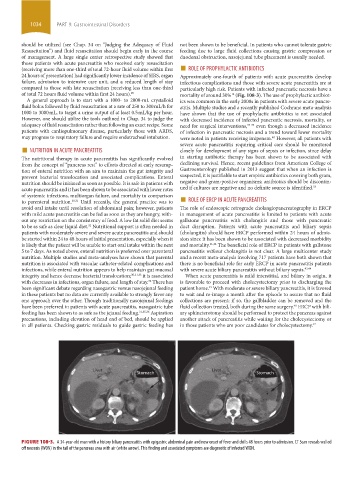
                 of total 72 hours fluid volume within first 24 hours). 29  mortality of around 30%  (Fig. 108-3). The use of prophylactic antibiot-
                                                                                         14
                   A general approach is to start with a 1000- to 2000-mL crystalloid   ics was common in the early 2000s in patients with severe acute pancre-
                 fluid bolus followed by fluid resuscitation at a rate of 250 to 300 mL/h for   atitis. Multiple studies and a recently published Cochrane meta-analysis
                 1000 to 3000 mL, to target a urine output of at least 0.5 mL/kg per hour.   have shown that the use of prophylactic antibiotics is not associated
                 However, one should utilize the tools outlined in Chap. 34 to judge the   with decreased incidence of infected pancreatic necrosis, mortality, or
                 adequacy of fluid resuscitation rather than following an exact recipe. Some   need for surgical interventions, 37-39  even though a decreased incidence
                 patients with cardiopulmonary disease, particularly those with ARDS,   of infection in pancreatic necrosis and a trend toward lower mortality
                 may progress to respiratory failure and require endotracheal intubation.  were noted in patients receiving imipenem.  However, all patients with
                                                                                                       40
                     ■  NUTRITION IN ACUTE PANCREATITIS                severe acute pancreatitis requiring critical care should be monitored
                                                                       closely for development of any signs of sepsis or infection, since delay
                 The nutritional therapy in acute pancreatitis has significantly evolved   in  starting  antibiotic  therapy  has  been  shown  to  be  associated  with
                 from the concept of “pancreas rest” to efforts directed at early resump-  declining survival. Hence, recent guidelines from American College of
                 tion of enteral nutrition with an aim to maintain the gut integrity and   Gastroenterology published in 2013 suggest that when an infection is
                 prevent  bacterial  translocation  and associated  complications.  Enteral   suspected, it is justifiable to start empiric antibiotics covering both gram,
                 nutrition should be initiated as soon as possible. It is safe in patients with   negative and gram-positive organisms; antibiotics should be discontin-
                 acute pancreatitis and it has been shown to be associated with lower rates   ued if cultures are negative and no definite source is identified. 33
                                      Until recently, the general practice was to
                 of systemic infections, multiorgan failure, and mortality in comparison   ■
                 to parenteral nutrition. 30,31                           ROLE OF ERCP IN ACUTE PANCREATITIS
                 avoid oral intake until resolution of abdominal pain; however, patients   The role of endoscopic retrograde cholangiopancreatography in ERCP
                 with mild acute pancreatitis can be fed as soon as they are hungry, with-  in  management  of  acute  pancreatitis  is  limited  to  patients  with  acute
                 out any restriction on the consistency of food. A low fat solid diet seems   gallstone  pancreatitis  with  cholangitis  and  those  with  pancreatic
                 to be as safe as clear liquid diet.  Nutritional support is often needed in   duct  disruption.  Patients  with  acute  pancreatitis  and  biliary  sepsis
                                        32
                 patients with moderately severe and severe acute pancreatitis and should   (cholangitis) should have ERCP performed within 24 hours of admis-
                 be started within 24 to 48 hours of initial presentation, especially when it   sion since it has been shown to be associated with decreased morbidity
                 is likely that the patient will be unable to start oral intake within the next   and mortality. 41,42  The beneficial role of ERCP in patients with gallstone
                 5 to 7 days. As noted above, enteral nutrition is preferred over parenteral   pancreatitis without cholangitis is not clear. A large multicenter study
                 nutrition. Multiple studies and meta-analyses have shown that parental   and a recent meta-analysis involving 717 patients have both shown that
                 nutrition is associated with vascular catheter-related complications and   there is no beneficial role for early ERCP in acute pancreatitis patients
                 infections, while enteral nutrition appears to help maintain gut mucosal   with severe acute biliary pancreatitis without biliary sepsis. 43,44
                 integrity and hence decrease bacterial translocation; 30,31,33  it is associated   When acute pancreatitis is mild interstitial, and biliary in origin, it
                 with decreases in infections, organ failure, and length of stay.  There has   is favorable to proceed with cholecystectomy prior to discharging the
                                                            34
                 been significant debate regarding nasogastric versus nasojejunal feeding   patient home.  With moderate or severe biliary pancreatitis, it is favored
                                                                                 45
                 in these patients but no data are currently available to strongly favor any   to wait and re-image a month after the episode to assure that no fluid
                 one approach over the other. Though traditionally nasojejunal feedings   collections are present; if so, the gallbladder can be removed and the
                 have been preferred in patients with acute pancreatitis, nasogastric tube   fluid collection treated, both during the same surgery.  ERCP with bili-
                                                                                                              46
                 feeding has been shown to as safe as the jejunal feeding. 31,35,36  Aspiration   ary sphincterotomy should be performed to protect the pancreas against
                 precautions, including elevation of head end of bed, should be applied   another attack of pancreatitis while waiting for the cholecystectomy or
                 in all patients. Checking gastric residuals to guide gastric feeding has   in those patients who are poor candidates for cholecystectomy. 47


                                          Liver                                   Liver
                                                        Stomach                                  Stomach


                 FIGURE 108-3.  A 34-year-old man with a history biliary pancreatitis with epigastric abdominal pain and new onset of fever and chills 48 hours prior to admission. CT Scan reveals walled
                 off necrosis (WON) in the tail of the pancreas area with air (white arrow). This finding and associated symptoms are diagnostic of infected WON.


            section09.indd   1034                                                                                      1/14/2015   9:27:22 AM

