


Page 1499 - Hall et al (2015) Principles of Critical Care-McGraw-Hill
P. 1499
1038     PART 9: Gastrointestinal Disorders


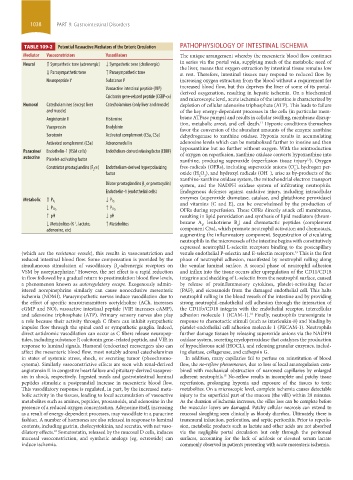
                   TABLE 109-2    Potential Vasoactive Mediators of the Enteric Circulation  PATHOPHYSIOLOGY OF INTESTINAL ISCHEMIA
                  Mediator  Vasoconstrictors  Vasodilators             The unique arrangement whereby the mesenteric blood flow continues
                  Neural  ↑ Sympathetic tone (adrenergic)  ↓ Sympathetic tone (cholinergic)  in series via the portal vein, supplying much of the metabolic need of
                                                                       the liver, means that oxygen extraction by intestinal tissue remains low
                          ↓ Parasympathetic tone  ↑ Parasympathetic tone  at rest. Therefore, intestinal tissues may respond to reduced flow by
                          Neuropeptide Y      Substance P              increasing oxygen extraction from the blood without a requirement for
                                              Vasoactive intestinal peptide (VIP)  increased blood flow, but this deprives the liver of some of its portal-
                                                                       derived oxygenation, resulting in hepatic ischemia. On a biochemical
                                              Calcitonin gene-related peptide (CGRP-α)
                                                                       and microscopic level, acute ischemia of the intestine is characterized by
                  Humoral  Catecholamines (except liver    Catecholamines (only liver and muscle)  depletion of cellular adenosine triphosphate (ATP). This leads to failure
                          and muscle)                                  of the key energy-dependent processes in the cells (in particular mem-
                          Angiotensin II      Histamine                brane ATPase pumps) and results in cellular swelling, membrane disrup-
                                                                       tion, metabolic arrest, and cell death.  Hypoxic conditions themselves
                                                                                                   11
                          Vasopressin         Bradykinin
                                                                       favor the conversion of the abundant amounts of the enzyme xanthine
                          Serotonin           Activated complement (C3a, C5a)  dehydrogenase to xanthine oxidase. Hypoxia results in accumulating
                          Activated complement (C5a)  Adrenomedullin   adenosine levels which can be metabolized further to inosine and then
                  Paracrine/  Endothelin-1 (VSM cells)  Endothelium-derived relaxing factor (EDRF)  hypoxanthine but no further without oxygen. With the reintroduction
                                                                       of oxygen on reperfusion, xanthine oxidase converts hypoxanthine into
                  autocrine  Platelet-activating factor                xanthine, producing superoxide (reperfusion tissue injury ). Oxygen
                                                                                                                  12
                          Constrictor prostaglandins (F α)  Endothelium-derived hyperpolarizing   free-radicals (OFRs), including superoxide anions (O ), hydrogen per-
                                                                                                              −
                                          2                                                                   2
                                                                                                     −
                                              factor                   oxide (H O ), and hydroxyl radicals (OH ), arise as by-products of the
                                                                                2
                                                                              2
                                                                       xanthine-xanthine oxidase system, the mitochondrial electron transport
                                              Dilator prostaglandins (I  or prostacyclin)  system, and the NADPH oxidase system of infiltrating neutrophils.
                                                           2
                                              Endothelin-1 (endothelial cells)  Endogenous defenses against oxidative injury, including intracellular
                  Metabolic  ↑ P O 2          ↓ P O 2                  enzymes (superoxide dismutase, catalase, and glutathione peroxidase)
                                                                       and  vitamins  (C  and  E),  can  be  overwhelmed  by  the  production  of
                          ↓ P CO 2            ↑ P CO 2                 OFRs during reperfusion. These OFRs directly attack cell membranes,
                          ↑ pH                ↓ pH                     resulting in lipid peroxidation and synthesis of lipid mediators (throm-
                          ↓ Metabolites (K , lactate,   ↑ Metabolites  boxane A , leukotriene B ) and chemotactic peptides (complement
                                   +
                                                                                           4
                                                                               2
                          adenosine, etc)                              component C5a), which promote neutrophil activation and chemotaxis,
                                                                       augmenting the inflammatory component. Sequestration of circulating
                                                                       neutrophils in the microvessels of the intestine begins with constitutively
                                                                       expressed neutrophil L-selectin receptors binding to the postcapillary
                 (which are the  resistance vessels), this results in   vasoconstriction and   venule endothelial P-selectin and E-selectin receptors.  This is the first
                                                                                                              13
                 reduced intestinal blood flow. Some compensation is provided by the   phase  of  neutrophil  adhesion,  manifested  by  neutrophil  rolling  along
                 simultaneous stimulation of vasodilatory  β -adrenergic receptors on   the  venular  luminal surface. A  second  phase of  neutrophil  adhesion
                                                  2
                 VSM by norepinephrine.  However, the net effect is a rapid reduction   and influx into the tissue occurs after upregulation of the CD11/CD18
                                   9
                 in flow followed by a gradual return to prestimulation blood flow levels,   integrins and shedding of L-selectin from the neutrophil surface, caused
                 a  phenomenon  known  as  autoregulatory escape.  Exogenously  admin-  by release of  proinflammatory cytokines, platelet-activating  factor
                 istered norepinephrine similarly can cause nonocclusive mesenteric   (PAF), and eicosanoids from the damaged endothelial cell. This halts
                 ischemia (NOMI). Parasympathetic nerves induce vasodilation due to   neutrophil rolling in the blood vessels of the intestine and by providing
                 the effect of specific neurotransmitters acetylcholine (ACh, increases   strong neutrophil-endothelial cell adhesion through the interaction of
                 cGMP and NO), vasoactive intestinal peptide (VIP, increases cAMP),   the CD11b/CD18 integrin with the endothelial receptor, intercellular
                 and adenosine triphosphate (ATP). Primary sensory nerves also play   adhesion molecule 1 (ICAM-1).  Finally, neutrophils transmigrate in
                                                                                               14
                 a role because their activity through C fibers can inhibit sympathetic   response to chemotactic stimuli (such as interleukin-8) and binding by
                 impulse flow through the spinal cord or sympathetic ganglia. Indeed,   platelet-endothelial cell adhesion molecule 1 (PECAM-1). Neutrophils
                 direct antidromic vasodilation can occur as C fibers release neuropep-  further damage tissues by releasing superoxide anions via the NADPH
                 tides, including substance P, calcitonin gene–related peptide, and VIP, in   oxidase system, secreting myeloperoxidase that catalyzes the production
                 response to luminal signals. Humoral (endocrine) messengers also can   of hypochlorous acid (HOCL), and releasing granular enzymes, includ-
                 affect the mesenteric blood flow, most notably adrenal catecholamines   ing elastase, collagenase, and cathepsin G.
                 in states of systemic stress, shock, or secreting tumor (pheochromo-  In addition, many capillaries fail to perfuse on reinstitution of blood
                 cytoma). Similarly vasoconstrictive effects are seen with renal-derived   flow, the no-reflow phenomenon, due to loss of local autoregulation com-
                 angiotensin II in congestive heart failure and pituitary-derived vasopres-  bined with mechanical obstruction of narrowed capillaries by enlarged
                 sin in shock, respectively. Ingested meals and gastrointestinal luminal   adherent neutrophils.  No-reflow results in incomplete and patchy tissue
                                                                                      15
                 peptides stimulate a postprandial increase in mesenteric blood flow.   reperfusion, prolonging hypoxia and exposure of the tissues to toxic
                 This vasodilatory response is regulated, in part, by the increased meta-  metabolites. On a microscopic level, complete ischemia causes detectable
                 bolic activity in the tissues, leading to local accumulation of vasoactive   injury to the superficial part of the mucosa (the villi) within 20 minutes.
                 metabolites such as amines, peptides, prostanoids, and adenosine in the   As the duration of ischemia increases, the villus loss can be complete before
                 presence of a reduced oxygen concentration. Adenosine itself, increasing   the muscular layers are damaged. Patchy cellular necrosis can extend to
                 as a result of energy-dependent processes, may vasodilate in a paracrine   mucosal sloughing seen clinically as bloody diarrhea. Ultimately, there is
                 fashion. A number of hormones are also released in response to luminal   transmural infarction, perforation, and septic peritonitis. Prior to reperfu-
                 contents, including gastrin, cholecystokinin, and secretin, with net vaso-  sion, metabolic products such as lactate and other acids are not absorbed
                 dilatory effects.  Somatostatin, released by the mucosal D cells, induces   via the negligible portal circulation but only through the peritoneal
                            10
                 mucosal vasoconstriction, and synthetic analogs (eg, octreotide) can   surfaces, accounting for the lack of acidosis or elevated serum lactate
                 induce ischemia.                                      commonly observed in patients presenting with acute mesenteric ischemia.


            section09.indd   1038                                                                                      1/14/2015   9:27:26 AM

