


Page 1501 - Hall et al (2015) Principles of Critical Care-McGraw-Hill
P. 1501
1040     PART 9: Gastrointestinal Disorders


                 not directly involved, hypotension may combine with pseudocoarctation   present in advanced mesenteric ischemia with sepsis or perforation.
                 to provoke ischemia or occlusion via a dissection flap), aortic trauma,   Arterial blood gases frequently are normal initially, but in the later
                 mesenteric aneurysm rupture, arteritis, fibromuscular dysplasia (FMD),   stages, metabolic acidosis and acute hypoxemia may supervene. Lactic
                 and extrinsic mechanical vascular obstruction. Acute intestinal ischemia   acidosis is often a late finding. Prerenal azotemia is a grave indicator,
                 also may arise as a result of extrinsic mechanical compression of the   signaling hypovolemia, sepsis, nephrotoxic effect, or disseminated intra-
                 arterial inflow or venous outflow. As low-pressure conduits, veins are   vascular coagulation (DIC). The erythrocyte sedimentation rate (ESR)
                 most susceptible to extrinsic compression; intramural venous plexi may   and later C-reactive protein (CRP) level may rise. Potential alternative
                 be obstructed due to wall distention, whereas mesenteric veins may be   serum markers, such as creatinine kinase (CK) BB isoenzyme, lactate
                 compressed by tumor, adhesion, volvulus, hernia, or intussusception.  dehydrogenase, intestinal isoenzyme of alkaline phosphatase, diamine
                                                                       oxidase, hexosaminidase, and aspartate transferase, have not proved suf-
                 DIAGNOSIS OF ACUTE MESENTERIC ISCHEMIA                ficiently sensitive or specific. The most encouraging markers are serum
                                                                       inorganic phosphate,   α-glutathione-S-transferase,  and d-lactate.
                                                                                                                          29
                                                                                                             28
                                                                                       27
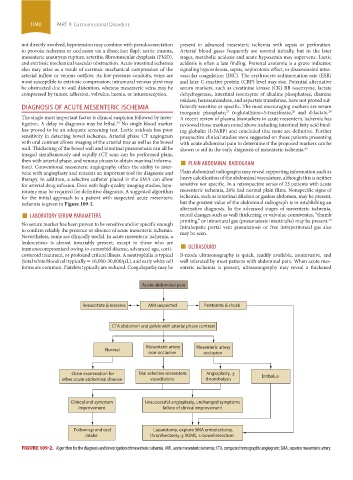
                 The single most important factor is clinical suspicion followed by inves-  A recent review of plasma biomarkers in acute mesenteric ischemia has
                 tigation. A delay in diagnosis may be lethal.  No single blood marker   reviewed those markers noted above including intestinal fatty acid bind-
                                                  20
                 has proved to be an adequate screening test. Lactic acidosis has poor   ing globulin (I-FABP) and concluded that none are definitive. Further
                 sensitivity in detecting bowel ischemia. Arterial phase CT angiogram   prospective clinical studies were suggested on those patients presenting
                 with oral contrast allows imaging of the arterial tree as well as the bowel   with acute abdominal pain to determine if the proposed markers can be
                 wall. Thickening of the bowel wall and intestinal pneumatosis can all be   shown to aid in the early diagnosis of mesenteric ischemia. 65
                 imaged simultaneously and rapidly (CT scan can be performed plain,
                 then with arterial phase, and venous phases to obtain maximal informa-    ■  PLAIN ABDOMINAL RADIOGRAM
                 tion). Conventional mesenteric angiography offers the ability to inter-
                 vene with angioplasty and remains an important tool for diagnosis and   Plain abdominal radiographs may reveal supporting information such as
                 therapy. In addition, a selective catheter placed in the SMA can allow   heavy calcification of the abdominal vasculature, although this is neither
                 for arterial drug infusion. Even with high-quality imaging studies, lapa-  sensitive nor specific. In a retrospective series of 23 patients with acute
                 rotomy may be required for definitive diagnosis. A suggested algorithm   mesenteric ischemia, 26% had normal plain films. Nonspecific signs of
                 for the initial approach to a patient with suspected acute mesenteric   ischemia, such as intestinal dilation or gasless abdomen, may be present,
                 ischemia is given in Figure 109-2.                    but the greatest value of the abdominal radiograph is in establishing an
                     ■  LABORATORY SERUM PARAMETERS                    mural changes such as wall thickening or valvulae conniventes, “thumb
                                                                       alternative diagnosis. In the advanced stages of mesenteric ischemia,
                                                                                                                          30
                 No serum marker has been proven to be sensitive and/or specific enough   printing,” or intramural gas (pneumatosis intestinalis) may be present.
                                                                       Intrahepatic  portal  vein  pneumatosis  or  free  intraperitoneal  gas  also
                 to confirm reliably the presence or absence of acute mesenteric ischemia.    may be seen.
                 Nevertheless, some are clinically useful. In acute mesenteric ischemia, a
                 immunocompromised owing to comorbid disease, advanced age, corti-  ■  ULTRASOUND
                 leukocytosis  is  almost  invariably  present,  except  in  those  who  are
                 costeroid treatment, or profound critical illness. A neutrophilia is typical   B-mode ultrasonography is quick, readily available, noninvasive, and
                 (total white blood cell typically = 16,000-30,000/µL), and early white cell   well tolerated by most patients with abdominal pain. When acute mes-
                 forms are common. Platelets typically are reduced. Coagulopathy may be     enteric ischemia is present, ultrasonography may reveal a thickened

                                                          Acute abdominal pain


                                      Resuscitate & reassess   AMI suspected    Peritonitis & shock


                                                CTA abdomen and pelvis with arterial phase contrast


                                                            Mesenteric artery  Mesenteric artery
                                              Normal
                                                            non-occlusive      occlusion

                                  Close examination for  Trial selective mesenteric   Angioplasty,
                               other acute abdominal disease    vasodilators    thrombolysis       Embolus


                                  Clinical and symptom     Unsuccessful angioplasty, unchanged symptoms
                                     improvement                 failure of clinical improvement


                                   Follow-up and oral         Laparotomy, explore SMA embolectomy,
                                       intake                thrombectomy     ROMS,     bowel resection

                 FIGURE 109-2.  Algorithm for the diagnosis and investigation of mesenteric ischemia. AMI, acute mesenteric ischemia; CTA, computed tomographic angiogram; SMA, superior mesenteric artery.


            section09.indd   1040                                                                                      1/14/2015   9:27:27 AM

