


Page 1502 - Hall et al (2015) Principles of Critical Care-McGraw-Hill
P. 1502
CHAPTER 109: Mesenteric Ischemia  1041


                    (>5 mm) bowel wall and signs of ileus  (distended bowel loops and   methods. Vascular findings on CT that contribute to the diagnosis of
                    hypoperistalsis). In advanced cases (mesenteric infarction), ultrasound   mesenteric ischemia include arterial stenosis, embolus visualization,
                    may show intraperitoneal fluid, pneumatosis, or intrahepatic portal   arterial  aneurysm  with  thrombus,  thrombosis  of  mesenteric  vessels,
                    venous gas. However, ultrasonography is operator-dependent and may   arterial dissection, and mesenteric vein thrombosis. Nonvascular CT
                    be confounded by the degree of intraluminal intestinal gas or by obe-  findings include bowel wall thickening, hypoperfusion and hypoattenu-
                    sity. For patients with suspected chronic mesenteric ischemia, duplex   ation, bowel dilation, bowel wall hemorrhage, mesenteric fat stranding,
                    ultrasonography has become the investigation of choice by many.  A   pneumatosis intestinalis, and portal venous gas.  Alternatives to iodinated
                                                                                                           67
                                                                    31
                    peak systolic velocity of greater than 275 cm/s in the SMA or greater   contrast agents, such as gadolinium, may be used for patients with a
                    than 200 cm/s in the celiac artery or no flow signal (in the SMA or celiac   contraindication to standard contrast material. Ischemic bowel wall
                    artery) predicts a stenosis of greater than 70% with a sensitivity of 89%   typically is seen as thin and poorly enhanced, more prominent on the
                    and a specificity of 92%.                             antimesenteric border in NOMI. Air may be seen in the bowel wall or
                     Following successful bypass or revascularization, postoperative   the portal vein. Reperfused bowel segments appear enlarged and edema-
                    duplex surveillance can be used to assess the patency of bypass grafts to   tous, often with increased mucosal and submucosal enhancement due
                    mesenteric arteries. Although the inflow arterial peak systolic velocity   to interstitial extravasation of contrast material.  With the increased
                                                                                                             32
                    may be higher for retrograde bypasses, the anastomotic and midgraft   availability of modern multislice helical CT scanners, rapidly acquired
                    velocities are not significantly affected by the orientation of the graft. 68  high-quality CTA images of the main mesenteric trunks and small col-
                        ■  CT SCAN AND CT-ANGIOGRAM                       laterals are possible.  Compared with mesenteric angiography, CTA
                                                                                         57
                                                                          may prove safer, cheaper, and better tolerated and result in decreased
                    CT scanning has become the radiologic investigation of choice for acute   radiation exposure for both patient and staff. When combining vascular
                    abdominal pain. Oral contrast enhancement may give better luminal   imaging and bowel wall appearance, the specificity is reported at 94%
                    definition but is not used by many centers, especially in the emergency   and sensitivity of 96%. 67
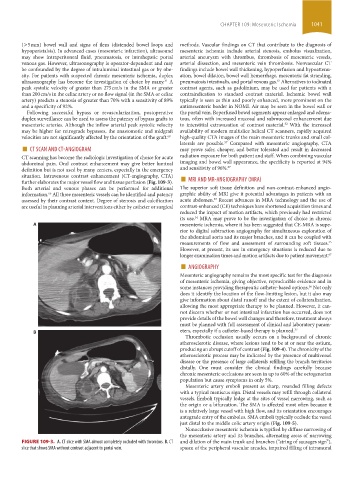
                    further elaborates the major vessel flow and tissue perfusion (Fig. 109-3).    ■  MRI AND MR-ANGIOGRAPHY (MRA)
                    situation. Intravenous contrast enhancement (CT-angiography, CTA)
                    Both  arterial  and venous  phases can be  performed for  additional   The superior soft tissue definition and non-contrast-enhanced angio-
                      information.  All three mesenteric vessels can be identified and patency   graphic ability of MRI give it potential advantages in patients with an
                             66
                    assessed by their contrast content. Degree of stenosis and calcification   acute abdomen.  Recent advances in MRA technology and the use of
                                                                                     33
                    are useful in planning arterial interventions either by catheter or  surgical   contrast-enhanced (CE) techniques have shortened acquisition times and
                                                                          reduced the impact of motion artifacts, which previously had restricted
                                                                          its use.  MRA may prove to be the investigation of choice in chronic
                                                                               34
                        A                                                 mesenteric ischemia, where it has been suggested that CE-MRA is supe-
                                                                          rior to digital subtraction angiography for simultaneous exploration of
                                                                          the abdominal aorta and its major branches, and it can be coupled with
                                                                          measurements of flow and assessment of surrounding soft tissues.
                                                                                                                            35
                                                                          However, at present, its use in emergency situations is reduced due to
                                                                          longer examination times and motion artifacts due to patient movement. 67
                                                                              ■  ANGIOGRAPHY
                                                                          Mesenteric angiography remains the most specific test for the diagnosis
                                                                          of mesenteric ischemia, giving objective, reproducible evidence and in
                                                                          some instances providing therapeutic catheter-based options.  Not only
                                                                                                                     36
                                                                          does it identify the location of the flow-limiting lesion, but it also may
                                                                          give information about distal runoff and the extent of collateralization,
                                                                          allowing the most appropriate therapy to be planned. However, it can-
                                                                          not discern whether or not intestinal infarction has occurred, does not
                                                                          provide details of the bowel wall changes and therefore, treatment always
                                                                          must be planned with full assessment of clinical and laboratory param-
                        B                                                 eters, especially if a catheter-based therapy is planned. 37
                                                                           Thrombotic occlusion usually occurs on a background of chronic
                                                                          atherosclerotic disease, where lesions tend to be at or near the ostium,
                                                                          producing an abrupt cutoff of contrast (Fig. 109-4). The chronicity of the
                                                                          atherosclerotic process may be indicated by the presence of multivessel
                                                                          disease or the presence of large collaterals refilling the branch territories
                                                                          distally. One must consider the clinical findings carefully because
                                                                          chronic mesenteric occlusions are seen in up to 60% of the octogenarian
                                                                          population but cause symptoms in only 5%.
                                                                           Mesenteric artery emboli present as sharp, rounded filling defects
                                                                          with a typical meniscus sign. Distal vessels may refill through collateral
                                                                          vessels. Emboli typically lodge at the sites of vessel narrowing, such as
                                                                          the origin or a bifurcation. The SMA is affected most often because it
                                                                          is a relatively large vessel with high flow, and its orientation encourages
                                                                          antegrade entry of the embolus. SMA emboli typically occlude the vessel
                                                                          just distal to the middle colic artery origin (Fig. 109-5).
                                                                           Nonocclusive mesenteric ischemia is typified by diffuse narrowing of
                                                                          the mesenteric artery and its branches, alternating areas of narrowing
                    FIGURE 109-3.  A. CT slice with SMA almost completely occluded with thrombus. B. CT   and dilation of the main trunk and branches (“string of sausages sign”),
                    slice that shows SMA without contrast adjacent to portal vein.  spasm of the peripheral vascular arcades, impaired filling of intramural


            section09.indd   1041                                                                                      1/14/2015   9:27:28 AM

