


Page 1503 - Hall et al (2015) Principles of Critical Care-McGraw-Hill
P. 1503
1042     PART 9: Gastrointestinal Disorders


                                                                       electrolyte disturbances such as hypokalemia, hypomagnesemia, and
                                                                       hypophosphatemia should be corrected. Broad-spectrum antibiotics
                                                                       (eg, second-generation penicillin or third-generation cephalosporin,
                                                                       along with anaerobic coverage) should be administered intravenously.
                                                                       Analgesia should not be withheld in the conscious patient. Systemic
                                                                       heparinization is advocated once the diagnosis is suspected, unless there
                                                                       are absolute contraindications. The goal is a partial thromboplastin time
                                                                       (PTT) of greater than 2 times control.
                                                                           ■
                                                           IMA origin     DIAGNOSTIC APPROACH
                                                                       Where there is diagnostic doubt in a patient with suspected mesenteric
                                                                       ischemia,  CT  angiography  is  recommended  as  the  initial  diagnostic
                                                                       test. Patients should receive fluid resuscitation prior to contrast admin-
                                                                       istration to prevent renal contrast toxicity. Scan review with an expert
                                                                       radiologist will determine the next steps. Alternately diagnostic mes-
                                                                       enteric angiography is advocated.  Modern catheters and techniques
                                                                                                38
                                                                       reduce the risks of bleeding, dissection, and embolization. In a well-
                                                                       resuscitated patient, small-volume nonionic contrast and digital sub-
                                                                       traction angiography (DSA) limit the risk of nephrotoxicity and contrast
                                                                       reaction. An initial flush aortogram may define the origins of the major
                                                                       vessels  and  outline  possible  collateral  pathways.  Selective  mesenteric
                                                                       artery catheterization allows for thorough assessment of individual arte-
                                                                       rial territories and opens up therapeutic options. 39
                                                                           ■
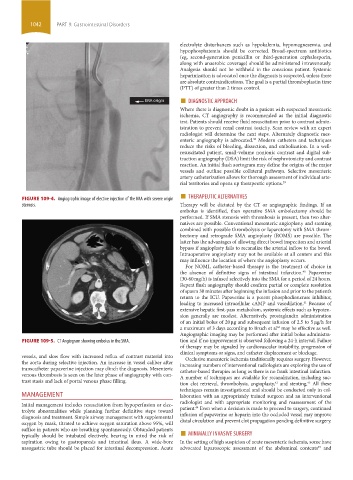
                 FIGURE 109-4.  Angiographic image of elective injection of the IMA with severe origin   THERAPEUTIC ALTERNATIVES
                 stenosis.                                             Therapy will be dictated by the CT or angiographic findings. If an
                                                                       embolus is identified, then operative SMA embolectomy should be
                                                                       performed. If SMA stenosis with thrombosis is present, then two alter-
                                                                       natives are possible. Conventional mesenteric angioplasty and stenting
                                                                       combined with possible thrombolysis or laparotomy with SMA throm-
                                                                       bectomy and retrograde SMA angioplasty (ROMS) are possible. The
                                                                       latter has the advantages of allowing direct bowel inspection and arterial
                                                                       bypass if angioplasty fails to recanalize the arterial inflow to the bowel.
                                                                       Intraoperative angioplasty may not be available at all centers and this
                                                                       may influence the location of where the angioplasty occurs.
                                                                         For  NOMI,  catheter-based  therapy  is  the  treatment  of  choice  in
                                                                       the absence of definitive signs of intestinal infarction.  Papaverine
                                                                                                                 40
                                                                       (30-60 mg/h) is infused selectively into the SMA for a period of 24 hours.
                                                                       Repeat flush angiography should confirm partial or complete resolution
                                                                       of spasm 30 minutes after beginning the infusion and prior to the patient’s
                                                                       return to the ICU. Papaverine is a potent phosphodiesterase inhibitor,
                                                                       leading to increased intracellular cAMP and vasodilation.  Because of
                                                                                                                 41
                                                                       extensive hepatic first-pass metabolism, systemic effects such as hypoten-
                                                                       sion generally are modest. Alternatively, prostaglandin administration
                                                                       of an initial bolus of 20 µg and subsequent infusion of 2.5 to 5 µg/h for
                                                                       a maximum of 3 days according to Bruch et al  may be effective as well.
                                                                                                        62
                                                                       Angiographic imaging may be performed after initial bolus administra-
                 FIGURE 109-5.  CT Angiogram showing embolus in the SMA.  tion and if no improvement is observed following a 24-h interval. Failure
                                                                       of therapy may be signaled by cardiovascular instability, progression of
                                                                       clinical symptoms or signs, and catheter displacement or blockage.
                 vessels, and slow flow with increased reflux of contrast material into   Occlusive mesenteric ischemia traditionally requires surgery. However,
                 the aorta during selective injection. An increase in vessel caliber after   increasing numbers of interventional radiologists are exploring the use of
                 transcatheter papaverine injection may clinch the diagnosis. Mesenteric   catheter-based therapies as long as there is no frank intestinal infarction.
                 venous thrombosis is seen on the later phase of angiography with con-  A number of techniques are available for recanalization, including suc-
                 trast stasis and lack of portal venous phase filling.  tion clot retrieval, thrombolysis, angioplasty,  and stenting.  All these
                                                                                                        42
                                                                                                                   43
                                                                       techniques remain investigational and should be conducted only in col-
                 MANAGEMENT                                            laboration with an appropriately trained surgeon and an interventional
                 Initial management includes resuscitation from hypoperfusion or elec-  radiologist and with appropriate monitoring and reassessment of the
                                                                            44
                 trolyte abnormalities while planning further definitive steps toward   patient.  Even when a decision is made to proceed to surgery, continued
                 diagnosis and treatment. Simple airway management with supplemental   infusion of papaverine or heparin into the occluded vessel may improve
                 oxygen by mask, titrated to achieve oxygen saturation above 95%, will   distal circulation and prevent clot propagation pending definitive surgery.
                 typically should be intubated electively, bearing in mind the risk of   ■  MINIMALLY INVASIVE SURGERY
                 suffice in patients who are breathing spontaneously. Obtunded patients
                 aspiration owing to gastroparesis and intestinal ileus. A wide-bore   In the setting of high suspicion of acute mesenteric ischemia, some have
                 nasogastric tube should be placed for intestinal decompression. Acute   advocated laparoscopic assessment of the abdominal contents  and
                                                                                                                      45


            section09.indd   1042                                                                                      1/14/2015   9:27:29 AM

