


Page 1535 - Hall et al (2015) Principles of Critical Care-McGraw-Hill
P. 1535
1054     PART 10: The Surgical Patient


                   TABLE 111-1    Considerations for Preoperative Anesthesia Assessment    TABLE 111-2    ASA Classification
                  1.  Request for consultation—either patient- or surgeon-initiated request for preoperative   1.  Healthy
                      anesthetic care discussion                        2.  Illness that does not impede activities of daily living
                  2.  Anesthetic considerations
                    •  Patient has personal history of anesthesia-related serious adverse event  3.  Illness that impedes activities of daily living
                    •  Patient or family history of malignant hyperthermia  4.  Illness that represents a constant threat to life
                    •  Anticipated or past history of difficult intubation
                  3.  Surgical considerations                           5.  Not expected to survive 24 h (with or without surgery)
                    •  Major cardiac, vascular, or intrathoracic procedures  6.  The patient declared dead for purposes of organ donation
                    •  Cervical spinal procedures                       The suffix “E” denotes emergency surgery
                    •  Implantable cardiac defibrillator procedures
                    •  Percutaneous procedures to repair aneurysms (aortic or cerebral) or cardiac valves
                  4.  Patient considerations                           patients is thought to be better than 1:50,000. The risk rises acutely for
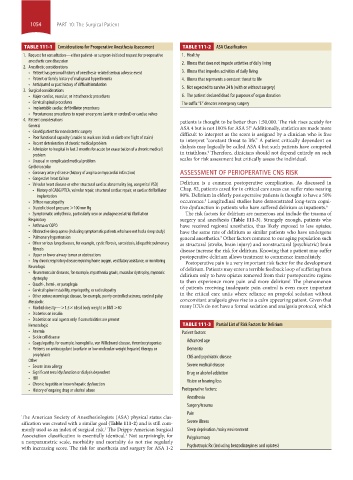
                    General                                            ASA 4 but is not 100% for ASA 5!  Additionally, statistics are made more
                                                                                               3
                    •  Gravid patient for nonobstetric surgery         difficult to interpret as the score is assigned by a clinician who is free
                    •  Poor functional capacity (unable to walk one block or climb one flight of stairs)  to interpret “constant threat to life.” A patient critically dependent on
                    •  Recent deterioration of chronic medical problem  dialysis may logically be called ASA 4 but such patients have competed
                    •  Admission to hospital in last 2 months for acute (or exacerbation of a chronic medical)   in triathlons.  Therefore, clinicians should not depend entirely on such
                                                                                 4
                     problem
                    •  Unusual or complicated medical problem          scales for risk assessment but critically assess the individual.
                    Cardiovascular
                    •  Coronary artery disease (history of angina or myocardial infarction)  ASSESSMENT OF PERIOPERATIVE CNS RISK
                    •  Congestive heart failure
                    •  Valvular heart disease or other structural cardiac abnormality (eg, congenital VSD)  Delirium is a common postoperative complication. As discussed in
                     •  History of CABG/PTCA, valvular repair, structural cardiac repair, or cardiac  defibrillator   Chap. 82, patients cared for in critical care areas can suffer rates nearing
                        implantation                                   80%. Delirium in elderly postoperative patients is thought to have a 50%
                                                                                5
                    •  Diffuse vasculopathy                            occurrence.  Longitudinal studies have demonstrated long-term cogni-
                    •  Diastolic blood pressure >100 mm Hg             tive dysfunction in patients who have suffered delirium as inpatients. 6
                    •  Symptomatic arrhythmia, particularly new or undiagnosed atrial fibrillation  The risk factors for delirium are numerous and include the trauma of
                    Respiratory                                        surgery  and  anesthesia  (Table 111-3).  Strangely  enough,  patients  who
                    •  Asthma or COPD                                  have received regional anesthetics, thus likely exposed to less opiates,
                    •  Obstructive sleep apnea (including symptomatic patients who have not had a sleep study)  have the same rate of delirium as similar patients who have undergone
                    •  Pulmonary hypertension                          general anesthetics.  Other factors common to our aging population such
                                                                                     7
                    •  Other serious lung diseases, for example, cystic fibrosis, sarcoidosis, idiopathic pulmonary   as structural (stroke, brain injury) and nonstructural (psychiatric) brain
                     fibrosis                                          disease increase the risk for delirium. Knowing that a patient may suffer
                    •  Upper or lower airway tumor or obstructions     postoperative delirium allows treatment to commence immediately.
                    •  Any chronic respiratory disease requiring home oxygen, ventilatory assistance, or  monitoring  Postoperative pain is a very important risk factor for the development
                    Neurologic                                         of delirium. Patients may enter a terrible feedback loop of suffering from
                    •  Neuromuscular diseases, for example, myasthenia gravis, muscular dystrophy,  myotonic   delirium only to have opiates removed from their postoperative regime
                     dystrophy                                         to then experience more pain and more delirium! The phenomenon
                    •  Quadri-, hemi-, or paraplegia                   of  patients  receiving  inadequate  pain  control  is  even  more  important
                    •  Cervical spine instability, myelopathy, or radiculopathy  in the critical care units where reliance on propofol sedation without
                    •  Other serious neurologic disease, for example, poorly controlled seizures, cerebral palsy
                    Metabolic                                          concomitant analgesia gives rise to a calm appearing patient. Given that
                    •  Morbid obesity—>1.5× ideal body weight or BMI >40  many ICUs do not have a formal sedation and analgesia protocol, which
                    •  Diabetics on insulin
                    •  Diabetics on oral agents only if comorbidities are present
                    Hematologic                                          TABLE 111-3    Partial List of Risk Factors for Delirium
                    •  Anemia                                           Patient factors:
                    •  Sickle cell disease
                    •  Coagulopathy, for example, hemophilia, von Willebrand disease, thrombocytopenias    Advanced age
                    •  Patients on anticoagulant (warfarin or low-molecular-weight heparin) therapy or      Dementia
                     prophylaxis                                          CNS and psychiatric disease
                    Other
                    •  Severe latex allergy                               Severe medical disease
                    •  Significant renal dysfunction or dialysis dependent    Drug or alcohol addiction
                    •  HIV                                                Vision or hearing loss
                    •  Chronic hepatitis or known hepatic dysfunction
                    •  History of ongoing drug or alcohol abuse         Postoperative factors:
                                                                          Anesthesia
                                                                          Surgery/trauma
                                                                          Pain
                 The American Society of Anesthesiologists (ASA) physical status clas-
                 sification was created with a similar goal (Table 111-2) and is still com-    Severe illness
                 monly used as an index of surgical risk.  The Dripps-American Surgical     Sleep deprivation /noisy environment
                                              1
                 Association classification is essentially identical.  Not surprisingly, for     Polypharmacy
                                                     2
                 a nonparametric scale, morbidity and mortality do not rise regularly
                 with increasing score. The risk for anesthesia and surgery for ASA 1-2     Psychotropic Rx (including benzodiazepines and opiates)


            section10.indd   1054                                                                                      1/20/2015   9:19:32 AM

