


Page 1536 - Hall et al (2015) Principles of Critical Care-McGraw-Hill
P. 1536
CHAPTER 111: Preoperative Assessment of the High-Risk Surgical Patient  1055


                    includes sedation and analgesia goals, patients risk being sedated with-  complications. Clearly, patients who require emergent surgery should
                    out analgesia.  These patients are at high risk for postoperative delirium.  proceed immediately to the operating theatre without delay for cardiac
                             8
                     Postoperative delirium requires a multimodal treatment strategy. While   testing. Patients deemed to be in the high-risk group (those who suffer
                    haloperidol is sometimes considered,  the evidence for improved   from unstable coronary artery disease [CAD], decompensated conges-
                                                 9
                    outcomes in those treated with this medication is lacking. Pretreating   tive heart failure [CHF], severe valvular disease, and unstable arrhyth-
                    patients at risk for delirium has had limited success. 10  mias)  should  have  their  noncardiac  surgery  delayed  for  full  cardiac
                     Identifying at risk patients allows the surgeon caring for postoperative   evaluation and treatment.
                    patients to reduce the risk for delirium. This is done by ensuring that   It is the group of patients in the intermediate risk category who will
                    environmental, medical, and pharmacological factors favor recovery.   benefit most from the investigations described below, in an effort to
                    Examples of such measures include ensuring the patient has appropri-  further elucidate the extent of their underlying cardiac disease and to
                    ate vision and hearing aids in place, controlling noise and lighting that    attempt to quantify and possibly reduce the perioperative risks before
                    affect sleep-wake cycles, ensuring adequate pain control, treating of   the commencement of the surgical procedure.
                    dehydration, appropriate nutrition, and avoiding polypharmacy.  Testing becomes more important as patients face intermediate-
                                                                          or high-risk surgery without good preoperative functional capacity.
                    ASSESSMENT OF CARDIAC MORBIDITY                       Patients who suffer from functional limitation due to surgical disease
                    FOR NONCARDIAC SURGERY                                may mask important cardiorespiratory disease. In addition, North
                                                                          America and many other Western countries are in the midst of an
                    Our aging population, rising rates of obesity, and type II diabetes suggest   obesity epidemic. The US Department of Health and Human Services
                    that  more patients presenting for  noncardiac  surgery  will  have diag-  suggests that most American citizens lead sedentary lives. Forty percent
                    nosed or clinically suspected ischemic heart disease and thus increased   of survey respondents do no leisure physical activity whatsoever. The
                    risk for perioperative complications. Using multivariate analysis of 1001   lack of symptoms in this large segment of the population results from
                    consecutive patients presenting for noncardiac surgery, Goldman and   “auto–β-blockade.” The patient never achieves in their activities of daily
                    associates developed an index for perioperative risk (cardiac risk index)   living enough physiologic challenge to reveal their disease.
                    based on clinical, electrocardiographic (ECG), and routine biochemi-  Without symptoms of CHF, the possibility of complete left ventricle
                    cal parameters.  The strongest predictors of cardiac morbidity were   (LV) systolic decompensation is low. Routine LV function studies by
                               11
                    the severity of coronary artery disease, a recent myocardial infarction   echocardiography are contraindicated. The question remains: “Does this
                    (MI), and perioperative heart failure. Detsky and coworkers reworked   patient have ischemic risk?” In the setting of patients who cannot exercise
                    the scoring  system to allow for broader applicability and less depen-  or do not have the physical fitness needed for exercise stress testing, the
                    dence on clinical examination findings.  At present, the standard for   ACC/AHA suggest nuclear medicine perfusion studies or stress echocar-
                                                 12
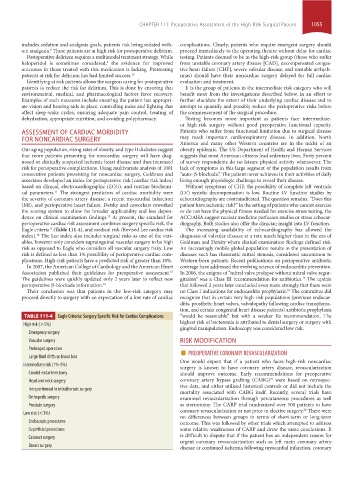
                    perioperative cardiac risk assessment combines surgery specific risk, the   diography. Both studies also offer the clinician insight into LV function.
                    Eagle criteria  (Table 111-4), and medical risk (Revised Lee cardiac risk   The increasing availability of echocardiography has allowed the
                             13
                    index).  The Lee index also includes surgical risks as one of the vari-  diagnosis of valvular disease at a rate much higher than in the era of
                         14
                    ables, however only considers suprainguinal vascular surgery to be high   Goldman and Detsky where clinical examination findings defined risk.
                    risk as opposed to Eagle who considers all vascular surgery risky. Low   An increasingly mobile global population results in the presentation of
                    risk is defined as less than 1% possibility of perioperative cardiac com-  diseases such has rheumatic mitral stenosis, considered uncommon to
                    plications. High-risk patients have a predicted risk of greater than 10%.  Western-born patients. Recent publications on perioperative antibiotic
                     In 2007, the American College of Cardiology and the American Heart   coverage have addressed the evolving science of endocarditis prevention.
                    Association published their  guidelines  for preoperative assessment.    In 2006, the enigma of “mitral valve prolapse without mitral valve regur-
                                                                      15
                    The guidelines were quickly updated only 2 years later to reflect new   gitation” was a Class III recommendation for antibiotics.  The update
                                                                                                                   17
                    perioperative β-blockade information. 16              that followed 2 years later concluded even more strongly that there were
                     Their conclusion was that patients in the low-risk category may   no Class I indications for endocarditis prophylaxis.  The committee did
                                                                                                              18
                    proceed directly to surgery with an expectation of a low rate of cardiac   recognize that in certain very high-risk populations (previous endocar-
                                                                          ditis, prosthetic heart valves, valvulopathy following cardiac transplanta-
                                                                          tion, and certain congenital heart disease patients) antibiotic prophylaxis
                      TABLE 111-4    Eagle Criteria: Surgery Specific Risk for Cardiac Complications  “would be reasonable” but with a weaker IIa recommendation. The
                    High risk (>5%)                                       highest risk of bacteremia is attributed to dental surgery or surgery with
                                                                          gingival manipulation. Endoscopy was considered low risk.
                      Emergency surgery
                      Vascular surgery                                    RISK MODIFICATION
                      Prolonged operation                                     ■
                      Large fluid shifts or blood loss                      PREOPERATIVE CORONARY REVASCULARIZATION
                                                                          One would expect that if a patient who faces high-risk noncardiac
                    Intermediate risk (1%-5%)
                                                                          surgery is known to have coronary artery disease, revascularization
                      Carotid endarterectomy                              should  improve  outcome.  Early  recommendations  for  preoperative
                                                                                                        19
                      Head and neck surgery                               coronary artery bypass grafting (CABG)  were based on retrospec-
                                                                          tive data, and either utilized historical controls or did not include the
                      Intraperitoneal or intrathoracic surgery
                                                                          mortality associated with CABG itself. Recently, several trials have
                      Orthopedic surgery                                  examined revascularization through percutaneous procedures as well
                      Prostate surgery                                    as sternotomy. The CARP trial randomized over 500 patients to have
                                                                          coronary revascularization or not prior to elective surgery.  There were
                                                                                                                    20
                    Low risk (<1%)
                                                                          no  differences  between  groups in  terms of short-term  or long-term
                      Endoscopic procedures                               outcome. This was followed by other trials which attempted to address
                      Superficial procedures                              some relative weaknesses of CARP and drew the same conclusions. It
                      Cataract surgery                                    is difficult to dispute that if the patient has an independent reason for
                                                                          urgent coronary revascularization such as left main coronary artery
                      Breast surgery                                      disease or continued ischemia following myocardial infarction, coronary


            section10.indd   1055                                                                                      1/20/2015   9:19:32 AM

