


Page 1543 - Hall et al (2015) Principles of Critical Care-McGraw-Hill
P. 1543
1062     PART 10: The Surgical Patient


                                                                       translocation, decreased length of stay, and decreased rates of infec-
                   TABLE 112-1     Association of Surgical Technologists Malignant Hyperthermia                12,13
                              Treatment Guidelines 9                   tion when compared to delayed initiation of feedings.   In addition,
                                                                       patients who cannot assume normal nutritional requirements by
                  •  Immediate discontinuation of anesthesia and the paralytic succinylcholine. If the surgery   oral feeding alone may need additional enteral nutritional support.
                   is for a life-threatening condition or cannot be immediately stopped, then continue with   Trauma patients with blunt or penetrating abdominal injuries show
                   use of different anesthetic agent and machine.      reduced infection rates when fed enterally, and in burn patients,
                  •  Consider immediate contact of Malignant Hyperthermia Association of the United States   studies demonstrate that nutrition should be started immediately.
                   (MHAUS) or delayed contact if assistance is needed at (800)644-9737.  Even delaying 18 hours results in a higher rate of parenteral nutrition
                  •  Hyperventilate with 1.0 fraction of inspired oxygen at high flow rate to treat   requirement. 14
                     hypercapnia,  metabolic acidosis, and increased oxygen consumption.  Even when critically ill, most postoperative patients who have under-
                  •  Dantrolene at a dose of 2.5 mg/kg IV immediately and every 5 min until symptoms   gone a laparotomy have return of bowel function in the first few days.
                   subside.                                            Gastroparesis can occur and will delay gastric emptying. Clinical signs
                  •  Change ventilator tubing and soda lime canister. Newer research indicates this may not   of gastroparesis include abdominal distention, 500 mL/day of nasogastric
                   be  necessary with aggressive oxygen delivery.      tube output, or residual volumes greater than 300 mL in the stomach after
                  •  Administer sodium bicarbonate, 1-2 mEq/kg IV, for the metabolic acidosis from    feedings. Theoretically, one method to combat this would be to initiate
                   increased lactate.                                  postpyloric feeding,  but postpyloric feeding has not been shown to
                                                                                      15
                  •  Apply ice packs to the groin, axillary region, and sides of the neck.  decrease ICU length of stay, mortality rate, or pneumonia rate when com-
                  •  In some instances, ice lavage of the stomach and rectum can be performed, but be    pared with gastric feeding. Prokinetic agents, such as metoclopramide
                   cautious not to induce hypothermia. Cooling measures should be stopped when the core   and erythromycin, can be used with some positive results. 16
                   body temperature reaches 38°C.                        While  most  critically  ill  patients  tolerate  gastric  feedings  well,  the
                  •  Administer mannitol at 0.25 g/kg IV and/or furosemide at 1 mg/kg IV, up to four doses   Eastern Association for the Surgery of Trauma (EAST) outlines which
                   of each, in order to promote and maintain urinary flow to help reduce the amount of   trauma patients warrant postpyloric feedings including patients with
                   myoglobin in the kidneys. It is recommended to maintain urinary output of at least   severe traumatic brain injury who did not tolerate gastric feedings in the
                   2 mL/kg/h to help reduce the incidence of renal failure.  first 48 hours of trauma and patients with abdominal trauma who have
                  •  If cardiac arrhythmias develop, the use of procainamide, 200 mg IV, may be helpful.  undergone laparotomy.  It is critical that trauma patients are adequately
                                                                                        17
                  •  Monitor potassium closely because hyperkalemia can develop rapidly from destruction   resuscitated or else they may develop intestinal necrosis in the face of
                   of muscle cells. Treat hyperkalemia with dextrose, 50 g IV, and regular insulin, 10 U IV,   direct small bowel feeding.
                   as well as sodium bicarbonate, as previously mentioned.  In cases of acute pancreatitis, the degree of inflammation plays a role
                  •  Insert a Foley catheter, if not already in place, to monitor urinary output.  in route of nutrition. In mild pancreatitis, enteral nutrition (feeding via
                  •  Monitor potassium, sodium chloride, calcium, phosphate, and magnesium levels every   a tube into the stomach or small intestine) will not be needed unless oral
                   10 min until symptoms subside.                      (taking food by mouth) feeding cannot be tolerated after 5 to 7 days. In
                  •  Check arterial blood gases every 5 to 10 min to monitor oxygenation and acidosis.  patients with severe acute pancreatitis, early enteral feeding should be
                  •  Insert arterial and central lines if not already present. Dantrolene should be administered   used. This route has been shown to have reduced infection, need for
                   via a central line. Monitor end-tidal carbon dioxide levels through a ventilator.  surgery, and length of stay compared with parenteral nutrition.  Gastric
                                                                                                                    18
                 Data from Guideline statement for malignant hyperthermia in the perioperative environment: http://www.   feedings can be used in most patients with acute pancreatitis. 19
                 ast.org/uploadedFiles/Main_Site/Content/About_Us/Guideline_Malignant_Hyperthermia.pdf.  Parenteral nutrition has not been shown to reduce morbidity or mor-
                                                                       tality and it is associated with increased risk of catheter- and noncatheter-
                                                                       related infections. 20,21  A recent study by Casaer and colleagues found
                                                                       that those patients where parenteral nutrition was initiated at day 8 or
                                                                       after had a faster overall recovery time and fewer overall complications.
                                                                                                                          22
                 must be reconstituted at bedside. In an average 70-kg patient, thirty-six   If bowel function or injury will not allow enteral nutrition or if enteral
                 20-mg vials will be needed for stabilization. After the patient is stabi-  nutrition is not expected within 7 days, then parental nutrition should
                 lized, dantrolene is administered at 1 mg/kg every 6 to 8 hours for 1 to   be given. It is generally recommended that if patients fail to reach at
                 3 days to prevent recurrence during which time patients should remain   least 50% of their goal enteral rate by day 7, parenteral nutrition should
                 in the ICU for monitoring. Comprehensive treatment guidelines for MH   be started, but the combination of parenteral and enteral nutrition
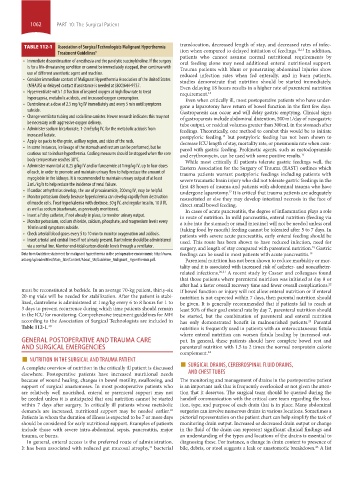
                 according to the Association of Surgical Technologists are included in   has only demonstrated benefit in malnourished patients.  Parental
                                                                                                                   23
                 Table 112-1. 1,9                                      nutrition is frequently used in patients with an enterocutaneous fistula
                                                                       where enteral nutrition can worsen fistula healing by increased out-
                 GENERAL POSTOPERATIVE AND TRAUMA CARE                 put.  In  general,  these  patients  should  have  complete  bowel  rest  and
                 AND SURGICAL EMERGENCIES                              parenteral nutrition with 1.5 to 2 times the normal nonprotein calorie
                     ■
                                                                       complement.
                                                                                 24
                 A complete overview of nutrition in the critically ill patient is discussed   ■  SURGICAL DRAINS, CEREBROSPINAL FLUID DRAINS,
                    NUTRITION IN THE SURGICAL AND TRAUMA PATIENT
                 elsewhere. Postoperative patients have increased nutritional needs   AND CHEST TUBES
                 because of wound healing, changes in bowel motility, swallowing, and   The monitoring and management of drains in the postoperative patient
                 support of surgical anastomoses. In most postoperative patients who   is an important task that is frequently overlooked or not given the atten-
                 are relatively well nourished, enteral or parenteral support may not   tion that it deserves. The surgical team should be queried during the
                 be needed unless it is anticipated that oral nutrition cannot be started   handoff communication with the critical care team regarding the loca-
                 within 7 days after surgery. In critically ill patients whose metabolic   tion, type, and purpose of each drain that is in place. Many abdominal
                 demands are increased, nutritional support may be needed earlier.    surgeries can involve numerous drains in various locations. Sometimes a
                                                                    10
                 Patients in whom the duration of illness is expected to be 7 or more days   pictorial representation on the patient chart can help simplify the task of
                 should be considered for early nutritional support. Examples of patients   monitoring drain output. Increased or decreased drain output or change
                 include those with severe intra-abdominal sepsis, pancreatitis, major   in the fluid of the drain can represent significant clinical findings and
                 trauma, or burns.                                     an understanding of the types and locations of the drains is essential to
                   In general, enteral access is the preferred route of administration.   diagnosing these. For instance, a change in drain content to presence of
                 It has been associated with reduced gut mucosal atrophy,  bacterial   bile, debris, or stool suggests a leak or anastomotic breakdown.  A list
                                                             11
                                                                                                                     25


            section10.indd   1062                                                                                      1/20/2015   9:19:34 AM

