


Page 1547 - Hall et al (2015) Principles of Critical Care-McGraw-Hill
P. 1547
1066     PART 10: The Surgical Patient


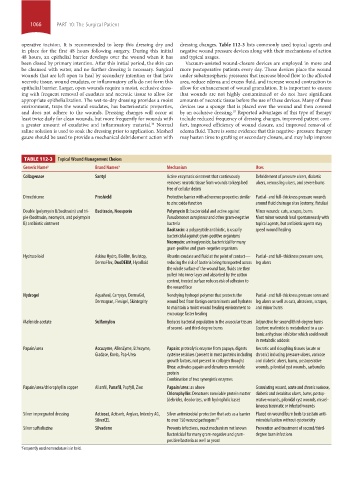
                 operative incision. It is recommended to keep this dressing dry and   dressing changes. Table 112-3 lists commonly used topical agents and
                 in place for the first 48 hours following surgery. During this initial     negative wound pressure devices along with their mechanisms of action
                 48 hours, an epithelial barrier develops over the wound when it has   and typical usages.
                 been closed by primary intention. After this initial period, the skin can   Vacuum-assisted wound-closure devices are employed in more and
                 be cleansed with water, and no further dressing is necessary. Surgical   more postoperative patients every day. These devices place the wound
                 wounds that are left open to heal by secondary intention or that have   under subatmospheric pressures that increase blood flow to the affected
                 necrotic tissue, wound exudates, or inflammatory cells do not form this   area, reduce edema and excess fluid, and increase wound contraction to
                 epithelial barrier. Larger, open wounds require a moist, occlusive dress-  allow for enhancement of wound granulation. It is important to ensure
                 ing with frequent removal of exudates and necrotic tissue to allow for   that wounds are not highly contaminated or do not have significant
                 appropriate epithelialization. The wet-to-dry dressing provides a moist   amounts of necrotic tissue before the use of these devices. Many of these
                 environment, traps the wound exudates, has bacteriostatic properties,   devices use a sponge that is placed over the wound and then covered
                 and does not adhere to the wounds. Dressing changes will occur at   by an occlusive dressing.  Reported advantages of this type of therapy
                                                                                         37
                 least twice daily for clean wounds, but more frequently for wounds with   include reduced frequency of dressing changes, improved patient com-
                 a greater amount of exudative and inflammatory material.  Normal   fort, improved efficiency of wound closure, and improved removal of
                                                             36
                 saline solution is used to soak the dressing prior to application. Meshed   edema fluid. There is some evidence that this negative- pressure therapy
                 gauze should be used to provide a mechanical debridement action with   may hasten time to grafting or secondary closure, and may help improve


                   TABLE 112-3    Topical Wound Management Choices
                  Generic Name a          Brand Names a            Mechanism                     Uses
                  Collagenase             Santyl                   Active enzymatic ointment that continuously   Debridement of pressure ulcers, diabetic
                                                                   removes necrotic tissue from wounds to keep bed   ulcers, venous leg ulcers, and severe burns
                                                                   free of cellular debris
                  Dimethicone             Proshield                Protective barrier with adherence properties similar   Partial- and full-thickness pressure wounds
                                                                   to zinc oxide function        around fluid drainage sites (ostomy, fistulas)
                  Double (polymyxin B/bacitracin) and tri-  Bacitracin, Neosporin  Polymyxin B: bactericidal and active against   Minor wounds: cuts, scrapes, burns
                  ple (bacitracin, neomycin, and polymyxin         Pseudomonas aeruginosa and other gram-negative   Most minor wounds heal spontaneously with
                  B) antibiotic ointment                           bacteria                      topical agents, but antibiotic agents may
                                                                   Bacitracin: a polypeptide antibiotic, is usually    speed wound healing
                                                                   bactericidal against gram-positive organisms
                                                                   Neomycin: aminoglycoside, bactericidal for many
                                                                   gram-positive and gram-negative organisms
                  Hydrocolloid            Askina Hydro, Biofilm, Brulstop,   Absorbs exudate and fluid at the point of contact—  Partial- and full- thickness pressure sores,
                                          DermaFlex, DuoDERM, Hycolloid  reducing the risk of bacteria being transported across   leg ulcers
                                                                   the whole surface of the wound face, fluids are then
                                                                   pulled into inner layer and absorbed by the cotton
                                                                   content, treated surface reduces risk of adhesion to
                                                                   the wound face
                  Hydrogel                Aquaheal, Carrysyn, DermaGel,   Nondrying hydrogel polymer that protects the   Partial- and full-thickness pressure sores and
                                          Dermagran, Flexigel, Skintegrity  wound bed from foreign contaminants and hydrates  leg ulcers as well as cuts, abrasions, scrapes,
                                                                   to maintain a moist wound healing environment to   and minor burns
                                                                   encourage faster healing
                  Mafenide acetate        Sulfamylon               Reduces bacterial population in the avascular tissues   Adjunctive for second/third-degree burns
                                                                   of second- and third-degree burns  Caution: mafenide is metabolized to a car-
                                                                                                 bonic anhydrase inhibitor which could result
                                                                                                 in metabolic acidosis
                  Papain/urea             Accuzyme, AllenZyme, Ethezyme,   Papain: proteolytic enzyme from papaya, digests    Necrotic and sloughing tissues (acute or
                                          Gladase, Kovia, Pap-Urea  cysteine residues (present in most proteins including   chronic) including pressure ulcers, varicose
                                                                   growth factors, not present in collagen though)  and diabetic ulcers, burns, postoperative
                                                                   Urea: activates papain and denatures nonviable    wounds, pilonidal cyst wounds, carbuncles
                                                                   protein
                                                                   Combination of two synergistic enzymes
                  Papain/urea/chlorophyllin copper   Allanfil, Panafil, Papfyll, Ziox  Papain/urea: as above  Granulating wound, acute and chronic varicose,
                                                                   Chlorophyllin: Denatures nonviable protein matter  diabetic and decubitus ulcers, burns, postop-
                                                                   (debrides, deodorizes, with hydrophilic base)  erative wounds, pilonidal cyst wounds, miscel-
                                                                                                 laneous traumatic or infected wounds
                  Silver impregnated dressing  Acticoat, Actisorb, Arglaes, Interdry AG,   Silver antimicrobial protection that acts as a barrier  Placed on wound/burn beds to sustain anti-
                                          SilverCEL                to over 150 wound pathogens 125  microbialization without cytotoxicity
                  Silver sulfadiazine     Silvadene                Prevents infections, exact mechanism not known  Prevention and treatment of second/third-
                                                                   Bactericidal for many gram-negative and gram-  degree burn infections
                                                                   positive bacteria as well as yeast
                 a Frequently used nomenclature is in bold.


            section10.indd   1066                                                                                      1/20/2015   9:19:41 AM

