


Page 1546 - Hall et al (2015) Principles of Critical Care-McGraw-Hill
P. 1546
CHAPTER 112: Principles of Postoperative Critical Care  1065


                      TABLE 112-2    Surgical Drains and Wound Management Systems (Continued)
                                    Composition and Drainage
                    Drain           Method            Collecting System  Typical Uses    Photographic Representation
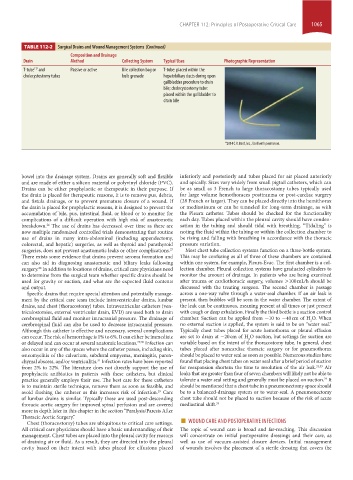
                    T-tube  and     Passive or active  Bile collection bag or   T-tube: placed within the
                        117
                    cholecystostomy tubes             bulb grenade  hepatobiliary ducts during open
                                                                    gallbladder procedure to drain
                                                                    bile; cholecystostomy tube:
                                                                    placed within the gallbladder to
                                                                    drain bile


                                                                                         ®2014 C.R. Bard, Inc., Used with permission.


                    bowel into the drainage system. Drains are generally soft and flexible   inferiorly and posteriorly and tubes placed for air placed anteriorly
                    and are made of either a silicon material or polyvinyl chloride (PVC).   and apically. Sizes vary widely from small pigtail catheters, which can
                    Drains can be either prophylactic or therapeutic in their purpose. If   be as small as 3 French to large thoracostomy tubes typically used
                    the drain is placed for therapeutic reasons, it is to remove pus, debris,   for large volume hemothoraces posttrauma or post-cardiac surgery
                    and fistula drainage, or to prevent premature closure of a wound. If     (28 French or larger). They can be placed directly into the hemithorax
                    the drain is placed for prophylactic reasons, it is designed to prevent the   or mediastinum or can be tunneled for long-term drainage, as with
                    accumulation of bile, pus, intestinal fluid, or blood or to monitor for   the Pleurx catheter. Tubes should be checked for the functionality
                    complications of a difficult operation with high risk of anastomotic   each day. Tubes placed within the pleural cavity should have conden-
                    breakdown.  The use of drains has decreased over time as there are   sation in the tubing and should tidal with breathing. “Tidaling” is
                            26
                    now multiple randomized controlled trials demonstrating that routine   noting the fluid within the tubing or within the collection chamber to
                    use of drains in many intra-abdominal (including appendectomy,   be rising and falling with breathing in accordance with the thoracic
                    colorectal, and hepatic) surgeries, as well as thyroid and parathyroid   pressure variation.
                    surgeries, does not prevent anastomotic leaks or other complications.    Most chest tube collection systems function on a three-bottle system.
                                                                      27
                    There exists some evidence that drains prevent seroma formation and   This may be confusing as all of three of these chambers are contained
                    can also aid in diagnosing anastomotic and biliary leaks following     within one system, for example, Pleura-Evac. The first chamber is a col-
                    surgery.  In addition to locations of drains, critical care physicians need   lection chamber. Pleural collection systems have graduated cylinders to
                         28
                    to determine from the surgical team whether specific drains should be   monitor the amount of drainage. In patients who are being examined
                    used for gravity or suction, and what are the expected fluid contents   after trauma or cardiothoracic surgery, volumes >100 mL/h should be
                    and output.                                           discussed  with the treating surgeon. The  second chamber is passage
                     Specific drains that require special attention and potentially manage-  across a one-way valve through a water-seal chamber. If an air leak is
                    ment by the critical care team include intraventricular drains, lumbar   present, then bubbles will be seen in the water chamber. The extent of
                    drains, and chest (thoracostomy) tubes. Intraventricular catheters (ven-  the leak can be continuous, meaning present at all times or just present
                    triculostomies, external ventricular drain, EVD) are used both to drain   with cough or deep exhalation. Finally the third bottle is a suction control
                    cerebrospinal fluid and monitor intracranial pressure. The drainage of   chamber. Suction can be applied from −10 to −40 cm of H O. When
                                                                                                                      2
                    cerebrospinal fluid can also be used to decrease intracranial pressure.   no external suction is applied, the system is said to be on “water seal.”
                    Although this catheter is effective and necessary, several complications   Typically chest tubes placed for acute hemothorax or pleural effusion
                    can occur. The risk of hemorrhage is 1% to 6%. It can either be immediate   are set to drain at −20 cm of H O suction, but settings for suction are
                                                                                                 2
                    or delayed and can occur at several anatomic locations. 29,30  Infection can   variable based on the intent of the thoracostomy tube. In general, chest
                    also occur in any of the spaces where the catheter passes, including skin,   tubes  placed after  noncardiac  thoracic  surgery  or  for  pneumothorax
                    osteomyelitis of the calvarium, subdural empyema, meningitis, paren-  should be placed to water seal as soon as possible. Numerous studies have
                    chymal abscess, and/or ventriculitis.  Infection rates have been reported   found that placing chest tubes on water seal after a brief period of suction
                                             31
                    from 2% to 22%. The literature does not directly support the use of    for reexpansion shortens the time to resolution of the air leak. 32,33  Air
                    prophylactic  antibiotics  in  patients with these  catheters,  but  clinical   leaks that are greater than four of seven chambers will likely not be able to
                    practice generally employs their use. The best care for these catheters   tolerate a water seal setting and generally must be placed on suction.  It
                                                                                                                           34
                    is to maintain sterile technique, remove them as soon as feasible, and   should be mentioned that a chest tube in a pneumonectomy space should
                    avoid flushing the catheter as this increases risk of infection.  Care   be to a balanced-drainage system or to water-seal. A pneumonectomy
                                                                  29
                    of  lumbar  drains  is  similar.  Typically  these  are  used  post-descending   chest tube should not be placed to suction because of the risk of acute
                    thoracic aortic surgery for improved spinal perfusion and are covered   mediastinal shift. 35
                    more in depth later in this chapter in the section “Paralysis/Paresis After
                     Chest (thoracostomy) tubes are ubiquitous to critical care settings.   ■
                    Thoracic Aortic Surgery.”                               WOUND CARE AND POSTOPERATIVE INFECTIONS
                    All critical care physicians should have a basic understanding of their     The topic of wound care is broad and far-reaching. This discussion
                    management. Chest tubes are placed into the pleural cavity for reasons   will concentrate on initial postoperative dressings and their care, as
                    of draining air or fluid. As a result, they are directed into the pleural   well as use of vacuum-assisted closure devices. Initial management
                    cavity based on their intent with tubes placed for effusions placed   of wounds involves the placement of a sterile dressing that covers the


            section10.indd   1065                                                                                      1/20/2015   9:19:41 AM

