


Page 1554 - Hall et al (2015) Principles of Critical Care-McGraw-Hill
P. 1554
CHAPTER 112: Principles of Postoperative Critical Care  1073


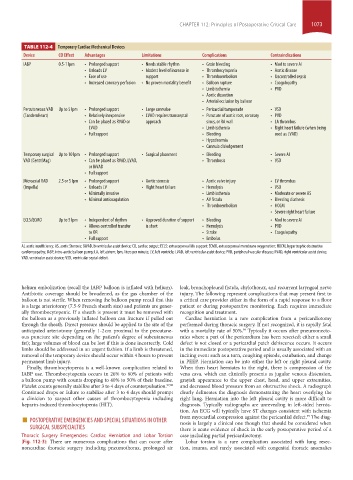
                      TABLE 112-4    Temporary Cardiac Mechanical Devices
                    Device      CO Effect  Advantages        Limitations         Complications          Contraindications
                    IABP        0.5-1 lpm  •  Prolonged support  •  Needs stable rhythm  •  Groin bleeding  •  Mod to severe AI
                                         •  Unloads LV       •  Modest level of increase in   •  Thrombocytopenia  •  Aortic disease
                                         •  Ease of use       support            •  Thromboembolism     •  Uncontrolled sepsis
                                         •  Increased coronary perfusion  •  No proven mortality benefit  •  Balloon rupture  •  Coagulopathy
                                                                                 •  Limb ischemia       •  PVD
                                                                                 •  Aortic dissection
                                                                                 •  Arterial occlusion by balloon
                    Percutaneous VAD  Up to 5 lpm  •  Prolonged support  •  Large cannulae  •  Pericardial tamponade  •  VSD
                    (TandemHeart)        •  Relatively inexpensive  •  LVAD requires transseptal   •  Puncture of aortic root, coronary   •  PVD
                                         •  Can be placed as RVAD or   approach    sinus, or RA wall    •  LA thrombus
                                          LVAD                                   •  Limb ischemia       •  Right heart failure (when being
                                         •  Full support                         •  Bleeding              used as LVAD)
                                                                                 •  Hypothermia
                                                                                 •  Cannula dislodgement
                    Temporary surgical  Up to 10 lpm •  Prolonged support  •  Surgical placement  •  Bleeding  •  Severe AI
                    VAD (CentriMag)      •  Can be placed as RVAD, LVAD,         •  Thrombosis          •  VSD
                                          or BiVAD
                                         •  Full support
                    Microaxial VAD   2.5 or 5 lpm  •  Prolonged support  •  Aortic stenosis  •  Aortic valve injury  •  LV thrombus
                    (Impella)            •  Unloads LV       •  Right heart failure  •  Hemolysis       •  VSD
                                         •  Minimally invasive                   •  Limb ischemia       •  Moderate or severe AS
                                         •  Minimal anticoagulation              •  AV fistula          •  Bleeding diathesis
                                                                                 •  Thromboembolism     •  HOCM
                                                                                                        •  Severe right heart failure
                    ECLS/ECMO   Up to 5 lpm  •  Independent of rhythm  •  Approved duration of support    •  Bleeding  •  Mod to severe AI
                                         •  Allows controlled transfer   is short  •  Hemolysis         •  PVD
                                          to OR                                  •  Stroke              •  Coagulopathy
                                         •  Full support                         •  Embolus
                    AI, aortic insufficiency; AS, aortic Stenosis; BiVAD, biventricular assist device; CO, cardiac output; ECLS: extracorporeal life support; ECMO, extracorporeal membrane oxygenation; HOCM, hypertrophic obstructive
                    cardiomyopathy; IABP, intra-aortic balloon pump; LA, left atrium; lpm, liters per minute; LV, left ventricle; LVAD, left ventricular assist device; PVD, peripheral vascular disease; RVAD, right ventricular assist device;
                    VAD, ventricular assist device; VSD, ventricular septal defect.


                    helium embolization (recall the IABP balloon is inflated with helium).   leak, bronchopleural fistula, chylothorax, and recurrent laryngeal nerve
                    Antibiotic coverage should be broadened, as the gas chamber of the   injury. The following represent complications that may present first to
                    balloon is not sterile. When removing the balloon pump recall that this   a critical care provider either in the form of a rapid response to a floor
                    is a large arteriotomy (7.5-9 French sheath size) and patients are gener-  patient or during postoperative monitoring. Each requires immediate
                    ally thrombocytopenic. If a sheath is present it must be removed with   recognition and treatment.
                    the balloon as a previously inflated balloon can fracture if pulled out   Cardiac  herniation  is  a  rare  complication  from  a  pericardiotomy
                    through the sheath. Direct pressure should be applied to the site of the   performed during thoracic surgery. If not recognized, it is rapidly fatal
                    anticipated arteriotomy (generally 1-2 cm proximal to the percutane-  with a mortality rate of 50%.  Typically it occurs after pneumonecto-
                                                                                               99
                    ous puncture site depending on the patient’s degree of subcutaneous   mies where a part of the pericardium has been resected; either a small
                    fat); large volumes of blood can be lost if this is done incorrectly. Cold   defect is not closed or a pericardial patch dehiscence occurs. It occurs
                    limbs should be addressed in an urgent fashion. If a limb is threatened,   in the immediate postoperative period and is usually associated with an
                    removal of the temporary device should occur within 4 hours to prevent   inciting event such as a turn, coughing episode, extubation, and change
                    permanent limb injury.                                in PEEP. Herniation can be into either the left or right pleural cavity.
                     Finally, thrombocytopenia is a well-known complication related to   When then heart herniates to the right, there is compression of the
                    IABP use. Thrombocytopenia occurs in 26% to 60% of patients with   vena cava, which can clinically presents as jugular venous distension,
                    a balloon pump with counts dropping to 40% to 50% of their baseline.   grayish appearance to the upper chest, head, and upper extremities,
                    Platelet counts generally stabilize after 3 to 4 days of  counterpulsation. 97,98    and decreased blood pressure from an obstructive shock. A radiograph
                    Continued drops or failure to stabilize after 3 to 4 days should prompt   clearly delineates the diagnosis demonstrating the heart overlying the
                    a clinician to suspect other causes of thrombocytopenia including   right lung. Herniation into the left pleural cavity is more difficult to
                    heparin-induced thrombocytopenia (HIT).               diagnosis. Typically radiographs are unrevealing in left-sided hernia-
                                                                          tion. An ECG will typically have ST changes consistent with ischemia
                        ■  POSTOPERATIVE EMERGENCIES AND SPECIAL SITUATIONS IN OTHER   from myocardial compression against the pericardial defect.  The diag-
                                                                                                                     99
                      SURGICAL SUBSPECIALTIES                             nosis is largely a clinical one though that should be considered when
                                                                          there is acute evidence of shock in the early postoperative period of a
                    Thoracic  Surgery  Emergencies:  Cardiac  Herniation  and  Lobar  Torsion   case including partial pericardiectomy.
                    (Fig.  112-3):  There are numerous complications that can occur after   Lobar torsion is a rare complication associated with lung resec-
                    noncardiac thoracic surgery including pneumothorax, prolonged air   tion, trauma, and rarely associated with congenital thoracic anomalies


            section10.indd   1073                                                                                      1/20/2015   9:19:45 AM

