


Page 1552 - Hall et al (2015) Principles of Critical Care-McGraw-Hill
P. 1552
CHAPTER 112: Principles of Postoperative Critical Care  1071


                    improving oxygenation. It can be associated with impaired platelet func-  present, patients are generally either electrically cardioverted or admin-
                    tion, but is not usually associated with any increased bleeding and lacks   istered transvenous rapid atrial pacing prior to discharge. 87
                    the rebound pulmonary hypertension seen with NO. A newer analog   Complete heart block can be a life-threatening arrhythmia after cardiac
                    of prostacyclin, iloprost, is also available and has also shown success in   surgery. Certain operations lend themselves to this condition as a result
                    post-cardiac surgery.  Its disadvantages involve cost and the require-  of suture placement, ischemia to the conduction system, or myocardial
                                   64
                    ment to break the ventilator circuit every few hours. 65  infarction. Practically speaking the conduction system can be injured with
                                                                          aortic, mitral, or tricuspid valve operations, as well as septal procedures
                        ■  POST-CARDIAC SURGERY ARRHYTHMIAS: ATRIAL FIBRILLATION,   (eg, certain septal defect repairs or septal myectomy).  The site of AV
                                                                                                                 88
                      ATRIAL FLUTTER, AND COMPLETE HEART BLOCK            block can be at the level of the AV node, His bundle, or distal conduc-
                                                                          tion system and determines what ability the affected heart will be able
                    Arrhythmias, especially atrial fibrillation (AF), are a frequent complica-  to generate an adequate junctional escape rhythm. Emergent temporary
                    tion after cardiac surgery. AF will develop in 15% to 40% of postbypass   transvenous pacers may need to be placed by the critical care provider in
                    patients, 37% to 50% of valvular operation patients, up to 60% of com-  patients with advanced second-degree or third-degree heart block.
                    bined valve/CABG patients, and 11% to 24% of heart transplant recipi-
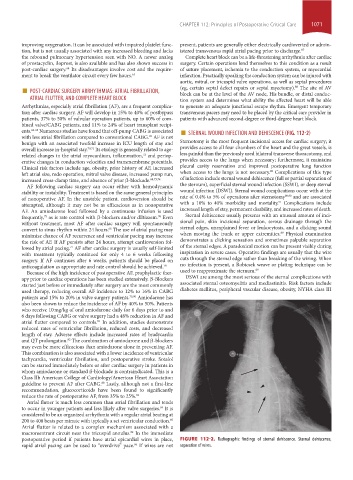
                    ents. 66-68  Numerous studies have found that off-pump CABG is associated     ■  STERNAL WOUND INFECTION AND DEHISCENCE (FiG. 112-2)
                    with less atrial fibrillation compared to conventional CABG.  AF is not
                                                               69
                    benign with an associated twofold increase in ICU length of stay and   Sternotomy is the most frequent incisional access for cardiac surgery; it
                    overall increase in-hospital stay. 70,71  Its etiology is generally related to age-  provides access to all four chambers of the heart and the great vessels, is
                    related changes in the atrial myocardium, inflammation,  and periop-  less painful than the previously used bilateral transverse thoracotomy, and
                                                             72
                    erative changes in conduction velocities and transmembrane potentials.   provides access to the lungs when necessary; furthermore, it maintains
                    Clinical risk factors include age, obesity, prior history of AF, increased   pleural cavity reservation and improved postoperative lung function
                                                                                                        89
                    left atrial size, redo operation, mitral valve disease, increased pump run,   when access to the lungs is not necessary.  Complications of this type
                    increased cross-clamp time, and absence of prior β-blockade. 68,73,74  of infection include sternal wound dehiscence (full or partial separation of
                     AF following cardiac surgery can occur either with hemodynamic   the sternum), superficial sternal wound infection (SSWI), or deep sternal
                    stability or instability. Treatment is based on the same general principles   wound infection (DSWI). Sternal wound complications occur with at the
                    of  nonoperative  AF. In  the unstable  patient, cardioversion should  be   rate of 0.4% to 5% of operations after sternotomy 89,90  and are associated
                                                                                                           91
                    attempted, although it may  not  be as efficacious as in nonoperative   with a 10% to 40% morbidity and mortality.  Complications include
                    AF. An amiodarone load followed by a continuous infusion is used   increased length of stay, permanent disability, and increased rates of death.
                    frequently,  as is rate control with β-blockers and/or diltiazem.  Even   Sternal dehiscence usually presents with an unusual amount of inci-
                                                                  76
                           75
                    without treatment, most AF after cardiac surgery will spontaneously   sional pain, skin incisional separation, serous drainage through the
                    convert to sinus rhythm within 24 hours.  The use of atrial pacing may   sternal edges, unexplained fever or leukocytosis, and a clicking sound
                                                 66
                                                                                                            89
                    minimize chance of AF recurrence and ventricular pacing may increase   when  moving  the  trunk  or  upper  extremities.  Physical examination
                    the risk of AF. If AF persists after 24 hours, attempt cardioversion fol-  demonstrates a clicking sensation and sometimes palpable separation
                    lowed by atrial pacing.  AF after cardiac surgery is usually self-limited   of the sternal edges. A paradoxical motion can be present visibly during
                                    77
                    with treatment typically continued for only 4 to 6 weeks following    inspiration in severe cases. Operative findings are usually that the wire
                    surgery. If AF continues after 6 weeks, patients should be placed on   cuts through the sternal edge rather than breaking of the wiring. When
                    anticoagulation as appropriate and rate control should be achieved. 78  no infection is present, a Robicsek weave or plating technique can be
                     Because of the high incidence of postoperative AF, prophylactic ther-  used to reapproximate the sternum. 89
                    apy prior to cardiac operations has been studied extensively. β-Blockers   DSWI are among the most serious of the sternal complications with
                    started just before or immediately after surgery are the most commonly   associated sternal osteomyelitis and mediastinitis. Risk factors include
                    used therapy, reducing overall AF incidence to 12% to 16% in CABG   diabetes mellitus, peripheral vascular disease, obesity, NYHA class III
                    patients and 15% to 20% in valve surgery patients. 79,80  Amiodarone has
                    also been shown to reduce the incidence of AF by 40% to 50%. Patients
                    who receive 10 mg/kg of oral amiodarone daily for 6 days prior to and
                    6 days following CABG or valve surgery had a 48% reduction in AF and
                    atrial flutter compared to controls.  In addition, studies demonstrate
                                             81
                    reduced rates of ventricular fibrillation, reduced costs, and decreased
                    length  of  stay.  Adverse  effects  include  increased  rates  of  bradycardia
                    and QT prolongation.  The combination of amiodarone and β-blockers
                                   82
                    may even be more efficacious than amiodarone alone in preventing AF.
                    This combination is also associated with a lower incidence of ventricular
                    tachycardia,  ventricular  fibrillation,  and  postoperative  stroke.  Sotalol
                    can be started immediately before or after cardiac surgery in patients in
                    whom amiodarone or standard ß-blockade is contraindicated. This is a
                    Class IIb American College of Cardiology/American Heart Association
                    guideline to prevent AF after CABG.  Lastly, although not a first-line
                                               80
                    recommendation, glucocorticoids have been found to significantly
                    reduce the rate of postoperative AF, from 35% to 25%. 83
                     Atrial flutter is much less common than atrial fibrillation and tends
                    to occur in younger patients and less likely after valve surgeries.  It is
                                                                   84
                    considered to be an organized arrhythmia with a regular atrial beating at
                    200 to 400 beats per minute with typically a set ventricular conduction.
                                                                      85
                    Atrial flutter is related to a complex mechanism associated with a
                    macroreentrant circuit near the tricuspid annulus.  In the immediate
                                                         84
                    postoperative period if patients have atrial epicardial wires in place,   FIGURE 112-2.  Radiographic findings of sternal dehiscence. Sternal dehiscence,
                    rapid atrial pacing can be used to “overdrive” pace.  If wires are not     separation of wires.
                                                          86


            section10.indd   1071                                                                                      1/20/2015   9:19:44 AM

