


Page 1549 - Hall et al (2015) Principles of Critical Care-McGraw-Hill
P. 1549
1068     PART 10: The Surgical Patient


                 pleural cavities, and electrical anatomy of the heart are mandatory in   pneumothoraces. For example, when there is no communication
                 order to be able to recognize when complications occur and how they   between the cavities, postoperative effusions are likely to be transudative
                 may be a technical or functional complication of the surgery.  and can be managed medically rather than with a pleural tap or drain
                   The  coronary  vessels  are  widely  described  as  three  main  arteries,   that would be required for a bloody postoperative effusion.
                 although there are only two ostia (origins) that come directly off the
                 aorta. There are three sinuses of Valsalva that protrude just above the     ■  BASIC OPERATIVE TERMINOLOGY
                 aortic valve to the level of the sinotubular junction (STJ). The left coro-
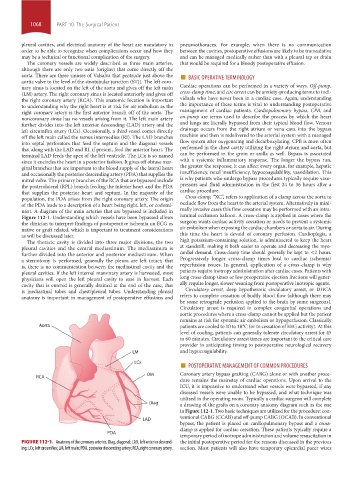
                 nary sinus is located on the left of the aorta and gives off the left main   Cardiac operations can be performed in a variety of ways. Off-pump,
                 (LM) artery. The right coronary sinus is located anteriorly and gives off   cross-clamp time, and circ arrest can be anxiety-producing terms to indi-
                 the right coronary artery (RCA). This anatomic location is important   viduals who have never been in a cardiac case. Again, understanding
                 to understanding why the right heart is at risk for air embolism as the   the importance of these terms is vital to understanding postoperative
                 right coronary artery is the first anterior branch off of the aorta. The   management of cardiac patients.  Cardiopulmonary bypass,  CPB, and
                 noncoronary sinus has no vessels arising from it. The left main artery   on-pump are terms used to describe the process by which the heart
                 further divides into the left anterior descending (LAD) artery and the   and lungs are literally bypassed from their typical blood flow. Venous
                 left circumflex artery (LCx). Occasionally, a third vessel comes directly   drainage  occurs  from  the  right  atrium  or  vena  cava  into  the  bypass
                 off the left main called the ramus intermedius (RI). The LAD branches   machine and then is redelivered to the arterial system with a managed
                 into septal perforators that feed the septum and the diagonal vessels   flow system after oxygenating and decarboxylating. CPB is most often
                 that along with the LAD and RI, if present, feed the anterior heart. The   performed in the chest cavity utilizing the right atrium and aorta, but
                 terminal LAD feeds the apex of the left ventricle. The LCx is so named   can be performed in the groin or axilla as well. Bypass is associated
                 since it encircles the heart in a posterior fashion. It gives off obtuse mar-  with a systemic inflammatory response. The longer the bypass run,
                 ginal branches that are important to the blood supply of the lateral heart   the greater the response; it can affect every organ, for example, hepatic
                 and occasionally the posterior descending artery (PDA) that supplies the   insufficiency, renal insufficiency, hypocoagulability, vasodilation. This
                 mitral valve. The primary branches of the RCA that are bypassed include   is why patients who undergo bypass procedures typically require vaso-
                 the posterolateral (RPL) branch feeding the inferior heart and the PDA   pressors  and  fluid  administration  in  the  first  24  to  36  hours  after  a
                 that supplies the posterior heart and septum. In the majority of the   cardiac procedure.
                 population, the PDA arises from the right coronary artery. The origin   Cross-clamp, “XC”, refers to application of a clamp across the aorta to
                 of the PDA leads to a description of a heart being right, left, or codomi-  occlude flow from the heart to the arterial system. Alternatively in mini-
                 nant. A diagram of the main arteries that are bypassed is included in     mally invasive cases this flow cessation may be performed with an intra-
                 Figure 112-1. Understanding which vessels have been bypassed allows   luminal occlusion balloon. A cross-clamp is applied in cases where the
                 the clinician to interpret findings of postoperative ischemia on ECG as   surgeon wants cardiac activity cessation or needs to prevent a systemic
                 native or graft related, which is important to treatment considerations   air embolism when exposing the cardiac chambers or aorta to air. During
                 as will be discussed later.                           this time the heart is devoid of coronary perfusion. Cardioplegia, a
                   The thoracic cavity is divided into three major divisions, the two   high potassium-containing solution, is administered to keep the heart
                 pleural cavities and the central mediastinum. The mediastinum is     at standstill, making it both easier to operate and decreasing the myo-
                 further divided into the anterior and posterior mediastinum. When   cardial demand. Cross-clamp time should generally be kept to  <2 hours.
                 a sternotomy is performed, generally the pleura are left intact; that    Progressively longer cross-clamp times lead to cardiac ischemia/
                 is, there is no communication between the mediastinal cavity and the   reperfusion issues. In general, application of a cross-clamp is why
                 pleural cavities. If the left internal mammary artery is harvested, most   patients require inotropy administration after cardiac cases. Patients with
                 physicians will open the left pleural cavity to ease in harvest. Each   long cross-clamp times or low preoperative ejection fractions will gener-
                 cavity that is entered is generally drained at the end of the case, that   ally require longer, slower weaning from postoperative inotropic agents.
                 is mediastinal tubes and chest/pleural tubes. Understanding pleural   Circulatory arrest, deep  hypothermic circulatory arrest, or DHCA
                 anatomy is important in management of postoperative effusions and   refers to complete cessation of bodily blood flow (although there may
                                                                       be some retrograde perfusion applied to the brain by some surgeons).
                                                                       Circulatory arrest is required in complex congenital operations and
                                                                       aortic procedures where a cross-clamp cannot be applied but the patient
                                                                       remains at risk for systemic air embolism or hypoperfusion. Classically
                       Aorta                                           patients are cooled to 10 to 18°C (or to cessation of EEG activity). At this
                                                                       level of cooling, patients can generally tolerate circulatory arrest for 45
                                                                       to 60 minutes. Circulatory arrest times are important to the critical care
                                                                       provider in anticipating timing to postoperative neurological recovery
                                                       LM              and hypocoagulability.
                                                                           ■
                                                        LCx               POSTOPERATIVE MANAGEMENT OF COMMON PROCEDURES

                                                            OM         Coronary artery bypass grafting (CABG) alone or with another proce-
                      RCA
                                                                       dure remains the mainstay of cardiac operations. Upon arrival to the
                                                                       ICU, it is imperative to understand what vessels were bypassed, if any
                                                                       diseased vessels were unable to be bypassed, and what technique was
                                                                       utilized in the operating room. Typically a cardiac surgeon will complete
                                                             Diag      a drawing of the grafts on a coronary anatomy diagram such as the one
                                                                       in Figure 112-1. Two basic techniques are utilized for the procedure: con-
                                                                       ventional CABG (CCAB) and off-pump CABG (OCAB). In conventional
                                                          LAD
                                                                       bypass, the patient is placed on cardiopulmonary bypass and a cross-
                                                                       clamp is applied for cardiac cessation. These patients typically require a
                                              PDA
                                                                       temporary period of inotrope administration and volume resuscitation in
                 FIGURE 112-1.  Anatomy of the coronary arteries. Diag, diagonal; LAD, left anterior descend-  the initial postoperative period for the reasons discussed in the previous
                 ing; LCx, left circumflex; LM, left main; PDA, posterior descending artery; RCA, right coronary artery.  section. Most patients will also have temporary epicardial pacer wires


            section10.indd   1068                                                                                      1/20/2015   9:19:43 AM

