


Page 1573 - Hall et al (2015) Principles of Critical Care-McGraw-Hill
P. 1573
1092     PART 10: The Surgical Patient


                                    100
                                                                      HALF-LIFE Alfa-1: 6.2 Years; CF: 7.5 Years; COPD: 5.3 Years;
                                                                      IPF: 4.4 Years; IPAH: 5.0 Years; Sarcoidosis: 5.3 Years
                                     80

                                    Survival (%)  60  Sarcoidosis (N = 849)


                                     40
                                             IPAH (N = 1,308)
                                             IPF (N = 7,540)
                                     20      COPD (N = 11,948)
                                             CF (N = 5,608)
                                             Alfa-1 (N = 2,490)
                                      0
                                       0    1   2    3    4   5    6    7   8    9   10   11   12  13   14
                                                                      Years
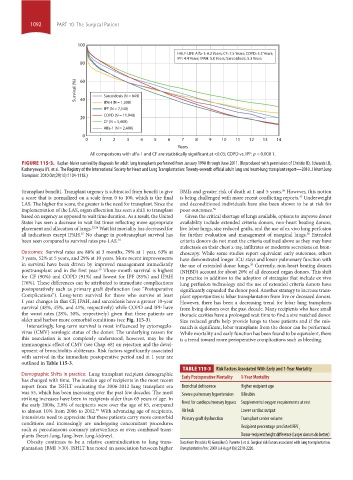
                                         All comparisons with alfa-1 and CF are statistically significant at <0.05; COPD vs. IPF: p < 0.000 1.
                 FIGURE 115-3.  Kaplan-Meier survival by diagnosis for adult lung transplants performed from January 1990 through June 2011. (Reproduced with permission of Christie JD, Edwards LB,
                 Kucheryavaya AY, et al. The Registry of the International Society for Heart and Lung Transplantation: Twenty-seventh official adult lung and heart-lung transplant report—2010. J Heart Lung
                 Transplant. 2010 Oct;29(10):1104-1118.)

                 (transplant benefit). Transplant urgency is subtracted from benefit to give   BMIs and greater risk of death at 1 and 5 years.  However, this notion
                                                                                                          36
                 a score that is normalized on a scale from 0 to 100, which is the final   is being challenged with more recent conflicting reports.  Underweight
                                                                                                                37
                 LAS. The higher the score, the greater is the need for transplant. Since the   and deconditioned individuals have also been shown to be at risk for
                 implementation of the LAS, organ allocation has seen a shift to transplant   poor outcomes. 36
                 based on urgency as opposed to wait time duration. As a result, the United   Given the critical shortage of lungs available, options to improve donor
                 States has seen a decrease in wait list times reflecting more appropriate   availability include extended criteria donors, non-heart beating donors,
                 placement and allocation of lungs. 33,34  Wait list mortality has decreased for   live lobar lungs, size reduced grafts, and the use of ex vivo lung perfusion
                 all indications except IPAH.  No change in posttransplant survival has   for further evaluation and management of marginal lungs.  Extended
                                     35
                                                                                                                  38
                 been seen compared to survival rates pre-LAS. 34      criteria donors do not meet the criteria outlined above as they may have
                                                                       atelectasis on their chest x-ray, infiltrates or moderate secretions on bron-
                 Outcomes:  Survival rates are 88% at 3 months, 79% at 1 year, 63% at     choscopy. While some studies report equivalent early outcomes, others
                 3 years, 52% at 5 years, and 29% at 10 years. More recent improvements   have demonstrated longer ICU stays and lower pulmonary function with
                 in survival have been driven by improved management immediately   the use of extended donor lungs.  Currently, non-heart beating donors
                                                                                               39
                                           29
                 posttransplant and in the first year.  Three-month survival is highest   (NHBD) account for about 20% of all deceased organ donors. This shift
                 for CF (90%) and COPD (91%) and lowest for IPF (85%) and IPAH   in practice in addition to the adoption of strategies that include ex vivo
                 (76%). These differences can be attributed to immediate complications   lung perfusion technology and the use of extended criteria donors have
                 postoperatively such as primary graft dysfunction (see “Postoperative   significantly expanded the donor pool. Another strategy to increase trans-
                 Complications”). Long-term survival for those who survive at least    plant opportunities is lobar transplantation from live or deceased donors.
                 1 year changes in that CF, IPAH, and sarcoidosis have a greater 10-year   However, there has been a decreasing trend for lobar lung transplants
                 survival (48%, 45%, and 41%, respectively) while COPD and IPF have   from living donors over the past decade. Many recipients who have small
                 the worst rates (28%, 30%, respectively) given that these patients are   thoracic cavities have a prolonged wait time to find a size matched donor.
                 older and harbor more comorbid conditions (see Fig. 115-3).  Size reduced grafts help provide lungs to these patients and if the mis-
                   Interestingly, long-term survival is most influenced by cytomegalo-  match is significant, lobar transplants from the donor can be performed.
                 virus (CMV) serologic status of the donor. The underlying reason for   While mortality and early function has been found to be equivalent, there
                 this association is not completely understood, however, may be the   is a trend toward more perioperative complications such as bleeding.
                 immunogenic effect of CMV (see Chap. 68) on rejection and the devel-
                 opment of bronchiolitis obliterans. Risk factors significantly associated
                 with survival in the immediate postoperative period and at 1 year are
                 outlined in Table 115-3.
                                                                         TABLE 115-3    Risk Factors Associated With Early and 1-Year Mortality
                 Demographic Shifts in practice:  Lung transplant recipient demographic
                 has changed with time. The median age of recipients in the most recent   Early Postoperative Mortality  1-Year Mortality
                 report from the ISHLT evaluating the 2006-2012 lung transplant era   Bronchial dehiscence  Higher recipient age
                 was 55, which has been increasing over the past few decades. The most   Severe pulmonary hypertension  Bilirubin
                 striking increases have been in recipients older than 65 years of age. In
                 the early 2000s, 2.8% of recipients were over the age of 65, compared   Need for cardiopulmonary bypass Supplemental oxygen requirements at rest
                 to almost 10% from 2006 to 2012.  With advancing age of recipients,   Air leak  Lower cardiac output
                                           30
                 intensivists need to appreciate that these patients carry more comorbid   Primary graft dysfunction  Transplant center volume
                 conditions and increasingly are undergoing concomitant procedures
                 such as percutaneous coronary interventions or even combined trans-        Recipient percentage predicted FEV 1
                 plants (heart-lung, lung-liver, lung-kidney).                              Donor-recipient height difference (larger donors do better)
                   Obesity continues to be a relative contraindication to lung trans-  Data from Paradela M, González D, Parente I, et al. Surgical risk factors associated with lung transplantation.
                 plantation (BMI >30). ISHLT has noted an association between higher   Transplantation Proc. 2009 Jul-Aug;41(6):2218-2220.


            section10.indd   1092                                                                                      1/20/2015   9:19:54 AM

