


Page 1586 - Hall et al (2015) Principles of Critical Care-McGraw-Hill
P. 1586
CHAPTER 115: The Transplant Patient  1105


                    patients, classic symptoms of infection are often blunted, causing them to     TABLE 115-17     Approach to Bilateral Airspace Disease and Altered Level
                    present at a later time when the infectious process is more disseminated.   of Consciousness in a Transplant Recipient
                    Furthermore, alternative causes of fever such as rejection can obscure
                    the clinical picture leading to empiric and recurrent antimicrobial use   Bilateral Airspace Disease  Decreased Level of Consciousness
                    when none may be warranted, and the frequent use of broad-spectrum   Bacterial pneumonia  Bacterial meningitis (including Listeria)
                    antimicrobials may lead to the development of resistant organisms.   a                             b
                    Multiple drug interactions exist between certain antimicrobials and   Viral/atypical/fungal/PJP  pneumonia  Viral meningitis (including JC  virus,
                                                                                                         c
                    immunosuppressive therapies. Knowledge of these potential interactions             HSV )
                    is imperative to prevent potential adverse side effects that could arise. The   Drug-induced hypersensitivity reaction (sirolimus) Fungal meningitis (including
                    side effects of immunosuppressive agents can sometimes be mistaken                 Cryptococcus neoformans)
                    for infectious processes such as the drug-induced pneumonitis due to   Pulmonary edema secondary to left ventricular   Calcineurin inhibitors
                    sirolimus, which can often present like community-acquired pneumonia.     failure
                    Table 115-17  outlines  the  differential  for  common  conditions  in  the
                    immunosuppressed population and the infections and noninfectious   Noncardiogenic pulmonary edema (ARDS due to   Central nervous system lymphoma
                                                                          local infectious or distal infections etiologies)
                    processes that should be considered in a transplant recipient.
                     In the initial post-operative phase, patients are particularly suscep-            Metabolic s/e immunosuppression (renal
                    tible  to  nosocomial  bacterial  and,  less  commonly,  fungal  infections.       failure, hyperosmotic nonketotic acidosis)
                    With time, the effects of sustained immunosuppression are seen with                Hyperammonemia
                    greater risk for opportunistic infections. This risk may be augmented   a Pneumocystis jiroveci pneumonia.
                    in patients who have had a more complicated post-operative course,   b
                    punctuated by episodes of acute rejection necessitating intensification   Papovavirus.
                    of their immunosuppression. In addition, modification in duration of   c Herpes simplex virus.
                    prophylaxis may simply defer infection to later in the patient’s course
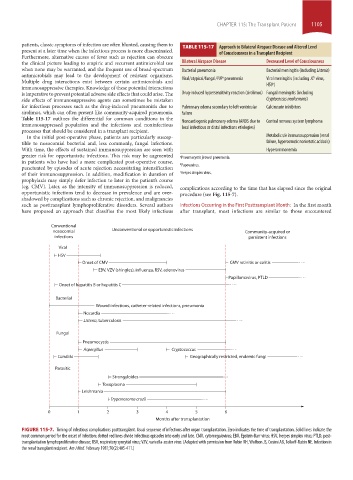
                    (eg,  CMV).  Later,  as  the  intensity  of  immunosuppression  is  reduced,   complications according to the time that has elapsed since the original
                    opportunistic infections tend to decrease in prevalence and are over-  procedure (see Fig. 115-7).
                    shadowed by complications such as chronic rejection, and malignancies
                    such as posttransplant lymphoproliferative disorders. Several authors   Infections Occurring in the First Posttransplant Month:  In the first month
                    have proposed an approach that classifies the most likely infectious   after transplant, most infections are similar to those encountered

                              Conventional
                              nosocomial          Unconventional or opportunistic infections    Community-acquired or
                               infections                                                        persistent infections

                                Viral
                                HSV
                                        Onset of CMV                                       CMV retinitis or colitis
                                              EBV, VZV (shingles), influenza, RSV, adenovirus
                                                                                          Papillomavirus, PTLD
                                Onset of hepatitis B or hepatitis C

                               Bacterial
                                             Wound infections, catheter-related infections, pneumonia
                                         Nocardia
                                         Listeria, tuberculosis

                               Fungal
                                        Pneumocystis
                                         Aspergillus                   Cryptococcus
                                Candida                                      Geographically restricted, endemic fungi
                               Parasitic
                                                   Strongyloides
                                               Toxoplasma
                                        Leishmania
                                                  Trypanosoma cruzii

                             0         1         2         3         4         5         6
                                                                 Months after transplantation
                    FIGURE 115-7.  Timing of infectious complications posttransplant. Usual sequence of infections after organ transplantation. Zero indicates the time of transplantation. Solid lines indicate the
                    most common period for the onset of infection; dotted red lines divide infectious episodes into early and late. CMV, cytomegalovirus; EBV, Epstein-Barr virus; HSV, herpes simplex virus; PTLD, post-
                    transplantation lymphoproliferative disease; RSV, respiratory syncytial virus; VZV, varicella-zoster virus. (Adapted with permission from Rubin RH, Wolfson JS, Cosimi AB, Tolkoff-Rubin NE. Infection in
                    the renal transplant recipient. Am J Med. February 1981;70(2):405-411.)


            section10.indd   1105                                                                                      1/20/2015   9:20:01 AM

