


Page 1581 - Hall et al (2015) Principles of Critical Care-McGraw-Hill
P. 1581
1100     PART 10: The Surgical Patient


                   TABLE 115-13    Postoperative Management of Liver Transplant Recipients  Calcineurin Inhibitors  Multiple trials have attempted to delineate which
                                                                       calcineurin inhibitor (tacrolimus or cyclosporine) is superior for the
                  Postoperative assessment of graft  Serial measurements of INR, lactate, total bilirubin,   liver transplant population. After multiple meta-analysis and systemic
                  function            glucose to assess function; transaminases  reviews, both are felt to be very effective. In one trial, tacrolimus was
                  Ventilation         Lung-protective ventilator management  superior with regard to preventing acute rejection, steroid resistant
                                      Consideration for early extubation a  rejection, and graft loss; however, diabetes was more commonly seen. 88,89
                                                                       The issue surrounding the use of calcineurin inhibitors in the setting
                  Fluid and hemodynamics  Cautious fluid administration  of renal failure is especially challenging as sicker patients are being
                                      Maintain low central venous pressure   prioritized based on their renal function. A strategy of low-dose tacroli-
                                      Hyperdynamic circulation may persist postoperatively  mus or delayed low-dose tacrolimus has been found in some studies to
                                                                       minimize renal injury.  Ongoing research is exploring the added benefit
                                                                                       90
                                      Monitor for evidence of bleeding
                                                                       of cyclosporine in HCV patients as it has been shown to inhibit HCV
                  Immunosuppressive medications  Maintenance: triple drug therapy with a calcineurin   replication in vitro. 91
                                      inhibitor, an antiproliferative, and a corticosteroid
                                                                       Sirolimus (Rapamycin)  While problems have been expressed with wound
                  Antimicrobial prophylaxis  See Infectious Disease section  healing in a variety of different solid organ transplants, in the liver
                 a Ongoing clinical trials.                            transplant population sirolimus has been associated with lower rates
                                                                                                           92
                                                                       of hepatocellular carcinoma posttransplantation.  Ongoing prospec-
                                                                       tive studies are attempting to further elucidate the interaction between
                                                                       hepatocellular carcinoma growth and sirolimus.
                 may benefit from insertion of a pulmonary artery catheter to assist with
                 the management of the portopulmonary hypertension and cardiac dys-    ■  POSTOPERATIVE COMPLICATIONS
                 function that is often present (Table 115-13).
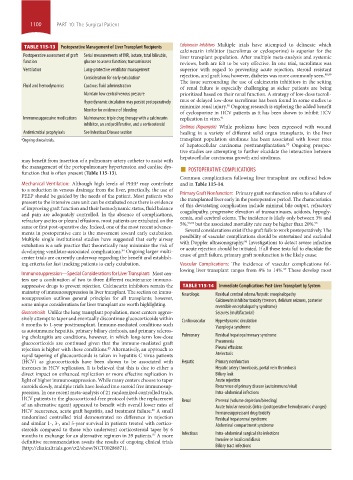
                                                                       Common complications following liver transplant are outlined below
                 Mechanical Ventilation:  Although high levels of PEEP may contribute   and in Table 115-14.
                 to a reduction in venous drainage from the liver, practically, the use of
                 PEEP should be guided by the needs of the patient. Most patients who   Primary Graft Nonfunction:  Primary graft nonfunction refers to a failure of
                 present to the intensive care unit can be extubated once there is evidence   the transplanted liver early in the postoperative period. The characteristics
                 of improving graft function and their hemodynamic status, fluid balance   of this devastating complication include minimal bile output, refractory
                 and pain are adequately controlled. In the absence of complications,   coagulopathy, progressive elevation of transaminases, acidosis, hypogly-
                 refractory ascites or pleural effusions, most patients are extubated on the   cemia, and cerebral edema. The incidence is likely only between 3% and
                                                                          93,94
                                                                                                                     95
                 same or first post-operative day. Indeed, one of the most recent advance-  5%,   but the associated mortality rate may be higher than 20%.
                 ments in postoperative care is the movement toward early extubation.   Several considerations exist if the graft fails to work postoperatively. The
                 Multiple  single  institutional  studies  have  suggested  that  early  airway   possibility of vascular complications should be entertained and excluded
                                                                                             96
                 extubation is a safe practice that theoretically may minimize the risk of   with Doppler ultrasonography.  Investigations to detect severe infection
                 developing ventilator-associated complications.  Ongoing larger multi-  or acute rejection should be initiated. If all these tests fail to elucidate the
                                                   84
                 center trials are currently underway regarding the benefit and establish-  cause of graft failure, primary graft nonfunction is the likely cause.
                 ing criteria for fast tracking patients to early extubation.  Vascular Complications:  The  incidence  of  vascular  complications  fol-
                                                                       lowing liver transplant ranges from 8% to 14%.  These develop most
                                                                                                          97
                 Immunosuppression—Special Considerations for Liver Transplant:  Most cen-
                 ters use a combination of two to three different maintenance immuno-
                 suppressive drugs to prevent rejection. Calcineurin inhibitors remain the     TABLE 115-14    immediate Complications Post-Liver Transplant by System
                 mainstay of immunosuppression in liver transplant. The section on immu-  Neurologic  Residual cerebral edema/hepatic encephalopathy
                 nosuppression outlines general principles for all transplants; however,   Calcineurin inhibitor toxicity (tremors, delirium seizures, posterior
                 some unique considerations for liver transplant are worth highlighting.  reversible encephalopathy syndrome)
                 Glucocorticoids  Unlike the lung transplant population, most centers aggres-  Seizures (multifactorial)
                 sively attempt to taper and eventually discontinue glucocorticoids within   Cardiovascular  Hyperdynamic circulation
                 6 months to 1-year posttransplant. Immune-mediated conditions such   Vasoplegia syndrome
                 as autoimmune hepatitis, primary biliary cirrhosis, and primary scleros-
                 ing cholangitis are conditions, however, in which long-term low-dose   Pulmonary  Residual hepatopulmonary syndrome
                 glucocorticoids  are  continued  given  that  the  immune-mediated  graft   Pneumonia
                 rejection is higher with these conditions.  Alternatively, an approach to   Pleural effusions
                                               85
                 rapid tapering of glucocorticoids is taken in hepatitis C virus patients   Atelectasis
                 (HCV) as glucocorticoids have been shown to be associated with   Hepatic  Primary nonfunction
                 increases in HCV replication. It is believed that this is due to either a   Hepatic artery thrombosis, portal vein thrombosis
                 direct impact on enhanced replication or more effective replication in   Biliary leak
                 light of higher immunosuppression. While many centers choose to taper   Acute rejection
                 steroids slowly, multiple trials have looked into steroid free immunosup-  Recurrence of primary disease (autoimmune/viral)
                 pression. In one recent meta-analysis of 21 randomized controlled trials,   Intra-abdominal infections
                 HCV patients in the glucocorticoid-free protocol (with the replacement   Renal  Prerenal (volume depletion/bleeding)
                 of an alternative agent) appeared to benefit with overall lower rates of   Acute tubular necrosis (intra-/postoperative hemodynamic changes)
                 HCV recurrence, acute graft hepatitis, and treatment failure.  A small   Immunosuppressant drug toxicity
                                                              86
                 randomized controlled trial demonstrated no difference in rejection   Residual hepatorenal syndrome
                 and similar 1-, 3-, and 5-year survival in patients treated with cortico-  Abdominal compartment syndrome
                 steroids compared to those who underwent corticosteroid taper by 6
                 months in exchange for an alternative regimen in 39 patients.  A more   Infectious  Intra-abdominal surgical site infections
                                                              87
                 definitive recommendation awaits the results of ongoing clinical trials     Invasive or local candidiasis
                 (http://clinicaltrials.gov/ct2/show/NCT00286871).                 Biliary tract infections


            section10.indd   1100                                                                                      1/20/2015   9:19:57 AM

