


Page 1582 - Hall et al (2015) Principles of Critical Care-McGraw-Hill
P. 1582
CHAPTER 115: The Transplant Patient  1101


                    commonly on the first postoperative day, but may occur up to several   After the biliary tree and vascular structures have been imaged using
                    weeks following surgery.  Thrombosis is the most common early   ultrasonography, a liver biopsy will help confirm the diagnosis of acute
                                      96
                    complication, with stenosis and pseudoaneurysm formation generally   rejection. As is the case in any solid-organ transplant recipient, treat-
                    developing later in the patient’s course. Hepatic artery thrombosis is the   ment of acute rejection should be aggressive and must be instituted
                    second most significant cause of liver graft failure after primary non-  promptly. For liver transplant recipients, therapy usually involves anti-
                    function in the immediate posttransplant period. The presentation of   thymocyte globulin and increased or pulsed doses of methylpredniso-
                    hepatic artery thrombosis has been associated with hepatic artery recon-  lone. Fortunately, with the advent of more potent immunosuppressive
                    struction with an interposition graft to the supraceliac aorta.  There   agents, acute rejection has decreased in incidence but still affects 15% to
                                                                 98
                    may also be an increased risk of hepatic artery thrombosis with the use   25% of liver transplant patients. 102
                    of sirolimus.  The clinical picture of this complication can vary from the   Chronic rejection can occur months to years after transplant. Chronic
                            99
                    asymptomatic rise in liver enzymes to fulminant hepatic failure. Urgent   rejection of the liver presents clinically as progressive cholestasis and
                    laparotomy and revision of the hepatic artery anastomosis is required if   histologically with mononuclear infiltration of the allograft, vascular
                    this complication develops, and unfortunately retransplantation is often   abnormalities, and fibrosis. These findings are most commonly seen as
                    necessary if hepatic necrosis has occurred.           part of the vanishing-bile-duct syndrome; treatment is often unsuccess-
                     Portal vein thrombosis develops less frequently and may present   ful and may require retransplantation.
                    more insidiously. Ascites may be seen to develop or worsen, and variceal   Primary Disease Recurrence:  Recurrence of the primary disease is not
                    bleeding (usually from preexisting varices) may ensue. Thrombectomy   uncommon posttransplant. Autoimmune diseases, hepatitis C, and
                    and anastomotic revision can be successful if this complication is diag-  hepatocellular carcinoma can recur posttransplantation. Reactivation
                    nosed early.
                                                                          HBV or HCV infection in the recipient and resultant allograft infection
                    Biliary Leaks:  Biliary complications occur in approximately 15% of   remains a major challenge. For HBV, most patients receive a combina-
                    patients following orthotopic liver transplantation.  Of these, bile leak is   tion  of  pretransplant  antiviral  therapy  followed  by  hepatitis  B  immu-
                                                       100
                    the most common early complication. Symptoms are nonspecific, and can   noglobulin (HBIg) and an antiviral to suppress replication of the virus
                    include fever, abdominal discomfort, and signs of peritoneal irritation.     in the postoperative setting. These therapies are generally continued
                    Though ultrasound may demonstrate an intra-abdominal fluid collec-  indefinitely, and have resulted in allograft and patient survival rates sim-
                                                                                                            103
                    tion, cholangiography will provide a definitive diagnosis. Endoscopic   ilar to those of patients not infected with HBV.  Combination therapy
                    insertion of biliary stents can sometimes provide satisfactory results,   has reduced the recurrence of HBV to less than 10% with a significant
                                                                                                          104
                    but surgical repair of the leak may be required. The risk of biliary leak   improvement in patient and graft survival.  Transplantation of an
                    depends on the type of reconstruction with duct-to-duct anastomosis felt   HCV patient with a new graft is likely to become reinfected with HCV
                    to have a slightly less risk given that there is preservation of the sphincter   given that effective antiviral therapies are lacking. These patients in
                                                                                                                            105
                    of Oddi to prevent reflux of contents into the bile duct. Hepatic artery   turn have been shown to have poorer graft and patient survival rates.
                    thrombosis, prolonged cold and warm ischemic times, CMV infection,   Recipient outcomes will depend on whether it is a newly acquired viral
                    primary sclerosing cholangitis, ABO mismatch, and donation after     strain, whether it is a reactivation of their previous strain, and if there is
                    cardiac death are other risk factors for the development of biliary leak.  evidence of immunity and the previous response to antiviral therapy. 106
                     Biliary strictures and stones typically appear later in the postopera-  Hepatocellular carcinoma recurrence was especially common with
                    tive period. Obstructions usually can be managed endoscopically  or   poorly differentiated tumors; however, with better patient selection
                                                                    101
                    through the use of interventional radiology techniques, but surgical   criteria, those patients with hepatocellular carcinoma undergoing trans-
                    correction is sometimes necessary. Strictures typically develop at the   plant have a better prognosis and lower risk of recurrent disease.
                    anastomotic site, and are likely the result of local ischemia. These may   Renal Dysfunction:  Following the liver transplant procedure, renal
                    present as cholestasis or possibly as overt cholangitis. Balloon dilation of   dysfunction is frequently observed, and postoperative renal failure
                    the stricture with or without stent placement usually is successful treat-  can be severe enough to require renal replacement therapy in 13%
                    ment, but surgical revision and even retransplantation may be required.  of patients.  Kidney function generally improves and only 5% of
                                                                                  107
                    Rejection:  Rejection of the hepatic allograft is usually not seen until about 1   patients require chronic hemodialysis following liver transplant. 108
                    to 2 weeks following the procedure, and most often manifests as fever, right   The most common precipitant is intravascular volume depletion
                    upper quadrant pain, and reduced bile pigment and volume. However, the   resulting in prerenal azotemia. Intraoperative hypotension, low cardiac
                    most sensitive marker of early rejection is a rise in serum transaminase   output syndromes, immunosuppressive therapies, sepsis, abdominal
                    (AST/ALT) levels and bilirubin. A rise in total white blood count may also   compartment syndrome, and contrast-induced nephropathies can also
                    develop. Liver biopsy remains the gold standard for the diagnosis of rejec-  contribute to renal injury posttransplant. Hepatorenal syndrome is a
                    tion. The most important consideration when elevation of these serum   reversible  cause of renal failure that arises  in patients  with advanced
                    enzymes occurs early in the postoperative course is the exclusion of one of   cirrhosis. Liver transplant can lead to complete renal recovery; however,
                    the various mechanical complications (such as vascular compromise, bili-  the rates are variable.
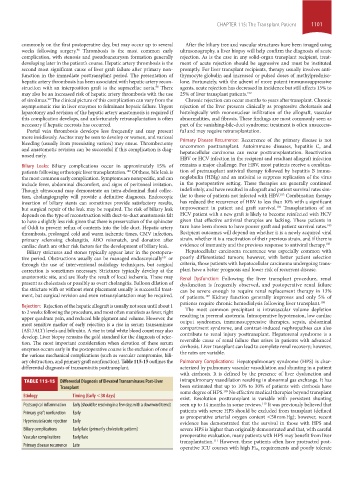
                    ary obstruction, and primary graft nonfunction). Table 115-15 outlines the   Pulmonary Complications:  Hepatopulmonary syndrome (HPS) is char-
                    differential diagnosis of transaminitis posttransplant.  acterized by pulmonary vascular vasodilation and shunting in a patient
                                                                          with cirrhosis. It is defined by the presence of liver dysfunction and
                      TABLE 115-15     Differential Diagnosis of Elevated Transaminases Post-Liver   intrapulmonary vasodilation resulting in abnormal gas exchange. It has
                                 Transplant                               been estimated that up to 10% to 30% of patients with cirrhosis have
                                                                          some degree of HPS.  No effective medical therapies beyond transplant
                                                                                        109
                    Etiology         Timing (Early <30 days)
                                                                          exist. Resolution posttransplant is variable with persistent shunting
                    Postsurgical inflammation  Early (should be resolving in a few days with a downward trend)  seen up to 14 months in some reviews.  It was previously believed that
                                                                                                      110
                    Primary graft nonfunction  Early                      patients with severe HPS should be excluded from transplant (defined
                                                                          as preoperative arterial oxygen content  <50 mm Hg);  however,  recent
                    Hyperacute/acute rejection  Early                     evidence  has  demonstrated  that  the  survival  in  those  with  HPS  and
                    Biliary complications  Early/late (primarily cholestatic pattern)  severe HPS is higher than originally demonstrated and that, with careful
                    Vascular complications  Early/late                    preoperative evaluation, many patients with HPS may benefit from liver
                                                                          transplantation.  However, these patients often have protracted post-
                                                                                     111
                    Primary disease recurrence  Late                                                  requirements and poorly tolerate
                                                                          operative ICU courses with high Fi O 2


            section10.indd   1101                                                                                      1/20/2015   9:19:58 AM

