


Page 1584 - Hall et al (2015) Principles of Critical Care-McGraw-Hill
P. 1584
CHAPTER 115: The Transplant Patient  1103


                    Immunosuppression:  Universal induction therapy for heart transplant   pulmonary hypertension being offered heart transplant, some patients
                    remains controversial. Most centers will implement induction in the   with milder preexisting pulmonary hypertension may experience
                    setting of high acute rejection risk for presensitized patients with anti-  post-operative right heart failure. Right heart failure results because
                    thymocyte polyclonal  antibodies and the  IL-2 receptor antagonists.   the newly transplanted right ventricle (which is accustomed to pump-
                    Similar to lung and liver transplantation, most maintenance regimes   ing against a normal pulmonary vascular resistance) is placed in a
                    include two to three drug combinations of a calcineurin inhibitor, an   circuit  characterized  by  an  increase  in  PVR  and  is  unable  to  over-
                    antiproliferative agent, and corticosteroids.         come the imposed afterload. Tricuspid regurgitation is often present
                     Sirolimus is sometimes used by certain centers in patients with cardiac   following the transplant (especially if the biatrial technique was used),
                    allograft vasculopathy, renal insufficiency, or malignancies given its   and may be exacerbated by an increase in right ventricular afterload.
                    inhibitory effect on smooth muscle proliferation and ability to slow pro-  Through its effects as a pulmonary vasodilator, isoproterenol can
                    gression of malignancy. Sirolimus has been found to be useful to slow   often reduce the right ventricular afterload. However, when sig-
                    disease progression. The high incidence of side effects including poor   nificant postoperative pulmonary hypertension persists, intravenous
                    wound healing has limited its routine use. 118,119    nitroglycerine, nitroprusside, and prostaglandin E1 may be required.
                        ■  POSTOPERATIVE COMPLICATIONS                    Systemic infusion of α-agonists such as norepinephrine or phenylephrine
                                                                          may be needed to support the systemic arterial pressure. Inhaled
                    Primary Heart Graft Failure:  Primary heart graft failure (PHGF) domi-  nitric oxide  is often  used  to  acutely  reduce right  ventricular  after-
                    nates the causes of perioperative or early (<30 day) mortality post-heart   load. By virtue of its mode of delivery, inhaled nitric oxide acts as a
                    transplant, accounting for 20% to 40% of early postoperative deaths.    selective pulmonary vasodilator with minimal systemic effects and
                                                                      120
                                                                                                     122-126
                    PHGF occurs when a mismatch exists between the capabilities of the   reduces intrapulmonary shunting.   More recently, sildenafil,
                    new heart and the demands imposed upon it by its new circulatory   a cyclic guanosine monophosphate (cGMP)–specific phosphodi-
                    environment. It is defined as severe dysfunction of the graft that is char-  esterase type 5 inhibitor has been used with success for persistent
                    acterized by shock, low cardiac output, and high filling pressures in the   pulmonary hypertension, and to prevent rebound after withdrawal
                                                                                     127
                    absence of secondary causes such as hyperacute rejection, pulmonary   of inhaled NO.  Owing to the expense associated with the use of
                    hypertension, or surgical complications. 121          inhaled NO, other inhaled therapies have been evaluated (NO donors
                                                                          and prostaglandin analogues) and appear to be of equal benefit. 128-130
                    Right Ventricular Failure and Pulmonary Hypertension:  Although pre-  However, the half-lives of these medications mandate repeated
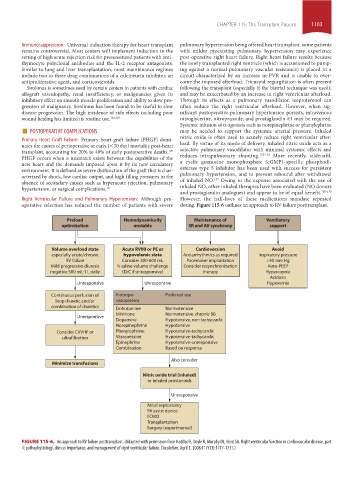
                    operative selection has reduced the number of patients with severe   dosing. Figure 115-6 outlines an approach to RV failure posttransplant.

                                   Preload            Hemodynamically         Maintenance of           Ventilatory
                                 optimization             unstable          SR and AV synchrony         support


                              Volume overload state   Acute RVMI or PE or      Cardioversion             Avoid
                              especially acute/chronic  hypovolemic state  Antiarrhythmics as required  Inspiratory pressure
                                   RV failure         Consider 300-600 mL   Pacemaker implantation     >30 mm Hg
                              Mild progressive diuresis  N saline volume challenge  Consider resynchronization  Auto-PEEP
                             negative 500 mL-1 L daily  (D/C if unresponsive)    therapy               Hypercapnia
                                                                                                        Acidosis
                                       Unresponsive          Unresponsive                              Hypoxemia

                              Continuous perfusion of  Inotrope-     Preferred use
                               loop diuretic and/or  vasopressor
                              combination of diuretics  Dobutamine   Normotensive
                                                    Milrinone        Normotensive, chronic BB
                                       Unresponsive
                                                    Dopamine         Hypotensive, non tachycardic
                                                    Norepinephrine   Hypotensive
                                Consider CVVHF or   Phenylephrine    Hypotensive-tachycardic
                                 ultrafiltration    Vasopressine     Hypotensive-tachycardic
                                                    Epinephrine      Hypotensive-unresponsive
                                                    Combination      Based on response

                                                                       Also consider
                              Minimize transfusions
                                                             Nitric oxide trial (inhaled)
                                                               or inhaled prostanoids

                                                                       Unresponsive
                                                              Atrial septostomy
                                                              RV assist device
                                                              ECMO
                                                              Transplantation
                                                              Surgery (experimental)

                    FIGURE 115-6.  An approach to RV failure posttransplant. (Adapted with permission from Haddad F, Doyle R, Murphy DJ, Hunt SA. Right ventricular function in cardiovascular disease, part
                    II: pathophysiology, clinical importance, and management of right ventricular failure. Circulation. April 1, 2008;117(13):1717-1731.)


            section10.indd   1103                                                                                      1/20/2015   9:19:59 AM

