


Page 1585 - Hall et al (2015) Principles of Critical Care-McGraw-Hill
P. 1585
1104     PART 10: The Surgical Patient


                 Arrhythmia:  Heart transplant is frequently complicated by arrhythmias   cellular and humoral immune response in addition to atherosclerosis.
                 secondary to structural abnormalities at the sinoatrial node, parasympa-  Effective prevention can be achieved with lipid-lowering therapy with
                 thetic and sympathetic denervation posttransplant, and heterogeneous   statins and possibly mTOR inhibitors and diltiazem. Statins have been
                 partial sympathetic reinnervation. The mechanism for arrhythmia is   shown to have a favorable impact on outcome through preventing and
                 secondary to complete cardiac denervation following biatrial or bicaval   minimizing the severity of CAV.  Some literature comparing mTOR
                                                                                               138
                 anastomosis, potential ischemia of the sinoatrial (SA) node, and enlarge-  inhibitors to antiproliferative agents suggest a reduction in CAV with
                 ment of the atria.  Loss of parasympathetic innervation leads to the   mTOR inhibitors 139,140 ; however, given the reports of impaired wound
                              131
                 absence of the suppressive effect on the SA node. Conversely, loss of   healing, anemia, thrombocytopenia, hyperlipidemia, and renal dysfunc-
                 sympathetic innervation results in a blunting of stress-induced elevation   tion associated with the mTOR inhibitors, their early use posttransplant
                 in heart rate. While the heart does undergo partial sympathetic rein-  may be problematic until further research is available. These drugs
                 nervation, it is often heterogeneous. Interestingly, bicaval anastomosis   are  currently  not  approved  for  this  indication  posttransplant.  There
                 appears to be associated with less incidence of arrhythmias perhaps   currently  exists  some  debate surrounding  the  usefulness  of  diltiazem
                 due to the preservation of the normal atrial anatomy and function,   after transplant in the prevention of CAV.  For localized disease, per-
                                                                                                      141
                 thus minimizing trauma at the level of the sinoatrial node. Myocardial    cutaneous coronary intervention should be performed if amenable to
                 scarring, altered cardiac anatomy, heterogeneous innervation, transplant   interventions in those who have clinically significant discrete lesions.
                 coronary artery disease, and rejection can all manifest as arrhythmias.   Retransplantation would be an alternative option in those with diffuse
                 Due to the loss of parasympathetic innervations, these patients have   triple vessel disease, decreased ventricular function and symptoms if
                 minimal response to atropine or digoxin.              no contraindications exist. Screening PRAs are performed on all heart
                   Atrial fibrillation and atrial flutter occur in 20% of patients posttrans-  transplant candidates prior to transplantation in an attempt to identify
                 plant.  It has been associated with a higher mortality posttransplant    their risk of rejection and facilitate steps to minimize its occurrence.
                     132
                 primarily in the group with late atrial fib/flutter (>30 days).  Risk factors   High PRA could significantly decrease the chance of a compatible donor
                                                           133
                 for the development of the arrhythmia include older donor and recipient   or increase the risk of unavoidable mismatches. Given the absence of
                 age.  Persistent tachyarrhythmias should raise suspicion of acute rejec-  international standards, each transplant center has a defined threshold
                    134
                 tion. Antiarrhythmic management posttransplant needs to take into con-  of antibody levels above which they deem an unacceptable risk of rejec-
                 sideration drug interactions with immunosuppression and the variability   tion. A PRA level >10% is often deemed a significant allosensitization
                 in response given the denervation of the posttransplanted heart.  and is often the threshold to consider instituting desensitized therapies.
                 Rejection:  Though immunosuppressive regimens have minimized epi-  Desensitization therapies include a combination of IV immunoglobu-
                 sodes of acute rejection, this complication still is responsible for 7% of   lin, plasmapheresis, rituximab, and in some cases splenectomy. The
                 deaths within the first 30 days of the procedure.  Most episodes of acute   strategies  employed  are  center  specific  and  determined  based  on
                                                   135
                 rejection are asymptomatic and are diagnosed on routine endomyocardial   the patients’ individual risk and results of the cross match. 142
                 biopsy. When symptoms are present, they are often nonspecific and may   Reperfusion Injury:  Prolonged ischemic time resulting in reperfusion
                 include fever, malaise, hypotension, congestive heart failure, or reduced   injury can range from a transient time period to 12 to 24 hours post-
                 exercise tolerance and fatigue. Consequently, surveillance for rejection   transplant. Cold ischemic times greater than 5 hours are associated with
                 through the use of endomyocardial biopsy has become standard practice.   reperfusion injury, greater risk of allograft dysfunction, and death. This
                 When performed by an experienced operator, this procedure is associated   often manifests as shock or LV systolic dysfunction posttransplant. The
                 with a morbidity of less than 1% and a procedure-related mortality of   causes of post-operative left ventricular systolic failure are provided in
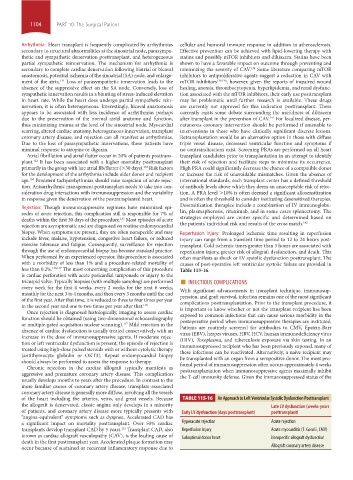
                 less than 0.2%. 136,137  The most concerning complication of this procedure   Table 115-16.
                 is cardiac perforation with acute pericardial tamponade or injury to the
                 tricuspid valve. Typically biopsies (with multiple sampling) are performed     ■  INFECTIOUS COMPLICATIONS
                 every week for the first 4 weeks, every 2 weeks for the next 6 weeks,   With significant advancements in transplant technique, immunosup-
                 monthly for the next 3 to 4 months, and then every 3 months until the end   pression, and graft survival, infection remains one of the most significant
                 of the first year. After that time, it is reduced to three to four times per year   complications posttransplantation. Prior to the transplant procedure, it
                 in the second year and one to two times per year after that. 115  is important to know whether or not the transplant recipient has been
                   Once rejection is diagnosed histologically, imaging to assess cardiac
                 function should be obtained (using two-dimensional echocardiography   exposed to common infections that can cause serious morbidity in the
                                                                       postoperative period when immunosuppressive therapies are instituted.
                 or multiple-gated acquisition nuclear scanning).  Mild rejection in the   Patients are routinely screened for antibodies to CMV, Epstein-Barr
                                                    117
                 absence of cardiac dysfunction is usually treated conservatively with an   virus (EBV), herpes viruses, HBV, HCV, human immunodeficiency virus
                 increase in the dose of immunosuppressive agents. If moderate rejec-  (HIV),  Toxoplasma, and tuberculosis exposure via skin testing. In an
                 tion or left ventricular dysfunction is present, the episode of rejection is   immunosuppressed recipient who has been previously exposed, many of
                 treated using high-dose pulsed steroids with or without cytolytic therapy   these infections can be reactivated. Alternatively, a naïve recipient may
                 (antithymocyte globulin or OKT3). Repeat endomyocardial biopsy   be transplanted with an organ from a seropositive donor. The most pro-
                 should always be performed to assess the response to therapy.  found period of immunosuppression often occurs approximately 4 weeks
                   Chronic rejection in the cardiac allograft typically manifests as   posttransplantation when immunosuppressive agents maximally inhibit
                 aggressive and premature coronary artery disease. This complication   the T-cell immunity defense. Given the immunosuppressed status of the
                 usually develops months to years after the procedure. In contrast to the
                 more familiar causes of coronary artery disease, transplant-associated
                 coronary artery disease is generally more diffuse, involving all the vessels
                 of the heart including the arteries, veins, and great vessels. Because     TABLE 115-16    An Approach to Left Ventricular Systolic Dysfunction Posttransplant
                 the allograft is denervated, classic angina only develops in a minority              Late LV dysfunction (weeks-years
                 of patients, and coronary artery disease more typically presents with   Early LV dysfunction (days posttransplant)  posttransplant)
                 “angina-equivalent” symptoms such as dyspnea. Accelerated CAD has
                 a significant impact on mortality posttransplant. Over 50% cardiac   Hyperacute rejection  Acute rejection
                 transplants develop transplant CAD by 5 years.  Transplant CAD, also   Reperfusion injury  Acute myocarditis (T. Gondii, CMV)
                                                   131
                 known as cardiac allograft vasculopathy (CAV), is the leading cause of   Suboptimal donor heart  Nonspecific allograft dysfunction
                 death in the first posttransplant year. Accelerated plaque formation may
                 occur because of sustained or recurrent inflammatory response due to                 Allograft coronary artery disease


            section10.indd   1104                                                                                      1/20/2015   9:20:00 AM

