


Page 1583 - Hall et al (2015) Principles of Critical Care-McGraw-Hill
P. 1583
1102     PART 10: The Surgical Patient


                 complications such as pneumonia. Identifying and correcting factors
                 that may be contributing to venous admixture is important.                                    Misc.
                   While pleural effusions are the most common postoperative pul-                              0%
                 monary  complication,  mortality  rate  is  highest  among  those  who                        Valvular
                 develop hospital-associated pneumonias compared to other pulmonary           CAD              4%
                   complications.  A meta-analysis of the use of selective digestive decon-   44%
                            112
                 tamination in the liver transplant population to minimize the risk of
                 bacterial infections showed the available literature supports a beneficial   ReTX
                 effect of SDD on reducing gram-negative pneumonias. However, larger   2%
                 randomized trials looking at its impact on infection, mortality, and anti-  Congenital  Myopathy
                 microbial resistance are needed. 113                              2%            48%
                   More information on the infectious disease complications can be
                 found in the section “Infectious Complications” below.
                 Neurologic Complications:  Mental status changes, delirium, seizures, and
                 coma are not uncommon following liver transplant. Neurologic compli-        1/1982-6/2011
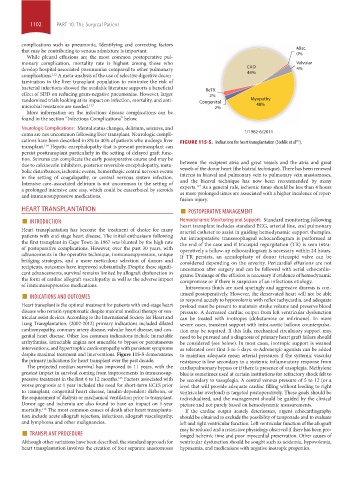
                 cations have been described in 8% to 40% of patients who undergo liver   FIGURE 115-5.  Indications for heart transplantation (Stehlik et al ).
                                                                                                               115
                 transplant.  Hepatic encephalopathy that is present pretransplant can
                         114
                 persist posttransplant particularly in the setting of delayed graft func-
                 tion. Seizures can complicate the early postoperative course and may be
                 due to calcineurin inhibitors, posterior reversible encephalopathy, meta-  between the recipient atria and great vessels and the atria and great
                 bolic disturbances, ischemic events, hemorrhagic central nervous events   vessels of the donor heart (the biatrial technique). There has been renewed
                 in the setting of coagulopathy, or central nervous system infection.   interest in bicaval and pulmonary vein to pulmonary vein anastomoses,
                 Intensive care–associated delirium is not uncommon in the setting of   and  the bicaval  technique  has now  been recommended  by  many
                                                                             117
                 a prolonged intensive care stay, which could be exacerbated by steroids   experts.  As a general rule, ischemic times should be less than 4 hours
                 and immunosuppressive medications.                    as more prolonged times are associated with a higher incidence of reper-
                                                                       fusion injury.
                 HEART TRANSPLANTATION                                     ■  POSTOPERATIVE MANAGEMENT
                     ■  INTRODUCTION                                   Hemodynamic Monitoring and Support:  Standard monitoring following


                 Heart transplantation has become the treatment of choice for many   heart transplant includes standard ECG, arterial line, and pulmonary
                                                                       arterial catheter to assist in guiding hemodynamic support therapies.
                 patients with end-stage heart disease. The initial enthusiasm following   An intraoperative transesophageal echocardiogram is performed at
                 the first transplant in Cape Town in 1967 was blunted by the high rate   the end of the case and if tricuspid regurgitation (TR) is seen intra-
                 of postoperative complications. However, over the past 30 years, with   operatively a follow-up echocardiogram is necessary within 24 hours.
                 advancements in the operative technique, immunosuppression, unique   If TR persists, an annuloplasty of donor tricuspid valve can be
                 bridging strategies, and a more meticulous selection of donors and     considered depending on the severity. Pericardial effusions are not
                 recipients, outcomes have improved substantially. Despite these signifi-  uncommon after surgery and can be followed with serial echocardio-
                 cant advancements, survival remains limited by allograft dysfunction in   grams. Drainage of the effusion is necessary if evidence of hemodynamic
                 the form of cardiac allograft vasculopathy as well as the adverse impact   compromise or if there is suspicion of an infectious etiology.
                 of immunosuppressive medications.                       Intravenous fluids are used sparingly and aggressive diuresis is con-
                     ■  INDICATIONS AND OUTCOMES                       tinued postoperatively. However, the denervated heart will not be able


                 Heart transplant is the optimal treatment for patients with end-stage heart   to respond acutely to hypovolemia with reflex tachycardia, and adequate
                                                                       preload must be present to maintain stroke volume and preserve blood
                 disease who remain symptomatic despite maximal medical therapy or ven-  pressure. A decreased cardiac output from left ventricular dysfunction
                 tricular assist devices. According to the International Society for Heart and   can be treated with inotropes (dobutamine or milrinone). In more
                 Lung Transplantation, (2002-2012) primary indications included dilated   severe cases, transient support with intra-aortic balloon counterpulsa-
                 cardiomyopathy, coronary artery disease, valvular heart disease, and con-  tion may be required. If this fails, mechanical circulatory support may
                 genital heart disease. Other less common indications include intractable   need to be pursued and a diagnosis of primary heart graft failure should
                 arrhythmias, intractable angina not amenable to bypass or percutaneous   be considered (see below). In most cases, inotropic support is weaned
                 interventions, and hypertrophic cardiomyopathy with persistent symptoms   as tolerated over first 3 to 5 days. α-Adrenergic agonists can be added
                 despite maximal treatment and interventions. Figure 115-5 demonstrates   to maintain adequate mean arterial pressures if the systemic vascular
                 the primary indications for heart transplant over the past decade.  resistance is low secondary to a systemic inflammatory response from
                   The projected median survival has improved to 11 years, with the   cardiopulmonary bypass or if there is presence of vasoplegia. Methylene
                 greatest impact in survival coming from improvements in immunosup-  blue is sometimes used at certain institutions for refractory shock felt to
                 pressive treatment in the first 6 to 12 months.  Factors associated with   be secondary to vasoplegia. A central venous pressure of 5 to 12 (or a
                                                  115
                 worse prognosis at 1 year included the need for short-term ECLS prior   level that will provide adequate cardiac filling without leading to right
                 to transplant, congenital heart disease, insulin-dependent diabetes, or   ventricular overload) is targeted postoperatively. These goals should be
                 the requirement of dialysis or mechanical ventilation prior to transplant.   individualized, and the management should be guided by the clinical
                 Donor age and ischemia are also found to have an impact on 1-year   picture and not purely based on hemodynamic measurements.
                 mortality.  The most common causes of death after heart transplanta-  If the cardiac output acutely deteriorates, urgent echocardiography
                        116
                 tion include acute allograft rejection, infections, allograft vasculopathy,   should be obtained to exclude the possibility of tamponade and to evaluate
                 and lymphoma and other malignancies.                  left and right ventricular function. Left ventricular function of the allograft
                     ■  TRANSPLANT PROCEDURE                           may be reduced and a restrictive physiology observed if there has been pro-
                                                                       longed ischemic time and poor myocardial preservation. Other causes of
                 Although other variations have been described, the standard approach for   ventricular dysfunction should be sought such as acidemia, hypovolemia,
                 heart transplantation involves the creation of four separate  anastomoses   hypoxemia, and medications with negative inotropic properties.


            section10.indd   1102                                                                                      1/20/2015   9:19:59 AM

