


Page 1600 - Hall et al (2015) Principles of Critical Care-McGraw-Hill
P. 1600
CHAPTER 117: Priorities in Multisystem Trauma  1119


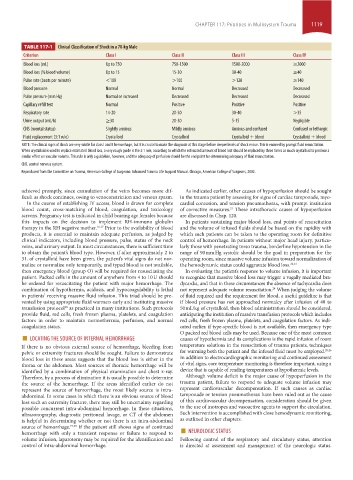
                      TABLE 117-1    Clinical Classification of Shock in a 70-kg Male
                    Criterion                   Class i                Class ii            Class iii            Class iV
                    Blood loss (mL)             Up to 750              750-1500            1500-2000            ≥2000
                    Blood loss (% blood volume)  Up to 15              15-30               30-40                ≥40
                    Pulse rate (beats per minute)  <100                >100                >120                 ≥140
                    Blood pressure              Normal                 Normal              Decreased            Decreased
                    Pulse pressure (mm Hg)      Normal or increased    Decreased           Decreased            Decreased
                    Capillary refill test       Normal                 Positive            Positive             Positive
                    Respiratory rate            14-20                  20-30               30-40                >35
                    Urine output (mL/h)         ≥30                    20-30               5-15                 Negligible
                    CNS (mental status)         Slightly anxious       Mildly anxious      Anxious and confused  Confused or lethargic
                    Fluid replacement (3:1 rule)  Crystalloid          Crystalloid         Crystalloid + blood  Crystalloid + blood
                    NOTE: The clinical signs of shock are very subtle for class I and II hemorrhage, but it is crucial to make the diagnosis at this stage before deeper levels of shock ensue. This is ensured by prompt fluid resuscitation.
                    When crystalloid is used to replace estimated blood loss, a very rough guide is the 3:1 rule, according to which the estimated amount of blood lost should be replaced by three times as much crystalloid to produce a
                    similar effect on vascular volume. This rule is only a guideline, however, and the adequacy of perfusion should be the end point for determining adequacy of fluid resuscitation.
                    CNS, central nervous system.
                    Reproduced from the Committee on Trauma, American College of Surgeons: Advanced Trauma Life Support Manual. Chicago, American College of Surgeons, 2002.


                    achieved promptly, since cannulation of the veins becomes more dif-  As indicated earlier, other causes of hypoperfusion should be sought
                    ficult as shock continues, owing to venoconstriction and venous spasm.  in the trauma patient by assessing for signs of cardiac tamponade, myo-
                     In the course of establishing IV access, blood is drawn for complete   cardial contusion, and tension pneumothorax, with prompt institution
                    blood count, cross-matching of blood, coagulation, and toxicology   of corrective measures.  These intrathoracic causes of hypoperfusion
                                                                                           21
                    screens. Pregnancy test is indicated in child bearing age females because   are discussed in Chap. 120.
                    this impacts  on  the  decision to implement  RH-immuno globulin   In patients sustaining major blood loss, end points of resuscitation
                    therapy in the RH negative mother. 16,17  Prior to the availability of blood   and the volume of infused fluids should be based on the rapidity with
                    products, it is essential to maintain adequate perfusion, as judged by   which such patients can be taken to the operating room for definitive
                    clinical indicators, including blood pressure, pulse, status of the neck   control of hemorrhage. In patients without major head injury, particu-
                    veins, and urinary output. In most circumstances, there is sufficient time   larly those with penetrating torso trauma, borderline hypotension in the
                    to obtain the patient’s blood type. However, if after approximately 2 to   range of 90 mm Hg systolic should be the goal in preparation for the
                    3 L of crystalloid have been given, the patient’s vital signs do not nor-  operating room, since massive volume infusion toward normalization of
                    malize or normalize only temporarily, and typed blood is not available,   the hemodynamic status could aggravate blood loss. 22,23
                    then emergency blood (group O) will be required for resuscitating the   In evaluating the patient’s response to volume infusion, it is important
                    patient. Packed cells in the amount of anywhere from 4 to 10 U should   to recognize that massive blood loss may trigger a vagally mediated bra-
                    be ordered for resuscitating the patient with major hemorrhage. The   dycardia, and that in these circumstances the absence of tachycardia does
                    combination of hypothermia, acidosis, and hypocoagulability is lethal   not represent adequate volume resuscitation.  When judging the volume
                                                                                                         24
                    in patients’ receiving massive fluid infusion. This triad should be pre-  of fluid required and the requirement for blood, a useful guideline is that
                    vented by using appropriate fluid warmers early and instituting massive   if blood pressure has not approached normalcy after infusion of 40 to
                    transfusion protocol  as practiced in many institutions. Such protocols   50 mL/kg of crystalloid, then blood administration should be considered,
                                  18
                    provide fluid, red cells, fresh frozen plasma, platelets, and coagulation   anticipating the institution of massive transfusion protocols which includes
                    factors in order to maintain normothermia, perfusion, and normal   red cells, fresh frozen plasma, platelets, and coagulation factors. As indi-
                    coagulation status.                                   cated earlier, if type-specific blood is not available, then emergency type
                        ■  LOCATING THE SOURCE OF INTERNAL HEMORRHAGE     O packed red blood cells may be used. Because one of the most common
                                                                          causes of hypothermia and its complications is the rapid infusion of room
                    If there is no obvious external source of hemorrhage, bleeding from   temperature solutions in the resuscitation of trauma patients, techniques
                    pelvic or extremity fractures should be sought. Failure to demonstrate   for warming both the patient and the infused fluid must be employed. 25,26
                    blood loss in these areas suggests that the blood loss is either in the   In addition to electrocardiographic monitoring and continued assessment
                    thorax or the abdomen. Most sources of thoracic hemorrhage will be   of vital signs, core temperature monitoring is therefore important, using a
                    identified  by  a  combination  of  physical  examination  and  chest  x-ray.   device that is capable of reading temperatures at hypothermic levels.
                    Therefore, by a process of elimination it is usually possible to determine   Although volume deficit is the major cause of hypoperfusion in the
                    the source of the hemorrhage. If the areas identified earlier do not   trauma patient, failure to respond to adequate volume infusion may
                    represent the source of hemorrhage, the most likely source is intra-  represent cardiovascular decompensation. If such causes  as  cardiac
                    abdominal. In some cases in which there is an obvious source of blood   tamponade or tension pneumothorax have been ruled out as the cause
                    loss such an extremity fracture, there may still be uncertainty regarding   of this cardiovascular decompensation, consideration should be given
                    possible concurrent intra-abdominal hemorrhage. In these situations,   to the use of inotropes and vasoactive agents to support the circulation.
                    ultrasonography, diagnostic peritoneal lavage, or CT of the abdomen   Such intervention is accomplished with close hemodynamic monitoring,
                    is helpful in determining whether or not there is an intra-abdominal   as outlined in other chapters.
                    hemorrhage with only a transient response or failure to respond to   ■  NEUROLOGIC STATUS
                                       If the patient still shows signs of continued
                    source of hemorrhage.
                                    19,20
                    volume infusion, laparotomy may be required for the identification and   Following control of the respiratory and circulatory status, attention
                    control of intra-abdominal hemorrhage.                is directed at assessment and management of the neurologic status.


            section10.indd   1119                                                                                      1/20/2015   9:20:10 AM

