


Page 1603 - Hall et al (2015) Principles of Critical Care-McGraw-Hill
P. 1603
1122     PART 10: The Surgical Patient


                     • Antiseizure prophylaxis with phenytoin is recommended for the
                    prevention of early posttraumatic seizures, that is, within 7 days
                    of the TBI. Routine prophylaxis later than 1 week following TBI is
                    not recommended
                     • Recent studies have not demonstrated an overall beneficial effect
                    of steroids on outcome and there is level I evidence that high-dose
                    methylprednisolone increases mortality after moderate to severe TBI.
                     • After TBI, persistent ICP  >20 is associated with poor outcome
                    and there are limited data—class III and II level evidence—that
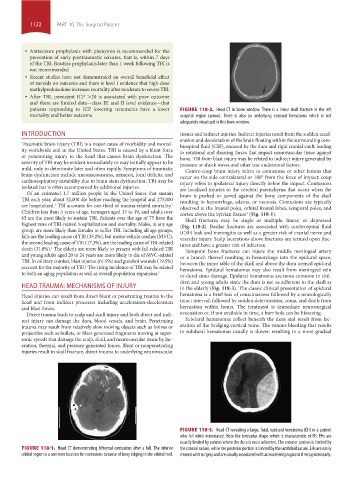
                    patients responding to ICP lowering treatments have a lower   FIGURE 118-2.  Head CT in bone window. There is a linear skull fracture in the left
                      mortality and better outcome.                      occipital region (arrow).  There is also an underlying epidural hematoma which is not
                                                                       adequately visualized in this bone window.
                 INTRODUCTION                                          tissues and indirect injuries. Indirect injuries result from the sudden accel-
                                                                       eration and deceleration of the brain floating within the surrounding cere-
                 Traumatic brain injury (TBI) is a major cause of morbidity and mortal-  brospinal fluid (CSF), encased by the dura and rigid cranial vault, leading
                 ity worldwide and in the United States. TBI is caused by a blunt force   to rotational and shearing forces that impact neurovascular  tissue against
                 or  penetrating  injury  to  the  head  that  causes  brain  dysfunction.  The   bone. TBI from blast injury may be related to indirect injury generated by
                 severity of TBI may be evident immediately or may initially appear to be   pressure or shock waves and other less understood factors.
                 mild, only to deteriorate later and often rapidly. Symptoms of traumatic   Contre-coup brain injury refers to contusions or other lesions that
                 brain dysfunction include unconsciousness, amnesia, focal deficits, and   occur on the side contralateral or 180° from the force of impact; coup
                 cardiorespiratory instability due to brain stem dysfunction. TBI may be   injury refers to ipsilateral injury directly below the impact. Contusions
                 isolated but is often accompanied by additional injuries.  are localized injuries to the cerebral parenchyma that occur when the
                   Of  an  estimated  1.7  million  people  in  the  United  States  that  sustain   brain is pushed or jarred against the bony components of the skull
                 TBI each year, about 52,000 die before reaching the hospital and 275,000   resulting in hemorrhage, edema, or necrosis. Contusions are typically
                 are hospitalized.  TBI accounts for one-third of trauma-related mortality.    observed at the frontal poles, orbital frontal lobes, temporal poles, and
                            1
                                                                    1
                 Children less than 5 years of age, teenagers aged 15 to 19, and adults over   cortex above the Sylvian fissure  (Fig. 118-1).
                                                                                              3
                 65 are the most likely to sustain TBI. Patients over the age of 75 have the   Skull  fractures  may  be  single  or  multiple,  linear,  or  depressed
                 highest rates of TBI-related hospitalization and mortality. Males, in any age   (Fig.  118-2). Basilar fractures are associated with cerebrospinal fluid
                 group, are more likely than females to suffer TBI. Including all age groups,   (CSF) leak and meningitis as well as a greater risk of cranial nerve and
                 falls are the leading cause of TBI (35.2%), but motor vehicle crashes (MVC),   vascular injury. Scalp lacerations above fractures are termed open frac-
                 the second leading cause of TBI (17.3%), are the leading cause of TBI-related   tures and have a greater risk of infection.
                 death (31.8%).  The elderly are more likely to present with fall-related TBI   Temporal  bone  fractures  can injure  the  middle  meningeal  artery
                           1
                 and young adults aged 20 to 24 years are more likely to die of MVC-related   or  a  branch  thereof  resulting  in  hemorrhage  into  the  epidural  space,
                 TBI. In military combat, blast injuries (61.9%) and gunshot wounds (19.5%)   between the inner table of the skull and above the dura termed epidural
                 account for the majority of TBI.  The rising incidence of TBI may be related   hematoma. Epidural hematomas may also result from meningeal vein
                                       2
                 to both an aging population as well as overall population expansion. 1  or dural sinus damage. Epidural hematomas are more common in chil-
                                                                       dren and young adults since the dura is not as adherent to the skull as
                 HEAD TRAUMA: MECHANISMS OF INJURY                     in the elderly (Fig. 118-3). The classic clinical presentation of epidural
                 Head injuries can result from direct blunt or penetrating trauma to the   hematoma is a brief loss of consciousness followed by a neurologically
                 head and from indirect processes including acceleration-deceleration   intact interval, followed by sudden deterioration, coma, and death from
                 and blast forces.                                     herniation  within  hours.  The  treatment  is  immediate  neurosurgical
                   Direct trauma leads to scalp and skull injury and both direct and indi-  evacuation or, if not available in time, a burr hole can be lifesaving.
                 rect injury can damage the dura, blood vessels, and brain. Penetrating   Subdural hematomas collect beneath the dura and result from lac-
                 trauma may result from relatively slow moving objects such as knives or   eration of the bridging cortical veins. The venous bleeding that results
                 projectiles such as bullets, or blast-generated fragments moving at super-  in subdural hematomas usually is slower, resulting in a more gradual
                 sonic speeds that damage the scalp, skull, and neurovascular tissue by lac-
                 eration, thermal, and pressure-generated forces. Blunt or nonpenetrating
                 injuries result in skull fracture, direct trauma to underlying neurovascular


                                                                       FIGURE 118-3.  Head CT revealing a large, fatal, epidural hematoma (EH) in a patient
                                                                       who fell while intoxicated. Note the lenticular shape which is characteristic of EH. EHs are
                                                                       usually limited by sutures where the dura is most adherent. The anterior portion is limited by
                 FIGURE 118-1.  Head CT demonstrating bifrontal contusions after a fall. The inferior   the coronal suture, while the posterior portion is limited by the lambdoid suture. EHs are easily
                 orbital region is a common location for contusions because of bony ridging in the orbital roof.  treated with surgery and are usually associated with an excellent prognosis if recognized early.


            section10.indd   1122                                                                                      1/20/2015   9:20:12 AM

