


Page 1605 - Hall et al (2015) Principles of Critical Care-McGraw-Hill
P. 1605
1124     PART 10: The Surgical Patient


                 related to motor vehicle collisions.  Deficits in memory and learning are   insignificant rate in humans  and gene therapy is in the early research
                                                                                            8
                                          5
                 common after TBI and may be related to frontal lesions. 6  phase without clinical application.  The prevention of secondary injury
                                                                                                9
                                                                       is the major goal in the treatment and optimization of outcomes of the
                 PRIMARY AND SECONDARY TBI                             patient after head injury. The optimal critical care of the head injured
                                                                       patient requires the provision and maintenance of a homeostatic
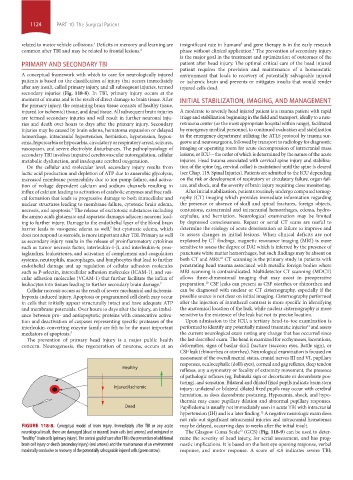
                 A conceptual framework with which to care for neurologically injured   environment that leads to recovery of potentially salvageable injured
                 patients is based on the classification of injury that occurs immediately   or ischemic brain and prevents or mitigates insults that would render
                 after any insult, called primary injury, and all subsequent injuries, termed   injured cells dead.
                 secondary injuries (Fig.  118-8). In TBI, primary injury occurs at the
                 moment of trauma and is the result of direct damage to brain tissue. After   INITIAL STABILIZATION, IMAGING, AND MANAGEMENT
                 the primary injury, the remaining brain tissue consists of healthy tissue,
                 injured (or ischemic) tissue, and dead tissue. All subsequent brain injuries     A moderate to severely head injured patient is a trauma patient with rapid
                 are termed secondary injuries and will result in further neuronal inju-  triage and stabilization beginning in the field and transport, ideally to a neu-
                 ries and death over hours to days after the primary injury. Secondary   rotrauma center (or the most appropriate hospital within range), facilitated
                 injuries may be caused by brain edema, hematoma expansion or delayed     by emergency medical personnel, to continued evaluation and stabilization
                 hemorrhage, intracranial hypertension, herniation, hypotension, hypox-  in the emergency department utilizing the ATLS protocol by trauma sur-
                 emia, hypercarbia or hypocarbia, circulatory or respiratory arrest, seizures,   geons and neurosurgeons, followed by transport to radiology for diagnostic
                 vasospasm, and severe electrolyte disturbances. The pathophysiology of   imaging or operating room for acute decompression of intracranial mass
                 secondary TBI involves impaired cerebrovascular autoregulation, cellular   lesions, or ICU—the order of which is determined by the nature of the acute
                 metabolic dysfunction, and inadequate cerebral oxygenation.  injuries. Head trauma associated with cervical spine injury and stabiliza-
                   On  the  cellular  and  molecular  level,  secondary  injury  results  from   tion of the spine (eg, cervical collar) is maintained until the spine is cleared
                 lactic acid production and depletion of ATP due to anaerobic glycolysis,   (see Chap. 119, Spinal Injuries). Patients are admitted to the ICU depending
                 increased membrane permeability due to ion pump failure, and activa-  on the risk or development of respiratory or circulatory failure, organ fail-
                 tion of voltage dependent calcium and sodium channels resulting in   ure, and shock, and the severity of brain injury requiring close monitoring.
                 influx of calcium leading to activation of catabolic enzymes and free radi-  After initial stabilization, patients routinely undergo computed tomog-
                 cal formation that leads to progressive damage to both intracellular and   raphy (CT) imaging which provides immediate information regarding
                 nuclear structures leading to membrane failure, cytotoxic brain edema,   the presence or absence of skull and spinal fractures, foreign objects,
                 necrosis, and apoptosis.  The release of excitotoxic substances including   contusions, extracranial and intracranial hemorrhages, edema, hydro-
                                  7
                 the amino acids glutamate and aspartate damages adjacent neurons lead-  cephalus, and herniation. Neurological examination may be limited
                 ing to further injury. Damage to the endothelial layer of the blood brain   by depressed consciousness. Repeat or serial CT scans are useful to
                 barrier leads to vasogenic edema as well,  but cytotoxic edema, which   determine the etiology of acute deterioration or failure to improve and
                                               7
                 does not respond to steroids, is more important after TBI. Primary as well   to assess changes in initial lesions. When clinical deficits are not
                 as secondary injury results in the release of proinflammatory cytokines   explained by CT findings, magnetic resonance imaging (MRI) is more
                 such as tumor necrosis factor, interleukin-1-β, and interleukin-6; pros-  sensitive to assess the degree of DAI which is inferred by the presence of
                 taglandins, leukotrienes, and activation of complement and coagulation   punctuate white matter hemorrhages, but such findings may be absent on
                 systems, neutrophils, macrophages, and lymphocytes that lead to further   both CT and MRI.  CT scanning is the primary study in patients with
                                                                                     10
                 endothelial  damage  and up  regulation  of  cellular  adhesion  molecules   penetrating head trauma associated with metallic foreign bodies where
                 such as P-selectin, intercellular adhesion molecules (ICAM-1), and vas-  MRI scanning is contraindicated. Multidetector CT scanning (MDCT)
                 cular adhesion molecules (VCAM-1) that further facilitate the influx of   allows three-dimensional imaging that may assist in preoperative
                 leukocytes into tissues leading to further secondary brain damage. 7  preparation.  CSF leaks can present as CSF otorrhea or rhinorrhea and
                                                                                10
                   Cellular necrosis occurs as the result of severe mechanical and ischemia-   can be diagnosed with nuclear or CT cisternography, especially if the
                 hypoxia-induced injury. Apoptosis or programmed cell death may occur   possible source is not clear on initial imaging. Cisternography performed
                 in cells that initially appear structurally intact and have adequate ATP   after the injection of intrathecal contrast is more specific in identifying
                 and membrane potentials. Over hours to days after the injury, an imbal-  the anatomical location of the leak, while nuclear cisternography is more
                 ance between pro- and antiapoptotic proteins with consecutive activa-  sensitive to the existence of the leak but not its precise location.
                 tion and deactivation of caspases representing specific proteases of the   Upon admission to the ICU, a tertiary head-to-toe examination is
                 interleukin-converting enzyme family are felt to be the most important   performed to identify any potentially missed traumatic injuries  and assess
                                                                                                                  11
                 mediators of apoptosis. 7                             the current neurological exam noting any change that has occurred since
                   The prevention of primary head injury is a major public health   the last described exam. The head is examined for ecchymoses, lacerations,
                 concern. Neurogenesis, the regeneration of neurons, occurs at an   deformities, signs of basilar skull fracture (raccoon eyes, Battle sign), or
                                                                       CSF leak (rhinorrhea or otorrhea). Neurological examination is focused on
                                                                       assessment of the overall mental status, cranial nerves III and VI, pupillary
                                                                       responses, oculocephalic (doll’s eyes), corneal and gag reflexes, deep tendon
                                                    Healthy            reflexes, any a symmetry or focality of extremity movement, the presence
                                                                       of pathologic reflexes (eg, Babinski sign or decorticate or decerebrate pos-
                                                                       turing), and sensation. Bilateral and dilated fixed pupils indicate brain stem
                                                 Injured/Ischemic      injury; unilateral or bilateral dilated fixed pupils may occur with cerebral
                                                                       herniation, as does decerebrate posturing. Hypoxemia, shock, and hypo-
                                                                       thermia may cause pupillary dilation and abnormal pupillary responses.
                                                    Dead               Papilledema is usually not immediately seen in acute TBI with intracranial
                                                                       hypertension (IH) and is a later finding.  A negative neurologic exam does
                                                                                                   12
                                                                       not rule out significant intracranial injuries and intracranial hematomas
                 FIGURE 118-8.  Conceptual model of brain injury. Immediately after TBI or any acute   may be delayed, occurring days to weeks after the initial insult.
                                                                                            13
                 neurological insult, there are damaged (dead or injured) brain cells (red arrows) and uninjured or   The Glasgow Coma Scale  (GCS) (Fig. 118-9) can be used to deter-
                 “healthy” brain cells (primary injury). The central goal of care after TBI is the prevention of  additional   mine the severity of head injury, for serial assessment, and has prog-
                 brain cell injury or death (secondary injury) (red arrows) and the maintenance of an environment   nostic implications. It is based on the best eye opening response, verbal
                 maximally conducive to recovery of the potentially salvageable injured cells (green arrow).  response, and motor response. A score of  ≤8 indicates severe TBI;


            section10.indd   1124                                                                                      1/20/2015   9:20:15 AM

