


Page 1655 - Hall et al (2015) Principles of Critical Care-McGraw-Hill
P. 1655
1174     PART 10: The Surgical Patient


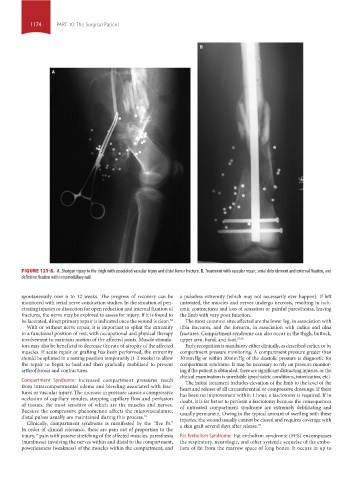
                 FIGURE 121-8.  A. Shotgun injury to the thigh with associated vascular injury and distal femur fracture. B. Treatment with vascular repair, serial debridement and external fixation, and
                 definitive fixation with intramedullary nail.


                 spontaneously over 6 to 12 weeks. The progress of recovery can be   a pulseless extremity (which may not necessarily ever happen). If left
                 monitored with serial nerve conduction studies. In the situation of pen-  untreated, the muscles and nerves undergo necrosis, resulting in isch-
                 etrating injuries or dissection for open reduction and internal fixation of   emic contractures and loss of sensation or painful paresthesias, leaving
                 fractures, the nerve may be explored to assess for injury. If it is found to   the limb with very poor function.
                 be lacerated, direct primary repair is indicated once the wound is clean. 32  The most common sites affected are the lower leg, in association with
                   With or without nerve repair, it is important to splint the extremity   tibia fractures, and the forearm, in association with radius and ulna
                 in a functional position of rest, with occupational and physical therapy   fractures. Compartment syndrome can also occur in the thigh, buttock,
                 involvement to maintain motion of the affected joints. Muscle stimula-  upper arm, hand, and foot. 35,36
                 tors may also be beneficial to decrease the rate of atrophy of the affected   Early recognition is mandatory either clinically, as described earlier, or by
                 muscles. If acute repair or grafting has been performed, the extremity   compartment pressure monitoring. A compartment pressure greater than
                 should be splinted in a resting position temporarily (1-2 weeks) to allow   30 mm Hg or within 30 mm Hg of the diastolic pressure is diagnostic for
                 the  repair  to  begin  to  heal  and  then  gradually  mobilized  to  prevent   compartment syndrome. It may be necessary to rely on pressure monitor-
                 arthrofibrosis and contractures.                      ing if the patient is obtunded, there are significant distracting injuries, or the
                                                                       clinical examination is unreliable (psychiatric conditions, intoxication, etc).
                 Compartment Syndrome:  Increased compartment pressures result   The initial treatment includes elevation of the limb to the level of the
                 from intracompartmental edema and bleeding associated with frac-  heart and release of all circumferential or compressive dressings. If there
                 tures or vascular injury. The increase in pressure causes a compressive   has been no improvement within 1 hour, a fasciotomy is required. If in
                 occlusion of capillary venules, stopping capillary flow and perfusion   doubt, it is far better to perform a fasciotomy because the consequences
                 of tissues, the most sensitive of which are the muscles and nerves.   of untreated compartment syndrome are extremely debilitating and
                 Because the compressive phenomenon affects the microvasculature,   usually permanent. Owing to the typical amount of swelling with these
                 distal pulses usually are maintained during this process. 33  injuries, the wound usually cannot be closed and requires coverage with
                   Clinically, compartment syndrome is manifested by the “five Ps.”   a skin graft several days after release. 37
                 In order of clinical relevance, these are pain out of proportion to the
                 injury,  pain with passive stretching of the affected muscles, paresthesia   Fat Embolism Syndrome:  Fat embolism syndrome (FES) encompasses
                      34
                 (numbness) involving the nerves within and distal to the compartment,   the respiratory, neurologic, and other systemic sequelae of the embo-
                 powerlessness (weakness) of the muscles within the compartment, and   lism of fat from the marrow space of long bones. It occurs in up to


            section10.indd   1174                                                                                      1/20/2015   9:21:28 AM

