


Page 1728 - Hall et al (2015) Principles of Critical Care-McGraw-Hill
P. 1728
CHAPTER 124: Toxicology in Adults  1197


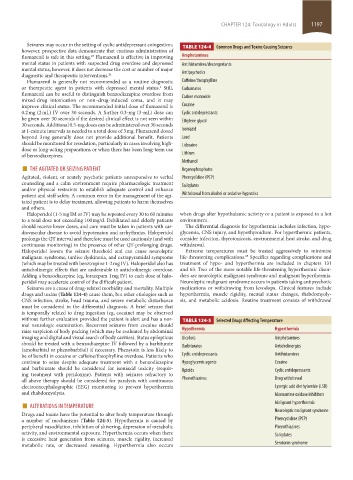
                     Seizures may occur in the setting of cyclic antidepressant coingestion;     TABLE 124-4    Common Drugs and Toxins Causing Seizures
                    however, prospective data demonstrate that cautious administration of
                    flumazenil is safe in this setting.  Flumazenil is effective in improving   Amphetamines
                                           23
                    mental status in patients with suspected drug overdose and depressed   Antihistamines/decongestants
                    mental status; however, it does not decrease the cost or number of major
                    diagnostic and therapeutic interventions. 24          Antipsychotics
                     Flumazenil  is  generally  not  recommended  as  a  routine  diagnostic   Caffeine/theophylline
                    or therapeutic agent in patients with depressed mental status.  Still,   Carbamates
                                                                   2
                    flumazenil can be useful to distinguish benzodiazepine overdose from
                    mixed-drug intoxication or non–drug-induced coma, and it may   Carbon monoxide
                    improve clinical status. The recommended initial dose of flumazenil is   Cocaine
                    0.2 mg (2 mL) IV over 30 seconds. A further 0.3-mg (3-mL) dose can   Cyclic antidepressants
                    be given over 30 seconds if the desired clinical effect is not seen within     Ethylene glycol
                    30 seconds. Additional 0.5-mg doses can be administered over 30 seconds
                    at 1-minute intervals as needed to a total dose of 3 mg. Flumazenil dosed   Isoniazid
                    beyond  3 mg  generally  does  not  provide  additional  benefit.  Patients   Lead
                    should be monitored for resedation, particularly in cases involving high-  Lidocaine
                    dose or long-acting preparations or when there has been long-term use
                    of benzodiazepines.                                   Lithium
                        ■  THE AGITATED OR SEIZING PATIENT                Methanol
                                                                          Organophosphates
                    Agitated, violent, or acutely psychotic patients unresponsive to verbal   Phencyclidine (PCP)
                    counseling and a calm environment require pharmacologic treatment   Salicylates
                    and/or physical restraints to establish adequate control and enhance
                    patient and staff safety. A common error in the management of the agi-  Withdrawal from alcohol or sedative-hypnotics
                    tated patient is to delay treatment, allowing patients to harm themselves
                    and others.
                     Haloperidol (1-5 mg IM or IV) may be repeated every 30 to 60 minutes   when drugs alter hypothalamic activity or a patient is exposed to a hot
                    to a total dose not exceeding 100 mg/d. Debilitated and elderly patients   environment.
                    should receive lower doses, and care must be taken in patients with car-  The differential diagnosis for hypothermia includes infection, hypo-
                    diovascular disease to avoid hypotension and arrhythmias. Haloperidol   glycemia, CNS injury, and hypothyroidism. For hyperthermic patients,
                    prolongs the QT interval and therefore must be used cautiously (and with   consider infection, thyrotoxicosis, environmental heat stroke, and drug
                    continuous monitoring) in the presence of other QT-prolonging drugs.   withdrawal.
                    Haloperidol lowers the seizure threshold and can cause neuroleptic   Extreme temperatures must be treated aggressively to minimize
                    malignant syndrome, tardive dyskinesia, and extrapyramidal symptoms   life-threatening complications.  Specifics regarding complications and
                                                                                                25
                    (which may be treated with benztropine 1-2 mg IV). Haloperidol also has   treatment of hypo- and hyperthermia are included in chapters 131
                    anticholinergic effects that are undesirable in anticholinergic overdose.   and 63. Two of the more notable life-threatening hyperthermic disor-
                    Adding a benzodiazepine (eg, lorazepam 1 mg IV) to each dose of halo-  ders are neuroleptic malignant syndrome and malignant hyperthermia.
                    peridol may accelerate control of the difficult patient.  Neuroleptic malignant syndrome occurs in patients taking antipsychotic
                     Seizures are a cause of drug-related morbidity and mortality. Multiple   medications or withdrawing from levodopa. Clinical features include
                    drugs and toxins (Table 124-4) cause them, but other etiologies such as   hyperthermia, muscle rigidity, mental status changes, rhabdomyoly-
                    CNS infection, stroke, head trauma, and severe metabolic disturbance   sis, and metabolic acidosis. Routine treatment consists of withdrawal
                    must be considered in the differential diagnosis. A brief seizure that
                    is temporally related to drug ingestion (eg, cocaine) may be observed
                    without further evaluation provided the patient is alert and has a nor-    TABLE 124-5    Selected Drugs Affecting Temperature
                    mal neurologic examination. Recurrent seizures from cocaine should
                    raise suspicion of body packing (which may be evaluated by abdominal   Hypothermia    Hyperthermia
                    imaging and digital and visual search of body cavities). Status epilepticus   Alcohols  Amphetamines
                    should be treated with a benzodiazepine IV followed by a barbiturate   Barbiturates   Anticholinergics
                    (amobarbital or phenobarbital) if necessary. Phenytoin is less likely to
                    be of benefit in cocaine or caffeine/theophylline overdose. Patients who   Cyclic antidepressants  Antihistamines
                    continue to seize despite adequate treatment with a benzodiazepine   Hypoglycemic agents  Cocaine
                    and barbiturate should be considered for isoniazid toxicity (requir-  Opioids         Cyclic antidepressants
                    ing treatment with pyridoxine). Patients with seizures refractory to
                    all above therapy should be considered for paralysis with continuous   Phenothiazines  Drug withdrawal
                    electroencephalographic (EEG) monitoring to prevent hyperthermia                      Lysergic acid diethylamide (LSD)
                    and rhabdomyolysis.                                                                   Monoamine oxidase inhibitors
                        ■  ALTERATIONS IN TEMPERATURE                                                     Malignant hyperthermia

                    Drugs and toxins have the potential to alter body temperature through                 Neuroleptic malignant syndrome
                    a number of mechanisms (Table 124-5). Hypothermia is caused by                        Phencyclidine (PCP)
                    peripheral vasodilation, inhibition of shivering, depression of metabolic             Phenothiazines
                    activity, and environmental exposure. Hyperthermia occurs when there                  Salicylates
                    is excessive heat generation from seizures, muscle rigidity, increased
                    metabolic rate, or decreased sweating. Hyperthermia also occurs                       Serotonin syndrome


            section11.indd   1197                                                                                      1/19/2015   10:51:56 AM

