


Page 1732 - Hall et al (2015) Principles of Critical Care-McGraw-Hill
P. 1732
CHAPTER 124: Toxicology in Adults  1201


                      TABLE 124-14     Selected Drugs Associated With an Elevated Anion Gap      TABLE 124-16    Drugs/Toxins Associated With an Elevated Osmol Gap
                                 Metabolic Acidosis                       Ethanol (if not included in the formula)
                    Amiloride                         Ketamine            Ethylene glycol/glycolaldehyde
                    Ascorbic acid                     Metformin           Glycerol
                    Carbon monoxide                   Methanol            Glycine
                    Chloramphenicol                   Niacin              Intravenous immunoglobulin (maltose)
                    Colchicine                        Nitroprusside       Isopropanol/acetone
                    Cyanide                           NSAIDs              Mannitol
                    Dapsone                           Papaverine          Methanol/formaldehyde
                    Epinephrine                       Paraldehyde (hippuric acid)  Propylene glycol
                    Ethanol                           Phenformin          Radiocontrast media
                    Ethylene glycol                   Propofol            Sorbitol
                    Formaldehyde                      Salicylates
                    Hydrogen sulfide                  Terbutaline
                    Iron                              Tetracycline (outdated)  (blood urea nitrogen) and glucose are divided by 2.8 and 18, respectively,
                                                                          to convert mg/dL into mmol/L. Dividing ethanol concentration by 4.6
                    Isoniazid                         Toluene (hippuric acid)
                                                                          accounts for the effect of a measured plasma ethanol concentration (in
                                                      Verapamil           mg/dL) on calculated plasma osmolarity. Of note, measured osmolality
                    NSAIDs, nonsteroidal anti-inflammatory drugs.         has units of mOsm/kg and calculated osmolarity has units of mOsm/L;
                                                                          subtracting one from the other, however, generally does not cause a criti-
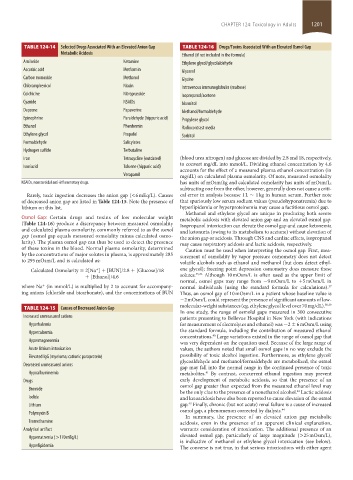
                     Rarely, toxic ingestion decreases the anion gap (<6 mEq/L). Causes   cal error in analysis because 1 L ∼ 1 kg in human serum. Further note
                    of decreased anion gap are listed in Table 124-15. Note the presence of   that spuriously low serum sodium values (pseudohyponatremia) due to
                    lithium on this list.                                 hyperlipidemia or hyperproteinemia may cause a factitious osmol gap.
                                                                           Methanol and ethylene glycol are unique in producing both severe
                    Osmol  Gap:  Certain drugs and toxins of low molecular weight   metabolic acidosis with elevated anion gap and an elevated osmol gap.
                    (Table 124-16) produce a discrepancy between measured osmolality   Isopropanol intoxication can elevate the osmol gap and cause ketonemia
                    and calculated plasma osmolarity, commonly referred to as the osmol   and ketonuria (owing to its metabolism to acetone) without elevation of
                    gap (osmol gap equals measured osmolality minus calculated osmo-  the anion gap or acidosis. Through CNS and cardiac effects, isopropanol
                    larity). The plasma osmol gap can thus be used to detect the presence   may cause respiratory acidosis and lactic acidosis, respectively.
                    of these toxins in the blood. Normal plasma osmolarity, determined   Caution must be used when interpreting the osmol gap. First, mea-
                    by the concentrations of major solutes in plasma, is approximately 285   surement of osmolality by vapor pressure osmometry does not detect
                    to 295 mOsm/L and is calculated as:                   volatile alcohols such as ethanol and methanol (but does detect ethyl-
                       Calculated Osmolarity = 2[Na ] + [BUN]/2.8 + [Glucose]/18   ene glycol); freezing point depression osmometry does measure these
                                             +
                                         + [Ethanol]/4.6                  solutes. 35,36  Although 10 mOsm/L is often used as the upper limit of
                                                                          normal,  osmol  gaps  may  range  from  −9 mOsm/L  to  +5 mOsm/L  in
                    where Na  (in mmol/L) is multiplied by 2 to account for accompany-  normal individuals (using the standard formula for calculations).
                           +
                                                                                                                            37
                    ing anions (chloride and bicarbonate), and the concentrations of BUN   Thus, an osmol gap of 10 mOsm/L in a patient whose baseline value is
                                                                          −2 mOsm/L could represent the presence of significant amounts of low-
                                                                          molecular-weight substances (eg, ethylene glycol level over 70 mg/dL). 38,39
                      TABLE 124-15    Causes of Decreased Anion Gap
                                                                          In one study, the range of osmolal gaps measured in 300 consecutive
                    Increased unmeasured cations                          patients presenting to Bellevue Hospital in New York (with indications
                      Hyperkalemia                                        for measurement of electrolytes and ethanol) was −2 ± 6 mOsm/L using
                      Hypercalcemia                                       the standard formula, including the contribution of measured ethanol
                                                                                     40
                                                                          concentrations.  Large variations existed in the range of osmol gap that
                      Hypermagnesemia                                     was very dependent on the equation used. Because of the large range of
                      Acute lithium intoxication                          values, the authors noted that small osmol gaps in no way exclude the
                      Elevated IgG (myeloma; cationic paraprotein)        possibility of toxic alcohol ingestion. Furthermore, as ethylene glycol/
                                                                          glycoaldehyde and methanol/formaldehyde are metabolized, the osmol
                    Decreased unmeasured anions
                                                                          gap may fall into the normal range in the continued presence of toxic
                      Hypoalbuminemia                                     metabolites.  By contrast, concurrent ethanol ingestion may prevent
                                                                                  41
                    Drugs                                                 early development of metabolic acidosis, so that the presence of an
                                                                          osmol gap greater than expected from the measured ethanol level may
                      Bromide
                                                                          be the only clue to the presence of a nonethanol alcohol.  Lactic acidosis
                                                                                                                 42
                      Iodide                                              and ketoacidosis have also been reported to cause elevation of the osmol
                                                                            43
                      Lithium                                             gap.  Finally, chronic (but not acute) renal failure is a cause of increased
                                                                          osmol gap, a phenomenon corrected by dialysis. 44
                      Polymyxin B
                                                                           In summary, the presence of an elevated anion gap metabolic
                      Tromethamine                                        acidosis, even in the presence of an apparent clinical explanation,
                    Analytical artifact                                   warrants consideration of intoxication. The additional presence of an
                      Hypernatremia (>170 mEq/L)                          elevated osmol gap, particularly of large magnitude  (>25 mOsm/L),
                                                                          is indicative of methanol or ethylene glycol intoxication (see below).
                      Hyperlipidemia                                      The converse is not true, in that serious intoxications with either agent


            section11.indd   1201                                                                                      1/19/2015   10:51:57 AM

