


Page 1752 - Hall et al (2015) Principles of Critical Care-McGraw-Hill
P. 1752
CHAPTER 124: Toxicology in Adults  1221


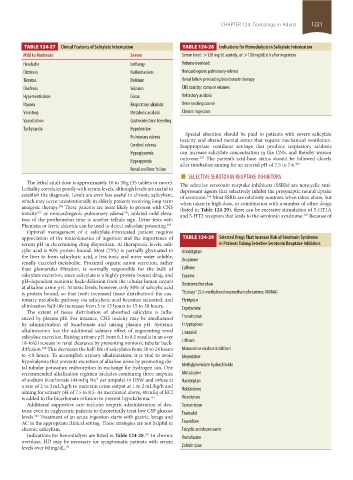
                      TABLE 124-27    Clinical Features of Salicylate Intoxication    TABLE 124-28    Indications for Hemodialysis in Salicylate Intoxication
                    Mild to Moderate                     Severe           Serum level: >120 mg/dL acutely, or >100 mg/dL 6 h after ingestion
                    Headache                             Lethargy         Volume overload
                    Dizziness                            Hallucinations   Noncardiogenic pulmonary edema
                    Tinnitus                             Delirium         Renal failure precluding bicarbonate therapy
                    Deafness                             Seizures         CNS toxicity: coma or seizures
                    Hyperventilation                     Coma             Refractory acidosis
                    Nausea                               Respiratory alkalosis  Deteriorating course
                    Vomiting                             Metabolic acidosis  Chronic ingestion
                    Vasodilation                         Gastrointestinal bleeding
                    Tachycardia                          Hypotension
                                                                           Special attention should be paid to patients with severe salicylate
                                                         Pulmonary edema
                                                                          toxicity and altered mental status that require mechanical ventilation.
                                                         Cerebral edema   Inappropriate ventilator settings that produce respiratory acidosis
                                                         Hypoglycemia     can increase salicylate concentration in the CNS, and thereby worsen
                                                                          outcome.  The patient’s acid-base status should be followed closely
                                                                                363
                                                         Hyperpyrexia
                                                                          after intubation aiming for an arterial pH of 7.5 to 7.6. 363
                                                         Renal and liver failure    ■
                                                                            SELECTIVE SEROTONIN REUPTAKE INHIBITORS
                     The lethal adult dose is approximately 10 to 30 g (35 tablets or more).   The selective serotonin reuptake inhibitors (SSRIs) are noncyclic anti-
                    Lethality correlates poorly with serum levels, although levels are useful to   depressant agents that selectively inhibit the presynaptic neural uptake
                    establish the diagnosis. Levels are even less useful in chronic salicylism,   of serotonin.  Most SSRIs are relatively nontoxic when taken alone, but
                                                                                   364
                    which may occur unintentionally in elderly patients receiving long-term   when taken in high dose, or combination with a number of other drugs
                    analgesic therapy.  These patients are more likely to present with CNS   (listed in Table 124-29), there can be excessive stimulation of 5-HT1A
                                356
                    toxicity  or noncardiogenic pulmonary edema ; isolated mild eleva-  and 5-HT2 receptors that leads to the serotonin syndrome.  Because of
                         357
                                                      358
                                                                                                                    365
                    tion of the prothrombin time is another telltale sign. Urine tests with
                    Phenistix or ferric chloride can be used to detect salicylate poisoning. 359
                     Optimal management of a salicylate-intoxicated patient requires
                    appreciation of the toxicokinetics of ingestion and the importance of     TABLE 124-29     Selected Drugs That Increase Risk of Serotonin Syndrome
                    serum pH in determining drug disposition. At therapeutic levels, sali-  in Patients Taking Selective Serotonin Reuptake Inhibitors
                    cylic acid is 90% protein bound. Most (75%) is partially glycinated in   Almotriptan
                    the liver to form salicyluric acid, a less toxic and more water soluble,
                    renally excreted metabolite. Proximal organic  anion secretion, rather   Buspirone
                    than glomerular filtration, is normally responsible for the bulk of   Caffeine
                    salicylate excretion, since salicylate is a highly protein-bound drug, and   Cocaine
                    pH-dependent nonionic back-diffusion from the tubular lumen occurs
                    at alkaline urine pH. At toxic levels, however, only 50% of salicylic acid   Dextromethorphan
                    is protein bound, so that (with increased tissue distribution) the cus-  “Ecstasy” (3,4-methylenedioxymethamphetamine; MDMA)
                    tomary metabolic pathway via salicyluric acid becomes saturated, and   Eletriptan
                    elimination half-life increases from 3 to 12 hours to 15 to 30 hours.  Ergotamine
                     The  extent of  tissue distribution of  absorbed  salicylate is influ-
                    enced by plasma pH. For instance, CNS toxicity may be ameliorated   Frovatriptan
                    by administration of bicarbonate and raising plasma pH. Systemic   l-tryptophan
                    alkalinization has the additional salutary effect of augmenting renal   Linezolid
                    salicylate excretion. Raising urinary pH from 6.1 to 8.1 results in an over
                    18-fold increase in renal clearance by preventing nonionic tubular back-   Lithium
                    diffusion.  This decreases the half-life of salicylates from 20 to 24 hours   Monoamine oxidase inhibitors
                           360
                    to <8 hours. To accomplish urinary alkalinization, it is vital to avoid   Meperidine
                    hypokalemia that prevents excretion of alkaline urine by promoting dis-
                    tal tubular potassium reabsorption in exchange for hydrogen ion. One   Methylphenidate hydrochloride
                    recommended alkalization regimen includes combining three ampules   Mirtazapine
                    of sodium bicarbonate (44 mEq Na  per ampule) in D5W and infuse at   Naratriptan
                                             +
                    a rate of 2 to 3 mL/kg/h to maintain urine output at 1 to 2 mL/kg/h and   Nefazodone
                    aiming for urinary pH of 7.5 to 8.5. As mentioned above, 40 mEq of KCl
                    is added to the bicarbonate infusion to prevent hypokalemia. 361  Rizatriptan
                     Additional supportive care includes empiric administration of dex-  Sumatriptan
                    trose even in euglycemic patients to theoretically treat low CSF glucose   Tramadol
                    levels.  Treatment of an acute ingestion starts with gastric lavage and
                        362
                    AC in the appropriate clinical setting. These strategies are not helpful in   Trazodone
                    chronic salicylism.                                   Tricyclic antidepressants
                     Indications for hemodialysis are listed in Table 124-28.  In chronic   Venlafaxine
                                                              361
                    overdose, HD may be necessary for symptomatic patients with serum
                    levels over 60 mg/dL. 78                              Zolmitriptan


            section11.indd   1221                                                                                      1/19/2015   10:52:04 AM

