


Page 1751 - Hall et al (2015) Principles of Critical Care-McGraw-Hill
P. 1751
1220     PART 11: Special Problems in Critical Care


                 by the mnemonic SLUDGE (salivation, lacrimation, urination, diarrhea,   repeated once. A continuous infusion is then administered at a rate of
                 gastrointestinal cramps, and emesis). Blurred vision, miosis, bradycar-  200 to 500 mg/h, titrated to achieve the desired effect. Continuous infu-
                 dia, and wheezing are also muscarinic effects. Nicotinic effects are less   sion of pralidoxime may be necessary for over 24 hours, depending on
                 sustained and characterized by fasciculations, muscle weakness (that can   the half-life and lipid solubility of the poison, after which the dose may
                 progress to paralysis), hypertension, and tachycardia. Organophosphates   be gradually reduced and stopped while the patient is observed for signs
                 penetrate the blood-brain barrier to cause anxiety, confusion, psychosis,   of recurrent muscle weakness.
                 seizures, and ataxia.
                   The two principal cholinesterases are RBC cholinesterase (also called     ■  SALICYLATES
                 acetylcholinesterase or AChE), which is present in red blood cells and   Acetylsalicylic acid or aspirin is converted rapidly to salicylic acid, its
                 nerve endings, and pseudocholinesterase (PChE), which is found pri-  active moiety. Salicylic acid is readily absorbed from the stomach and
                 marily in liver and serum. Carbamates and organophosphates inhibit   small bowel. At therapeutic doses, it is metabolized by the liver and
                 both. Clinical toxicity is due primarily to inhibition of AChE, but PChE   eliminated in 2 to 3 hours. Chronic ingestion can increase the half-life
                 is more readily quantified. Levels may not correlate with the severity of   to more than 20 hours.  Overdose can be accidental or deliberate, acute
                                                                                       346
                 poisoning.  A falsely low PChE may be seen in liver disease, anemia,   or chronic. A number of over-the-counter combination formulations
                         341
                 and malnutrition, and as a normal genetic variant (familial succinyl-  and herbal remedies contain salicylates. The use of alternate analgesics,
                 choline  sensitivity). Normal  levels  of enzyme activity do  not exclude   child-resistant containers, and package-size restrictions has decreased
                 poisoning because of wide variations in normal levels. In the absence   the incidence of poisoning. 347,348
                 of a baseline levels, serial measurements may confirm the diagnosis. 342  Therapeutic serum levels of salicylates are 10 to 30 mg/dL. Clinical
                   During initial patient stabilization, attention should be paid to the   features of intoxication occur in most individuals with serum levels above
                 respiratory status. Bronchoconstriction, excess secretions, muscle weak-  40 to 50 mg/dL; in chronic intoxication, severe poisoning occurs at lower
                 ness, and an altered mental status all increase the risk of respiratory   serum levels (particularly in elderly patients). In toxic amounts, salicylates
                 failure requiring. In agricultural exposures, it is important to remove all   are metabolic poisons that affect a number of organ systems by uncou-
                 contaminated clothing and cleanse hair and skin thoroughly to decrease   pling oxidative phosphorylation and interfering with the Krebs cycle. 349
                 skin absorption. Health care workers must protect themselves from   Minor intoxication causes tinnitus, vertigo, nausea, vomiting, and
                 accidental exposure by wearing appropriate gloves and gowns. Activated   diarrhea. More significant ingestions cause acid-base disturbances.
                 charcoal and gastric lavage may be useful if done immediately after   Respiratory  alkalosis is  caused  by direct  central  ventilatory  stimula-
                 ingestion, but the airway must be protected.          tion. Organic acids (including lactate and ketoacids) accumulate with
                   Symptomatic patients should receive atropine immediately. Treatment   uncoupling of oxidative phosphorylation to cause an elevated anion
                 should not await results of AChE or PChE levels. Atropine competitively   gap metabolic acidosis. Salicylic acid itself contributes minimally to the
                 blocks acetylcholine at muscarinic receptors but has no effect on nicotinic   measured anion gap (only 3 mEq/L with a 50 mg/dL level). Adults com-
                 receptors. Atropine crosses the blood-brain barrier and can cause CNS   monly present with respiratory alkalosis or combined metabolic acidosis
                 toxicity that is difficult to distinguish from organophosphate toxicity.   and respiratory alkalosis.  Children may develop pure metabolic aci-
                                                                                          350
                 In this situation, glycopyrrolate (which does not penetrate the CNS) is   dosis. Severe poisoning also causes noncardiogenic pulmonary edema,
                 a reasonable alternative to atropine.  In addition, regimens including   mental status changes, seizures, coma, gastrointestinal bleeding, liver
                                           343
                 combinations  of  atropine  and  glycopyrrolate  have  been  proposed  that   failure, renal failure, and death.  Systemic symptoms generally begin
                                                                                              351
                 would allow for less atropine. One study suggests decreased mortality with   within 4 to 8 hours after ingestion, although reports exist of delayed
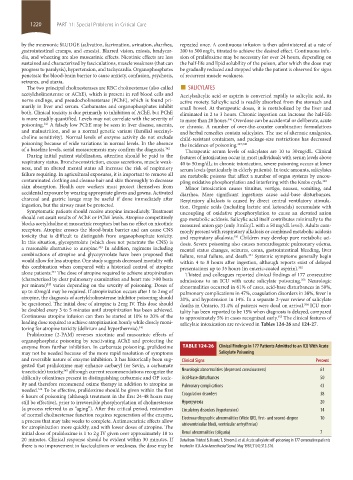
                 this combination when compared with a historical control of atropine   presentations up to 35 hours (in enteric-coated aspirin). 352
                 alone patients.  The dose of atropine required to achieve atropinization   Thisted and colleagues reported clinical findings of 177 consecutive
                           344
                 (characterized by clear pulmonary examination and heart rate >80 beats   admissions to an ICU with acute salicylate poisoning.  Neurologic
                                                                                                                353
                 per minute)  varies depending on the severity of poisoning. Doses of   abnormalities occurred in 61% of cases, acid-base disturbances in 50%,
                          340
                 up to 40 mg/d may be required. If atropinization occurs after 1 to 2 mg of   pulmonary complications in 47%, coagulation disorders in 38%, fever in
                 atropine, the diagnosis of acetylcholinesterase inhibitor poisoning should   20%, and hypotension in 14%. In a separate 2-year review of salicylate
                 be questioned. The initial dose of atropine is 2 mg IV. This dose should   deaths in Ontario, 31.4% of patients were dead on arrival.  ICU mor-
                                                                                                                 354
                 be doubled every 3 to 5 minutes until atropinization has been achieved.   tality has been reported to be 15% when diagnosis is delayed, compared
                 Continuous atropine infusion can then be started at 10% to 20% of the   to approximately 5% in cases recognized early.  The clinical features of
                                                                                                         355
                 loading dose required to achieve atropinization hourly while closely moni-  salicylate intoxication are reviewed in Tables 124-26 and 124-27.
                 toring for atropine toxicity (delirium and hyperthermia). 340
                   Pralidoxime (2-PAM) reverses nicotinic and muscarinic effects of
                 organophosphate poisoning by reactivating AChE and protecting the
                 enzyme from further inhibition. In carbamate poisoning, pralidoxime     TABLE 124-26     Clinical Findings in 177 Patients Admitted to an ICU With Acute
                 may not be needed because of the more rapid resolution of symptoms   Salicylate Poisoning
                 and reversible nature of enzyme inhibition. It has historically been sug-  Clinical Signs           Percent
                 gested that pralidoxime may enhance carbaryl (or Sevin, a carbamate
                 insecticide) toxicity,  although current recommendations recognize the   Neurologic abnormalities (depressed consciousness)  61
                               345
                 difficulty oftentimes present in distinguishing carbamate and OP toxic-  Acid-base disturbances       50
                 ity and therefore recommend oxime therapy in addition to atropine as   Pulmonary complications        43
                 needed.  To be effective, pralidoxime should be given within the first
                       334
                 6 hours of poisoning (although treatment in the first 24-48 hours may   Coagulation disorders         38
                 still be effective), prior to irreversible phosphorylation of cholinesterase   Hyperpyrexia           20
                 (a process referred to as “aging”). After this critical period, restoration   Circulatory disorders (hypotension)  14
                 of normal cholinesterase function requires regeneration of the enzyme,
                 a process that may take weeks to complete. Antimuscarinic effects allow   Electrocardiographic abnormalities (Wide QRS, first- and second-degree   10
                 for atropinization more quickly, and with lower doses of atropine. The     atrioventricular block, ventricular arrhythmias)
                 initial dose of pralidoxime is 1 to 2 g IV given over approximately 10 to   Renal abnormalities (oliguria)  7
                 20 minutes. Clinical response should be evident within 30 minutes. If   Data from Thisted B, Krantz T, Stroom J, et al. Acute salicylate self-poisoning in 177 consecutive patients
                 there is no improvement in fasciculations or weakness, the dose may be   treated in ICU. Acta Anaesthesiol Scand. May 1987;31(4):312-316.


            section11.indd   1220                                                                                      1/19/2015   10:52:04 AM

