


Page 1750 - Hall et al (2015) Principles of Critical Care-McGraw-Hill
P. 1750
CHAPTER 124: Toxicology in Adults  1219


                    of cyanide poisoning. Failure to respond to methylene blue suggests   occurs within minutes of naloxone administration and lasts for 1 to
                    cytochrome  b5 reductase deficiency, G6PD deficiency, or sulfhemo-  3 hours. Repeat boluses may be needed every 20 to 60 minutes to main-
                    globinemia. Exchange transfusion can be considered in severe cases   tain an adequate clinical response. Alternatively, a continuous naloxone
                    unresponsive to methylene blue.                       infusion may be used particularly in longer acting opioids (0.4-0.8 mg/h,
                        ■  OPIOIDS                                        or two-thirds of the initial dose needed to achieve a response, given each
                                                                          hour intravenously).
                    Opioid stimulation of opiate receptors causes generalized depression of   Noncardiogenic pulmonary edema may be initially difficult to
                    the central nervous system. Symptoms of overdose range from lethargy to   distinguish  from  aspiration  pneumonitis  and  acute  lung  injury;  how-
                    respiratory arrest and coma, depending on the dose, agent ingested, and   ever, improvement is generally quicker in opioid-induced pulmonary
                                                                               333
                    patient tolerance. The majority of deaths occur from the use of IV heroin,   edema.  Supplemental oxygen, positive end-expiratory pressure, and
                    although death rates from prescription opioids (eg, methadone, oxyco-  mechanical ventilation may all be required to achieve adequate gas
                    done, fentanyl)  have increased  more recently. 321,322   Ethanol appears  to   exchange. Since intravascular volume status may be reduced, diuresis
                    enhance the acute toxicity of heroin and may contribute to its mortality. 323  can aggravate hypotension.
                     Opioids cause respiratory failure through a number of mechanisms   Seizures unresponsive to naloxone may be treated with intravenous
                    such as alveolar hypoventilation (with slow deep respirations), aspira-  diazepam or lorazepam. Refractory seizures suggest either body packing
                    tion, and acute noncardiogenic pulmonary edema (which occurs most   or a secondary process.
                    after successful resuscitation and administration of naloxone, from   ■  ORGANOPHOSPHATE AND CARBAMATE INSECTICIDES
                    notably with heroin).  Noncardiogenic pulmonary edema may occur
                                   324
                    either heroin or naloxone itself. By inhalation, heroin can trigger acute   Organophosphates and carbamates are used extensively in the United
                    exacerbations of asthma. 325,326                      States as insecticides. In addition, interest in these substances has
                     Other features of opioid intoxication include hypotension, bradycardia,     grown in recent years because of their association with bioterrorism
                    decreased gut motility, rhabdomyolysis, muscle flaccidity, hypothermia,   and potential for mass exposure.  Organophosphates act as irrevers-
                                                                                                  334
                    and seizures. Seizures are most common with propoxyphene, tramadol,   ible acetylcholinesterase (AChE) inhibitors. Carbamates are reversible
                    and meperidine. The meperidine metabolite normeperidine may cause   AChE inhibitors. Insecticides can be absorbed through the mouth, skin,
                    seizures in the therapeutic dosing range, particularly if there is renal   conjunctiva, gastrointestinal tract, or respiratory tract. Toxicity occurs
                    insufficiency.  Propoxyphene was taken off the market because of its   within 12 to 24 hours after exposure from excess acetylcholine at neural
                             327
                    sodium-channel activity (similar to TCAs) and association with wide-  end plates due to inhibition of AChE. 335
                    complex tachyarrhythmias and negative inotropy at therapeutic doses.  The diagnosis of organophosphate poisoning is made on clinical
                     Patients classically present with small or pinpoint-sized pupils that   grounds and by measurement of cholinesterase activity in the blood. The
                    respond to naloxone; however, the lack of miosis does not rule out opi-  history may suggest attempted suicide, accidental ingestion, industrial/
                    oid poisoning, as coexisting toxins or other conditions such as anoxic   agricultural exposure, terrorism, or rarely ingestion of contaminated
                    brain injury influence pupil size.                    food. 336,337  Emergency department personnel have also been inadvertently
                     The diagnosis of opioid overdose depends on a history of ingestion or   poisoned through contact with patients.  The signs and symptoms of
                                                                                                       338
                    a high index of suspicion for drug overdose, combined with compatible   poisoning by both classes of insecticides are virtually identical except
                    clinical features. The combination of a Glasgow Coma Scale score ≤12   that carbamates do not readily cross the blood-brain barrier to cause CNS
                    with respiratory rate ≤12, miotic pupils, or circumstantial evidence of   toxicity. Clinical features include miosis (85%), vomiting (58%), exces-
                    drug use has a sensitivity of 92% and a specificity of 76% for opioid   sive salivation (58%), respiratory distress (48%), abdominal pain (42%),
                    overdose.  Rapid response to naloxone corroborates the diagnosis.   depressed mental status (42%), and muscle fasciculations (40%).
                                                                                                                            339
                          328
                    Urine drug screens can support the diagnosis, but treatment is gener-  In one case series, tachycardia occurred more often than bradycardia
                    ally required prior to results, limiting their usefulness. It should also be   (21% vs 10% of cases). In early poisoning, there is a transient period of
                    noted that certain opioids such as fentanyl and methadone may not be   intense sympathetic tone causing tachycardia, followed by heightened
                    detected by routine urine drug screening.             parasympathetic tone and bradycardia, heart block, and ST- and T-wave
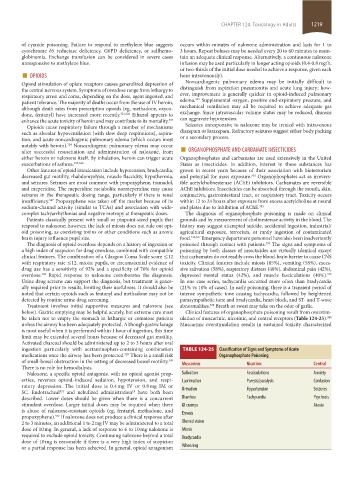
                     Treatment involves initial supportive measures and naloxone (see   abnormalities.  Breath or sweat may take on the odor of garlic.
                                                                                    338
                    below). Gastric emptying may be helpful acutely, but extreme care must   Clinical features of organophosphate poisoning result from overstim-
                    be taken not to empty the stomach in lethargic or comatose patients   ulation of muscarinic, nicotinic, and central receptors (Table 124-25).
                                                                                                                            340
                    unless the airway has been adequately protected. Although gastric lavage   Muscarinic overstimulation results in sustained toxicity characterized
                    is most useful when it is performed within 1 hour of ingestion, this time
                    limit may be extended several hours because of decreased gut motility.
                    Activated charcoal should be administered up to 2 to 3 hours after oral
                    ingestion particularly with acetaminophen-containing combination     TABLE 124-25     Classification of Signs and Symptoms of Acute
                    medications once the airway has been protected.  There is a small risk   Organophosphate Poisoning
                                                       329
                    of small-bowel obstruction in the setting of decreased bowel motility.    Muscarinic  Nicotinic    Central
                                                                      330
                    There is no role for hemodialysis.
                     Naloxone, a specific opioid antagonist with no opioid agonist prop-  Salivation  Fasciculations   Anxiety
                    erties, reverses opioid-induced sedation, hypotension, and respi-  Lacrimation  Paresis/paralysis  Confusion
                    ratory depression. The initial dose is 0.4 mg IV or 0.8 mg IM or   Urination  Hypertension         Seizures
                    SC. Endotracheal  and nebulized administration  have both been
                                 331
                                                         18
                    described.  Lower  doses  should  be  given  when  there  is  a  concurrent   Diarrhea  Tachycardia  Psychosis
                    stimulant overdose. Larger initial doses may be required when there   GI cramps                    Ataxia
                    is abuse of naloxone-resistant opioids (eg, fentanyl, methadone, and   Emesis
                    propoxyphene).  If naloxone does not produce a clinical response after
                               332
                    2 to 3 minutes, an additional 1 to 2 mg IV may be administered to a total   Blurred vision
                    dose of 10 mg. In general, a lack of response to 6 to 10 mg naloxone is   Miosis
                    required to exclude opioid toxicity. Continuing naloxone beyond a total   Bradycardia
                    dose of 10 mg is reasonable if there is a very high index of suspicion
                    or a partial response has been achieved. In general, opioid antagonism   Wheezing


            section11.indd   1219                                                                                      1/19/2015   10:52:03 AM

