


Page 1755 - Hall et al (2015) Principles of Critical Care-McGraw-Hill
P. 1755
1224     PART 11: Special Problems in Critical Care


                 therapeutic index and readily measurable plasma concentrations that are   Vd (the apparent volume of distribution) may be calculated: Vd = D/C,
                 proportional to drug effects (therapeutic and toxic). Finally, any change   since C = D/Vd. By assuming instantaneous distribution and concen-
                 in the status of an ICU patient must be considered to be potentially the   tration sampling (before any elimination has occurred), this model
                 result of an adverse drug reaction, especially in the absence of a clear-cut   describes the theoretical volume into which the administered drug must
                 explanation.                                          be distributed in order to produce the observed drug concentration
                                                                       (Fig. 125-1A). The volume of distribution of most drugs does not usu-
                 PHARMACOKINETIC                                       ally correspond to a physiologic volume (such as the extracellular fluid
                 AND PHARMACODYNAMIC PRINCIPLES                        volume [0.2 L/kg] or total body water space [0.5 to 0.7 L/kg]), but is often
                                                                       many times larger than the total body volume; drugs with a large volume
                 Pharmacokinetics is the study of drug movement through the body,    of distribution are usually characterized by low plasma protein binding,
                                                                   2-7
                 encompassing all aspects of drug disposition (“what the body does to   high lipid solubility, and extensive tissue binding.
                 the drug”), including (1) entry, (2) distribution, and (3) elimination. The   Drugs whose disposition may be described by a one-compartment
                 three most important quantifiable PK parameters considered in evaluat-  kinetic model exhibit log-linear plasma concentrations as a function
                 ing the disposition of a drug are therefore (1) bioavailability (fraction   of time, thus exhibiting “simple” or “linear” pharmacokinetics (see
                 of administered dose reaching the systemic circulation), (2) volume of   Fig. 125-1B). Since the absolute rate of drug elimination is a linear func-
                 distribution, and (3) clearance (elimination by biotransformation and/  tion of its plasma concentration, and the fraction of drug eliminated per
                 or excretion). Pharmacokinetic models divide the body into one or more   unit time is constant, a “first-order” kinetic  model applies. Following
                 compartments (see below), so that drug disposition may be described by   a single intravenous bolus (and assumed instantaneous complete dis-
                 a series of mathematical equations. Pharmacodynamics refers to the rela-  tribution), plasma drug concentration declines owing to a first-order
                 tionship of drug movement to pharmacologic response (“what the drug   elimination process (biotransformation and/or excretion), so that a
                 does to the body”). The relationship between PK data and the PD phe-  semilogarithmic plot of the logarithm of plasma drug concentration (log
                 nomenon of drug effect is based on the drug-receptor complex theory,   Cp) versus time yields a linear graph. Back-extrapolation of this graph to
                 which states that there is a correlation between drug concentrations in   time zero permits estimation of the plasma drug concentration immedi-
                 the plasma and at the receptor site, and that drug effect is proportional   ately following the bolus (Cp ), and thus an estimate of Vd, since Vd =
                                                                                            0
                 to the extent of drug-receptor complex formation.     D/C. The slope of this plot is called the elimination rate constant k (or k ).
                     ■  BIOAVAILABILITY                                described by the equation:
                                                                                                                         e
                                                                         The kinetics of drug elimination by this first-order process are
                 The  fraction  of  administered  drug  reaching  the  systemic  circulation   Cp   = Cp  e –k(T2 – T1)

                 is termed its  bioavailability. Intravascular injection generally results   (T2)  (T1)
                 in 100% bioavailability. Other parenteral routes (intramuscular, sub-  where Cp (T2)  and Cp (T1)  are the plasma drug concentrations at later and
                 cutaneous, transdermal, intraperitoneal, and inhalational) and enteral   earlier measurement points, respectively; T2 − T1 is the time elapsed
                 (oral, through enteral feeding tubes, and rectal) of administration often   between these two time points; and k is the elimination rate constant
                 achieve bioavailability which is both less complete and less predictable,     (in units of time ).
                                                                                   –1
                 although selected agents administered by the sublingual, inhalational,
                 and other routes may undergo extensive and rapid absorption. Formulation
                 properties (eg, elixir vs tablet) and the physicochemical properties     A  70   B 100
                 (eg, lipid solubility and degree of ionization at gastric pH) of the admin-
                 istered drug can substantially affect systemic bioavailability, particularly   60
                 following enteral administration. Enterally administered agents, except
                 drugs administered by sublingual or rectal routes, are uniquely subjected   Half-life = 2 hours
                 to the potential influence of first-pass (presystemic) metabolism of drug   50
                 by gut flora and by intestinal and liver enzymes (see below), which tends
                 to decrease the systemic bioavailability of the parent compound. 4,6,8    40
                 Presystemic metabolism may result in the production of metabo- Plasma concentration (Cp,  g/mL)  Log Cp  10
                 lites that are inactive (eg, most propranolol metabolites), or active   30
                 (4-hydroxypropranolol from propranolol, morphine from codeine, or
                 enalaprilat  from  enalapril) following enteral  substrate  administration.   20
                 Agents requiring metabolism to an active metabolite to elicit pharma-
                 cologic response, such as enalapril and codeine, are commonly referred
                 to as prodrugs. Locally administered drugs (eg, intraperitoneal antibiot-  10
                 ics for peritonitis or intraocular  β-blocking agents for glaucoma) are
                 intended for local effects, but it is important to remember the potential   0        1
                 systemic absorption and systemic effects of these drugs. In addition to   0  2  4  6  8  10  0  2  4  6  8  10
                 the factors that determine extent of absorption, drug formulation can be      Time (hours)
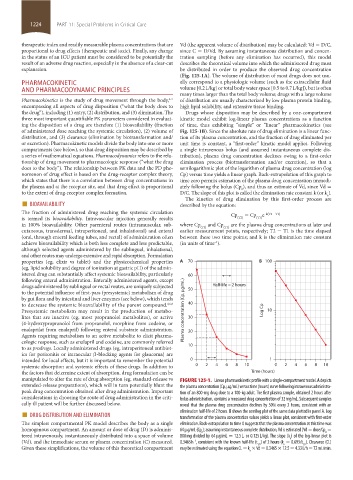
                 manipulated to alter the rate of drug absorption (eg, standard-release vs   FIGURE 125-1.  Linear pharmacokinetic profile with a single-compartment model. A depicts
                 extended-release preparations), which will in turn potentially blunt the   the plasma concentration (Cp, µg/mL) versus time (hours) curve following intravenous administra-
                 peak drug concentration obtained after drug administration. Important   tion of an 800-mg drug dose to a 100-kg adult. The first plasma sample, obtained 2 hours after
                 considerations in choosing the route of drug administration in the criti-  bolus administration, contains a measured drug concentration of 32 mg/mL. Subsequent samples
                 cally ill patient will be further discussed below.    reveal that the plasma drug concentration declines by 50% every 2 hours, consistent with an
                     ■  DRUG DISTRIBUTION AND ELIMINATION              elimination half-life of 2 hours. B shows the semilog plot of the same data plotted in panel A. Log

                 The simplest compartmental PK model describes the body as a single   transformation of the plasma concentration values yields a linear plot, consistent with first-order
                                                                       elimination. Back-extrapolation to time 0 suggests that the plasma concentration at this time was
                 homogenous compartment. An amount or dose of drug (D) is adminis-  64 µg/mL (Cp ); assuming instantaneous complete distribution, Vd is estimated (Vd = dose/Cp  =
                                                                               0
                                                                                                                         0
                 tered intravenously, instantaneously distributed into a space of volume   800 mg divided by 64 µg/mL = 12.5 L, or 0.125 L/kg). The slope (k ) of the log-linear plot is
                                                                                                             e
                 (Vd), and the immediate serum or plasma concentration (C) measured.   0.3465 h , consistent with the known half-life (t ) of 2 hours (k  = 0.693/t ). Clearance (CL)
                                                                            –1
                                                                                                                 1/2
                                                                                                          e
                                                                                                  1/2
                 Given these simplifications, the volume of this theoretical compartment   may be estimated using the equation CL = k  × Vd = 0.3465 × 12.5 = 4.33 L/h = 72 mL/min.
                                                                                               e
            section11.indd   1224                                                                                      1/19/2015   10:52:05 AM

