


Page 1766 - Hall et al (2015) Principles of Critical Care-McGraw-Hill
P. 1766
CHAPTER 125: Critical Care Pharmacology  1235


                                      CYP2E1                                TABLE 125-10    Phase II Drug Metabolizing Enzymes: Substrates and Polymorphisms
                                    CYP1A2                                Polymorphism  Examples
                                                                          “Slow” acetylation  N-acetylation polymorphism. Slow acetylators have deficient
                                                                                       N-acetyltransferase activity (NAT-2).
                                                                                       Incidence of slow acetylators: 50%-60% (Caucasian and African
                                      CYP2C
                                                                                       Americans; southern Indians); 5%-20% (Chinese, Japanese, Eskimos)
                                                                                       Incidence increased in HIV patients (thus sulfa reactions are more
                                                CYP3A
                                                                                       common)
                                     CYP2D6                                            Slow acetylators have increased risk of (1) isoniazid-induced
                                                                                       peripheral neuropathy, and possibly hepatotoxicity; (2) drug-
                                                                                       induced lupus: hydralazine, procainamide; (3) sulfonamide
                                                                                         hypersensitivity: deficient hydroxylamine metabolite  detoxification;
                                                                                       (4) sulfasalazine-induced hemolysis
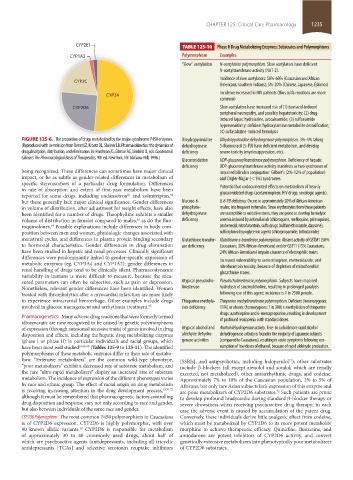
                    FIGURE 125-6.  The proportion of drugs metabolized by the major cytochrome P450 enzymes.   Dihydropyrimidine   Dihydropyrimidine dehydrogenase polymorphism. 3%-4% taking
                    (Reproduced with permission from Benet LZ, Kroetz DL, Sheiner LB. Pharmacokinetics: the dynamics of   dehydrogenase    5-fluorouracil (5-FU) have deficient metabolism, and develop
                    drug absorption, distribution, and elimination. In: Hardman JG, Gilman AG, Limbird LI, eds. Goodman &   deficiency  severe toxicity (myelosuppression, etc).
                    Gilman’s The Pharmacological Basis of Therapeutics. 9th ed. New York, NY: McGraw-Hill; 1996.)  Glucuronidation   UDP-glucuronyltransferase polymorphism. Deficiency of hepatic
                                                                          deficiency   UDP-glucuronyltransferase activity manifests as two syndromes of
                    being recognized. These differences can sometimes have major clinical   impaired bilirubin conjugation: Gilbert’s (2%-12% of population)
                    impact, or be as subtle as gender-related differences in metabolism of   and Crigler-Najjar (<1%) syndromes.
                    specific  stereoisomers  of  a  particular  drug  formulation.  Differences
                    in rate of absorption and extent of first-pass metabolism have been   Potential but undocumented effects on metabolism of heavily
                    reported for some drugs, including ondansetron  and zolmitriptan,    glucuronidated drugs (acetaminophen; HIV drugs; oncologic agents).
                                                        61
                                                                      62
                    but these generally lack major clinical significance. Gender differences   Glucose-6-  G-6-PD deficiency. Occurs in approximately 20% of African-American
                    in volume of distribution, after adjustment for weight effects, have also   phosphate-  males; less frequent in females. Since erythrocytes from these patients
                    been identified for a number of drugs. Theophylline exhibits a smaller   dehydrogenase   are susceptible to oxidative stress, they are prone to develop hemolytic
                    volume of distribution in females compared to males,  as do the fluo-  deficiency  anemia induced by antimalarials (chloroquine, mefloquine, primaquine),
                                                           63
                    roquinolones.  Possible explanations include differences in body com-  probenecid, nitrofurantoin, sulfa drugs (sulfamethoxazole, dapsone),
                              64
                    position between men and women, physiologic changes associated with   sulfonylurea hypoglycemic agents (chlorpropamide, tolbutamide)
                    menstrual cycles, and differences in plasma protein binding secondary   Glutathione transfer- Glutathione-s-transferase polymorphism. Absent activity of GSTM1 (50%
                    to hormonal characteristics. Gender differences in drug elimination   ase deficiency  Caucasians, 30% African-Americans) and/or GSTT1 (15% Caucasians,
                    have been studied in hepatic and renal processes. Clinically significant   24% African-Americans) impairs clearance of  electrophilic toxins.
                    differences were predominantly linked to gender-specific expression of   Increased vulnerability to acetaminophen, metronidazole, and
                    metabolic enzymes (eg, CYP3A4 and CYP1A2); gender differences in
                    renal handling of drugs tend to be clinically silent. Pharmacodynamic   nitrofurantoin toxicity, because of depletion of mitochondrial
                                                                                       glutathione stores.
                    variability in humans is more difficult to measure, because the mea-
                    sured parameters can often be subjective, such as pain or depression.   Atypical pseudocho- Pseudocholinesterase polymorphism. Subjects have impaired
                    Nonetheless, relevant gender differences have been identified. Women   linesterase  hydrolysis of succinylcholine, resulting in prolonged paralysis
                    treated with thrombolytics after a myocardial infarction are more likely   following use of this agent; incidence is 1 in 2500 people.
                    to experience intracranial hemorrhage. Other examples include drugs   Thiopurine methyla- Thiopurine methyltransferase polymorphism. Deficient (heterozygotes:
                    involved in glucose management and arrhythmia treatment. 65  tion deficiency  11%) or absent (homozygotes: 1 in 300) s-methylation of thiopurine
                    Pharmacogenetics:  Many adverse drug reactions that were formerly termed   drugs: azathioprine and 6-mercaptopurine, resulting in development
                    idiosyncratic are now recognized to be caused by genetic polymorphisms   of profound leukopenia with standard doses.
                    of expression (through autosomal recessive traits) of genes involved in drug   Atypical alcohol and  Alcohol dehydrogenase activity. Five- to sixfold more rapid alcohol
                    disposition and effects, including the hepatic drug metabolizing enzymes   aldehyde dehydro-  dehydrogenase activity is found in the majority of Japanese subjects
                    (phase I or phase II) in particular individuals and racial groups, which   genase activities  (compared to Caucasians), resulting in acute symptoms following con-
                    have been most well studied 16,66-69  (Tables 125-9 to 125-11). The identified   sumption of low doses of ethanol, because of rapid aldehyde production.
                    polymorphisms of these metabolic enzymes differ in their rate of metabo-
                    lism: “Extensive metabolizers” are the common wild-type phenotype,   [SSRIs], and antipsychotics, including haloperidol ); other substrates
                                                                                                               73
                    “poor metabolizers” exhibit a decreased rate of substrate metabolism, and   include  β-blockers  (all  except  atenolol  and  sotalol,  which  are  renally
                    the rare “ultra-rapid metabolizers” display an increased rate of substrate   excreted,  not  metabolized),  other  antiarrhythmic  drugs,  and  codeine.
                    metabolism. The incidence of expression of the different phenotypes varies   Approximately 7% to 10% of the Caucasian population, 2% to 5% of
                    by race and ethnic group. The effect of racial origin on drug metabolism   Africans, but only rare Asian subjects lack expression of this enzyme and
                    is receiving increasing attention in the  drug development process, 13,70-72    are poor metabolizers of CYP2D6 substrates.  Such patients are prone
                                                                                                          72
                    although it must be remembered that pharmacogenetic factors controlling   to develop profound bradycardia during standard β-blocker therapy or
                    drug disposition and response vary not only according to race and gender,   severe drowsiness when receiving psychoactive drug therapy; in each
                    but also between individuals of the same race and gender.  case the adverse event is caused by accumulation of the parent drug.
                    CYP2D6 Polymorphism  The most common P450 polymorphism in Caucasians   Conversely, these individuals derive little analgesic effect from codeine,
                    is of CYP2D6 expression. CYP2D6 is highly polymorphic, with over   which must be metabolized by CYP2D6 to its more potent metabolite
                    90 known allelic variants.  CYP2D6 is responsible for metabolism   morphine  to  achieve  therapeutic  efficacy.  Quinidine,  fluoxetine,  and
                                       18
                    of approximately 30 to 40 commonly used drugs, about half of   amiodarone are potent inhibitors of CYP2D6 activity, and convert
                    which are psychoactive agents (antidepressants, including all tricyclic   genetically extensive metabolizers into phenotypically poor metabolizers
                    antidepressants [TCAs] and selective serotonin reuptake inhibitors   of CYP2D6 substrates.


            section11.indd   1235                                                                                      1/19/2015   10:52:11 AM

