


Page 1765 - Hall et al (2015) Principles of Critical Care-McGraw-Hill
P. 1765
1234     PART 11: Special Problems in Critical Care
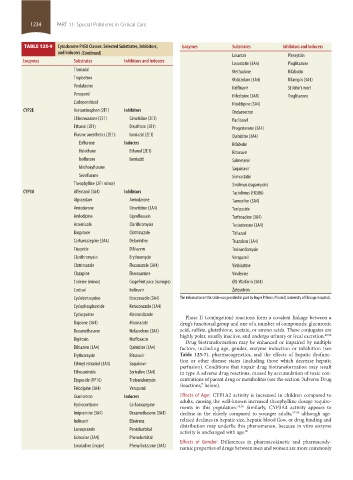
                                                                         TABLE 125-9     Cytochrome P450 Classes: Selected Substrates, Inhibitors,
                                                                                    and Inducers
                   TABLE 125-9     Cytochrome P450 Classes: Selected Substrates, Inhibitors,    Isozymes  Substrates  Inhibitors and Inducers
                              and Inducers (Continued)
                                                                                         Losartan           Phenytoin
                  Isozymes         Substrates       Inhibitors and Inducers              Lovastatin (3A4)    Pioglitazone
                                   Tramadol                                              Methadone          Rifabutin
                                   Tropisetron                                           Midazolam (3A4)    Rifampin (3A4)
                                   Venlafaxine                                           Nelfinavir         St John’s wort
                                   Verapamil                                             Nifedipine (3A4)    Troglitazone
                                   Zuclopenthixol                                        Nisoldipine (3A4)
                  CYP2E            Acetaminophen (2E1)  Inhibitors                       Ondansetron
                                   Chlorzoxazone (2E1)    Cimetidine (2E1)               Paclitaxel
                                   Ethanol (2E1)      Disulfiram (2E1)                   Progesterone (3A4)
                                   Flurane anesthetics (2E1):    Isoniazid (2E1)         Quinidine (3A4)
                                     Enflurane      Inducers                             Rifabutin
                                     Halothane        Ethanol (2E1)                      Ritonavir
                                     Isoflurane       Isoniazid                          Salmeterol
                                     Methoxyflurane                                      Saquinavir
                                     Sevoflurane                                         Simvastatin
                                   Theophylline (2E1 minor)                              Sirolimus (rapamycin)
                  CYP3A            Alfentanil (3A4)  Inhibitors                          Tacrolimus (FK506)
                                   Alprazolam         Amiodarone                         Tamoxifen (3A4)
                                   Amiodarone         Cimetidine (3A4)                   Teniposide
                                   Amlodipine         Ciprofloxacin                      Terfenadine (3A4)
                                   Astemizole         Clarithromycin                     Testosterone (3A4)
                                   Buspirone          Clotrimazole                       Tirilazad
                                   Carbamazepine (3A4)    Delavirdine                    Triazolam (3A4)
                                   Cisapride          Diltiazem                          Troleandomycin
                                   Clarithromycin     Erythromycin                       Verapamil
                                   Clotrimazole       Fluconazole (3A4)                  Vinblastine
                                   Clozapine          Fluvoxamine                        Vindesine
                                   Codeine (minor)    Grapefruit juice (naringin)        (R)-Warfarin (3A4)
                                   Cortisol           Indinavir                          Zatosetron
                                   Cyclobenzaprine    Itraconazole (3A4)  The information in this table was provided in part by Roger P. Dean, PharmD, University of Chicago Hospitals.
                                   Cyclophosphamide    Ketoconazole (3A4)
                                   Cyclosporine       Metronidazole
                                                                         Phase II (conjugation) reactions form a covalent linkage between a
                                   Dapsone (3A4)      Miconazole       drug’s functional group and one of a number of compounds: glucuronic
                                   Dexamethasone      Nefazodone (3A4)  acid, sulfate, glutathione, acetate, or amino acids. These conjugates are
                                                                       highly polar, usually inactive, and undergo urinary or fecal excretion. 49,54
                                   Digitoxin          Norfloxacin
                                                                         Drug biotransformation may be enhanced or impaired by multiple
                                   Diltiazem (3A4)    Quinidine (3A4)  factors, including age, gender, enzyme induction or inhibition (see
                                   Erythromycin       Ritonavir        Table 125-7), pharmacogenetics, and the effects of hepatic dysfunc-
                                                                       tion  or  other  disease  states  (including  those  which  decrease  hepatic
                                   Ethinyl estradiol (3A4)    Saquinavir
                                                                       perfusion). Conditions that impair drug biotransformation may result
                                   Ethosuximide       Sertraline (3A4)  in type A adverse drug reactions, caused by accumulation of toxic con-
                                   Etoposide (VP16)    Troleandomycin  centrations of parent drug or metabolites (see the section “Adverse Drug
                                                                       Reactions,” below).
                                   Felodipine (3A4)    Verapamil
                                   Granisetron      Inducers           Effects of Age:  CYP1A2 activity is increased in children compared to
                                                                       adults, causing the well-known increased theophylline dosage require-
                                   Hydrocortisone     Carbamazepine
                                                                       ments in this population. 55,56  Similarly, CYP3A4 activity appears to
                                   Imipramine (3A4)    Dexamethasone (3A4)  decline in the elderly compared to younger adults, 57-59  although age-
                                   Indinavir          Efavirenz        related declines in hepatic size, hepatic blood flow, or drug binding and
                                                                       distribution may underlie this phenomenon, because in vitro enzyme
                                   Lansoprazole       Pentobarbital
                                                                       activity is unchanged with age. 60
                                   Lidocaine (3A4)    Phenobarbital
                                                                       Effects  of  Gender:  Differences in pharmacokinetic and pharmacody-
                                   Loratadine (major)    Phenylbutazone (3A4)  namic properties of drugs between men and women are more commonly


            section11.indd   1234                                                                                      1/19/2015   10:52:10 AM

