


Page 1767 - Hall et al (2015) Principles of Critical Care-McGraw-Hill
P. 1767
1236     PART 11: Special Problems in Critical Care


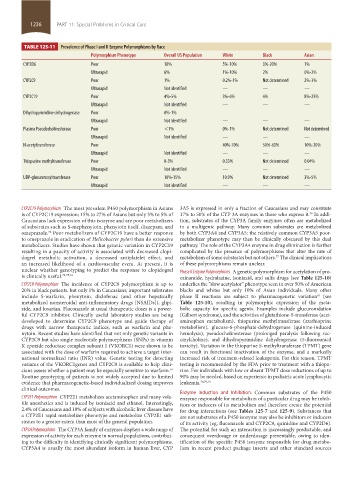
                   TABLE 125-11    Prevalence of Phase I and II Enzyme Polymorphisms by Race
                                         Polymorphism Phenotype   Overall US Population  White     Black          Asian
                  CYP2D6                 Poor                     10%                 5%-10%       0%-20%         1%
                                         Ultrarapid               6%                  1%-10%       2%             0%-2%
                  CYP2C9                 Poor                     1%                  0.2%-1%      Not determined  2%-3%
                                         Ultrarapid               Not identified      —            —              —
                  CYP2C19                Poor                     4%-5%               3%-6%        4%             8%-23%
                                         Ultrarapid               Not identified      —            —              —
                  Dihydropyrimidine dehydrogenase  Poor           0%-1%
                                         Ultrarapid               Not identified      —            —              —
                  Plasma Pseudocholinesterase  Poor               <1%                 0%-1%        Not determined  Not determined
                                         Ultrarapid               Not identified      —            —              —
                  N-acetyltransferase    Poor                                         40%-70%      50%-60%        10%-20%
                                         Ultrarapid               Not identified      —            —              —
                  Thiopurine methyltransferase  Poor              0-3%                0.33%        Not determined  0.04%
                                         Ultrarapid               Not identified      —            —              —
                  UDP-glucuronosyltransferase  Poor               10%-15%             10.9%        Not determined  3%-5%
                                         Ultrarapid               Not identified      —            —              —


                 CYP2C19 Polymorphism  The most prevalent P450 polymorphism in Asians   3A5 is expressed in only a fraction of Caucasians and may constitute
                 is of CYP2C19 expression; 15% to 27% of Asians but only 3% to 5% of   17% to 50% of the CYP 3A enzymes in those who express it.  In addi-
                                                                                                                   76
                 Caucasians lack expression of this isozyme and are poor metabolizers   tion, substrates of the CYP3A family enzymes often are metabolized
                 of substrates such as S-mephenytoin, phenytoin itself, diazepam, and   in  a  multigenic  pathway.  Many  common  substrates  are  metabolized
                 omeprazole.  Poor metabolizers of CYP2C19 have a better response   by both CYP3A4 and CYP3A5; the relatively common CYP3A5 poor-
                          72
                 to omeprazole in eradication of Helicobacter pylori than do extensive   metabolizer phenotype may  then be clinically obscured  by  this  dual
                 metabolizers. Studies have shown that genetic variation in CYP2C19   pathway. The role of the CYP3A4 enzyme in drug elimination is further
                 resulting in a paucity of activity is associated with decreased clopi-  complicated by the presence of polymorphisms that alter the rate of
                                                                                                        77
                 dogrel metabolic activation, a decreased antiplatelet effect, and   metabolism of some substrates but not others.  The clinical implications
                 an increased likelihood of a cardiovascular event. At present, it is   of these polymorphisms remain unclear.
                 unclear  whether  genotyping  to  predict  the  response  to  clopidogrel    Phase II Enzyme Polymorphisms  A genetic polymorphism for acetylation of pro-
                 is clinically useful. 74,75,16                        cainamide, hydralazine, isoniazid, and sulfa drugs (see Table 125-10)
                 CYP2C9 Polymorphism  The incidence of CYP2C9 polymorphism is up to   underlies the “slow acetylator” phenotype seen in over 50% of American
                 20% in black patients, but only 1% in Caucasians; important substrates   blacks  and  whites  but  only  10%  of  Asian  individuals.  Many  other
                                                                                                                      61
                 include  S-warfarin,  phenytoin,  diclofenac  (and  other  hepatically    phase II  reactions are subject to pharmacogenetic variation  (see
                 metabolized nonsteroidal anti-inflammatory drugs [NSAIDs]), glipi-  Table 125-10), resulting in polymorphic expression of the meta-
                 zide, and losartan. Fluconazole at usual therapeutic doses is a power-  bolic capacity for specific agents. Examples include glucuronidation
                 ful CYP2C9 inhibitor. Clinically useful laboratory studies are being   (Gilbert syndrome), and the activities of glutathione-S-transferase (acet-
                 developed  to  determine  CYP2C9  phenotype  and  guide  therapy  of   aminophen metabolism), thiopurine methyltransferase (azathioprine
                 drugs with narrow therapeutic indices, such as warfarin and phe-  metabolism), glucose-6-phosphate-dehydrogenase (quinine-induced
                 nytoin. Recent studies have identified that not only genetic variants in   hemolysis), pseudocholinesterase (prolonged paralysis following suc-
                 CYP2C9 but also single nucleotide polymorphisms (SNPs) in vitamin   cinylcholine),  and  dihydropyrimidine  dehydrogenase  (5-fluorouracil
                 K epoxide reductase complex subunit 1 (VKORC1) were shown to be   toxicity). Variation in the thiopurine S-methyltransferase (TPMT) gene
                 associated with the dose of warfarin required to achieve a target inter-  can result in functional inactivation of the enzyme, and a markedly
                 national normalized ratio (INR) value. Genetic testing for detecting   increased risk of treatment-related leukopenia. For this reason, TPMT
                 variants of the VKORC1genes and CYP2C9 is available to help clini-  testing is recommended by the FDA prior to treatment with a thiopu-
                 cians assess whether a patient may be especially sensitive to warfarin.    rine. For individuals with low or absent TPMT dose reductions of up to
                                                                    16
                 Routine genotyping of patients is not widely accepted due to limited   90% may be needed, based on experience in pediatric acute lymphocytic
                 evidence that pharmacogenetic-based individualized dosing improves   leukemia. 78,79,16
                 clinical outcomes.                                    Enzyme Induction and Inhibition:  Common substrates of the P450
                 CYP2E1 Polymorphism  CYP2E1 metabolizes acetaminophen and many vola-  enzyme responsible for metabolism of a particular drug may be inhib-
                 tile anesthetics and is induced by isoniazid and ethanol. Interestingly,   itors or inducers of its metabolism and therefore create the potential
                 2.4% of Caucasians and 10% of subjects with alcoholic liver disease have   for drug interactions (see Tables 125-7 and 125-9). Substances that
                 a CYP2E1 rapid metabolizer phenotype and metabolize CYP2E1 sub-  are not substrates of a P450 isozyme may also be inhibitors or inducers
                 strates to a greater extent than most of the general population.  of its activity (eg, fluconazole and CYP2C9, quinidine and CYP2D6).
                 CYP3A Polymorphism  The CYP3A family of enzymes displays a wide range of   The potential for such an interaction is increasingly predictable, and
                 expression of activity for each enzyme in normal populations, contribut-  consequent overdosage or underdosage preventable, owing to iden-
                 ing to the difficulty in identifying clinically significant polymorphisms.   tification of the specific P450 isozyme responsible for drug metabo-
                 CYP3A4 is usually the most abundant isoform in human liver, CYP   lism in recent product package inserts and other standard sources


            section11.indd   1236                                                                                      1/19/2015   10:52:12 AM

