


Page 1762 - Hall et al (2015) Principles of Critical Care-McGraw-Hill
P. 1762
CHAPTER 125: Critical Care Pharmacology  1231


                    tubules. Only 1.8 L of urine is produced from the 190 L per 24 hours of   Confounding factors include requirement of a steady-state serum creati-
                    daily glomerular filtrate (130 mL/min × 1440 minutes), because water and   nine value (SCr ), estimation of ideal body weight, the empiricism of the
                                                                                     ss
                    most solutes are predominantly reabsorbed (eg, the fractional excretion of   age and gender estimates used in development of the formula, 30-32  and the
                    sodium in a stable subject is 1%, thus 99% of filtered sodium is reabsorbed).  effects of some medications on tubular creatinine secretion.  It is particu-
                                                                                                                   33
                     Glomerular filtration of plasma constituents is primarily limited by   larly difficult to account accurately for the effects on the estimated GFR
                    size (≤50,000 Da), water solubility, plasma protein binding (only free   calculation of diminished muscle mass (and thus creatinine generation)
                    drug is filtered), and volume of distribution (extensively tissue-bound   in the elderly, or in patients with cirrhosis, spinal cord injury, cachexia, or
                                                         4,6
                    substances are less likely to be renally excreted).  Some drugs also   other causes of muscle wasting. This limitation of Scr is regardless of which
                    undergo significant renal tubular secretion or reabsorption (passive   equation is used and cannot be overcome by an adjustment of the equa-
                    or active). Passive reabsorption of weak acids or bases from the renal   tion.  Nevertheless, a rough estimate of the current GFR is obtained and
                                                                             34
                    tubular lumen may be influenced by urinary alkalization or acidifica-  should be used to guide dosing calculations. 35-37  The Modification of Diet
                    tion, respectively. Active tubular secretion by proximal tubular cationic   in Renal Disease (MDRD) equation offers another method to approximate
                    or anionic pumps may be subject to competitive inhibition, resulting in   GFR; the equation is found to be more accurate than the Cockcroft-Gault
                    decreased renal clearance and prolonged plasma half-life of the lower   equation and takes into account more clinical factors, such as serum albu-
                    affinity substance. For example, probenecid inhibits tubular penicillin   min and blood urea nitrogen, that likely reflect the patient’s clinical status
                    secretion, prolonging penicillin elimination half-life. Similarly, trim-  more accurately, but is much more complicated to use.  Web sites are
                                                                                                                  38
                    ethoprim  and cimetidine inhibit  renal tubular  creatinine  secretion,   available (such as www.nephron.com) to facilitate the use of the MDRD
                    reducing creatinine clearance and elevating serum creatinine, without   equation. The MDRD equation has been shown to overestimate measured
                    affecting actual GFR (see below).                     GFR in those values >60mL/min per 1.73m . The CKD- Epidemiology
                                                                                                          2
                     The plasma clearance of creatinine (creatinine clearance; CrCl) pro-  Collaboration (CKD-EPI) equation was recently developed specifically
                    vides a close approximation of GFR, because creatinine is produced from   to  overcome  this  limitation.  It  is  more  accurate  than  the  MDRD  study
                    muscle at a constant rate and freely filtered (it has a molecular weight   equation, particularly at higher levels of GFR.  Estimating equations are
                                                                                                          39
                    of 113 Da, is water soluble, and is not protein bound). The amount of   on average more accurate than measured creatinine clearance, given the
                    creatinine filtered (the product of the GFR and the plasma creatinine,   errors in urine collection.  Another interesting and accurate approach uses
                                                                                           20
                    PCr) is (theoretically) equal to the amount of creatinine excreted during   measured aminoglycoside clearance, which occurs entirely by glomerular
                    the same period (the product of the urine creatinine concentration UCr,   filtration, as a surrogate measurement of GFR. 40
                    and the urine flow rate V); thus, GFR = (UCr × V)/PCr. Measurement   Following GFR estimation, dosage is usually adjusted based on pub-
                    of CrCl requires a timed urine collection to quantify the urinary excre-  lished criteria for the agent in question. These maintenance dose adjust-
                    tion rate and a midpoint plasma creatinine sample (PCr). CrCl normally   ments for renal insufficiency are made as follows: 41-44
                    slightly overestimates GFR because some plasma creatinine is also
                    secreted by renal tubules, augmenting the measured clearance value   Patient’s Estimated GFR/Normal GFR × 100 = Dose Adjustment, %
                    beyond that due to filtration. This effect is magnified with the develop-  (ie, percentage increase in interval or percentage decrease in dose).
                    ment of progressive glomerular disease, as hypersecretion of creatinine   The dosing interval may be increased (interval extension), the size of
                    by remnant tubules accounts for an increasing fraction of declining   individual doses decreased (dose reduction), or a combination of both
                    serial CrCl values.  In critically ill patients, collection of a urine sample   approaches may sometimes be necessary.
                                 27
                    during a period of stable renal function with a steady plasma creatinine   For the interval extension method, the usual size dose is given, but the
                    value may not be possible; short (0.5- to 4-hour) collections have been   intervals between individual doses are lengthened. This method is useful
                    used in an attempt to overcome this problem. However, this method is   for drugs characterized by long plasma half-lives in the presence of renal
                    of limited clinical value because of frequent urine collection errors, ana-  impairment and a wide therapeutic range. This approach is convenient
                    lytical interference with the serum or urine creatinine assay as the result   but results in large plasma concentration fluctuations between peak and
                    of concomitant diseases, and drug therapies and the associated delay in   trough levels; in drugs with a low therapeutic index, toxic or subthera-
                                     20
                    the  reporting  of  results.   Inulin clearance  more closely approximates   peutic levels may result. For example, aminoglycosides are ideally suited
                    GFR, but is impractical for clinical use, since determination requires   to such a dosing strategy: The peak plasma concentration correlates with
                    inulin infusion, and the assay is difficult to perform. Other clearance   therapeutic efficacy, but trough levels must be monitored and kept low
                    techniques are equally impractical for routine clinical use, and  more   to minimize toxicity.
                    complex devices measuring real-time changes in renal function are not   Alternatively, in drugs with a low therapeutic index, and those
                    widely available for clinical applications at this time. 28  for which a constant level is preferred, the size of individual doses is
                     In patients with stable renal function, it is appropriate to use serum   reduced. This achieves a more constant plasma concentration, with less
                    creatinine values and demographic data in equations to calculate esti-  peak-trough fluctuation; however, increased toxicity because of higher
                    mated GFR (eGFR). These equations have a number of limitations, but   average trough levels may result. For example, antiseizure drugs must be
                    in critically ill patients it is most important to emphasize that calcula-  dose adjusted in this fashion.
                    tions with these equations assume steady-state conditions, in which   In the presence of renal insufficiency, hepatic metabolism accounts
                    renal function is not rapidly changing. This scenario is frequently   for the bulk of nonrenal elimination of drugs that are normally renally
                    not applicable to critically ill patients, in whom serum creatinine is   excreted. Hepatic biotransformation of some drugs is altered in patients
                    frequently increasing or decreasing; both conditions invalidate eGFR   with  renal  insufficiency.  Available  evidence  suggests  that  CKD  may
                    calculations with standard equations. In contrast, the use of equations   lead to alterations in nonrenal clearance of many medications as the
                    to estimate GFR is very valuable in patients with stable, apparently nor-  result of alterations in the activities of uptake and efflux transporters as
                    mal renal function and chronic kidney disease (CKD). The steady-state   well as cytochrome P450.  However in contrast, studies on the impact
                                                                                            45
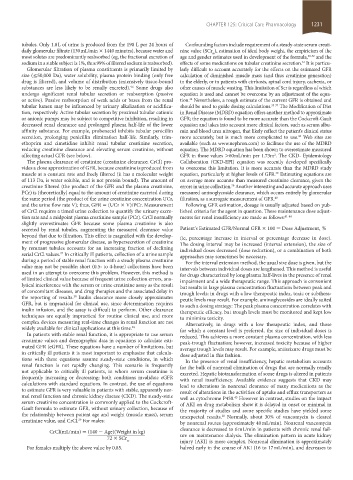
                    serum creatinine concentration is commonly applied to the Cockcroft-  of AKI on drug metabolism show it is delayed in onset or minimal in
                    Gault formula to estimate GFR, without urinary collection, because of   the majority of studies and some specific studies have yielded some
                    the relationship between patient age and weight (muscle mass), serum   unexpected results.  Normally, about 30% of vancomycin is cleared
                                                                                        20
                    creatinine value, and CrCl.  For males:               by nonrenal routes (approximately 40 mL/min). Nonrenal vancomycin
                                       29
                                                                          clearance is decreased to 6 mL/min in patients with chronic renal fail-
                             CrCl(mL/min) = (140 - Age)(Weight in kg)
                                                 72 × SCr                 ure on maintenance dialysis. The elimination pattern in acute kidney
                                                        ss                injury (AKI) is more complex. Nonrenal elimination is approximately
                     For females multiply the above value by 0.85.        halved early in the course of AKI (16 to 17 mL/min), and decreases to


            section11.indd   1231                                                                                      1/19/2015   10:52:09 AM

