


Page 1763 - Hall et al (2015) Principles of Critical Care-McGraw-Hill
P. 1763
1232     PART 11: Special Problems in Critical Care


                 values closer to those of subjects with CKD (10 mL/min) after 1 week     TABLE 125-7    Selected Cytochrome P450 Inhibitors and Inducers
                 of AKI.  This phenomenon requires an appropriate dosage adjustment,
                       46
                 which is facilitated in this case by the routine availability of plasma-level   Inhibitors   Inducers
                 monitoring. Conversely, nonrenal clearance of imipenem in acute renal   Amiodarone           Anticonvulsants
                 failure is nearly double that found in chronic renal insufficiency (95
                 vs 51 mL/min), approaching that found in patients with normal renal   Celecoxib              Carbamazepine
                 function (130 mL/min; comprising over half of normal total clearance   Cimetidine            Phenobarbital
                 of approximately 230 mL/min). As a result, the total clearance of imipe-  Erythromycin       Phenytoin
                 nem in anuric AKI patients is 108 mL/min, compared with 64 mL/min     Ethanol (acute intoxication)  Cigarette smoking
                 in CRI, and 230 mL/min in normal subjects. Therefore, the daily dose
                 requirement is appropriately reduced from 2000 to 4000 mg/d in normal   Fluconazole          Corticosteroids
                 subjects to 1847 mg/d in AKI patients—a near doubling of the dose that   Fluoxetine          Prednisone
                 would be administered based on CKD data (1111 mg/d).  In this case,   Isoniazid              Dexamethasone
                                                           47
                 the risk of seizure because of impaired clearance and imipenem accumu-  Itraconazole         Ethanol (chronic use)
                 lation is balanced against the risk of undertreatment, but accurate dosing
                 would not be achieved based solely on clearance data from CRI patients,   Ketoconazole       Grape fruit juice
                 and plasma drug levels are not routinely available for clinical use in most   Neuroleptics   Omeprazole
                 institutions. Definitive conclusions on the pharmacokinetics of metabo-  Oral contraceptives  Pioglitazone
                 lized medications in AKI remain hampered by the clinical complexity   Psoralen dermatologics  Rifampin
                 and potential confounders in the critically ill patients.  AKI data should
                                                        19
                 be used whenever possible; in the absence of this information, CKD data   Quinidine
                 must be used, but with an appropriate cautionary approach.  Quinolone antibiotics
                     ■  HEPATIC BIOTRANSFORMATION                       Selective serotonin reuptake

                 Most drugs are lipophilic, so that they tend to be reabsorbed across   inhibitors
                                                                        Ticlopidine
                 renal tubular or intestinal membranes following glomerular filtration
                 or biliary excretion, respectively. These drugs must therefore undergo   Tricyclic antidepressants
                 biotransformation to more polar/hydrophilic compounds to allow
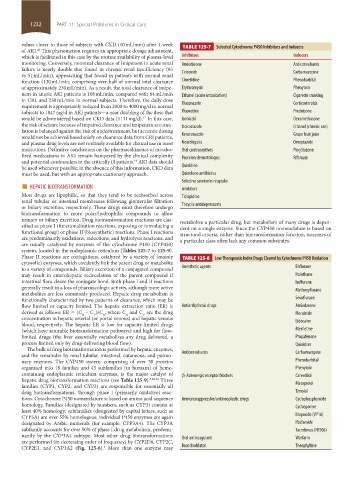
                 urinary or biliary excretion. Drug biotransformation reactions are clas-  metabolize a particular drug, but metabolism of many drugs is depen-
                 sified as phase I (functionalization reactions, exposing or introducing a   dent on a single enzyme. Since the CYP450 nomenclature is based on
                 functional group) or phase II (biosynthetic) reactions. Phase I reactions   structural criteria, rather than biotransformation function, isozymes of
                 are predominantly oxidations, reductions, and hydrolysis reactions, and   a particular class often lack any common substrates.
                 are usually catalyzed by enzymes of the cytochrome P450 (CYP450)
                 system, located in the endoplasmic reticulum (Tables 125-7 to 125-9).
                 Phase II reactions are conjugations, catalyzed by a variety of (mainly     TABLE 125-8    Low Therapeutic Index Drugs Cleared by Cytochrome P450 Oxidation
                 cytosolic) enzymes, which covalently link the parent drug or metabolite
                 to a variety of compounds. Biliary excretion of a conjugated compound   Anesthetic agents     Enflurane
                 may result in  enterohepatic recirculation  of the  parent  compound  if                      Halothane
                 intestinal flora cleave the conjugate bond. Both phase I and II reactions                     Isoflurane
                 generally result in a loss of pharmacologic activity, although more active                    Methoxyflurane
                 metabolites are less commonly produced. Hepatic drug metabolism is
                 functionally characterized by two patterns of clearance, which may be                         Sevoflurane
                 flow limited or capacity limited. The hepatic extraction ratio (ER) is   Antiarrhythmic drugs  Amiodarone
                 derived as follows: ER = (C  – C )/C , where C  and C  are the drug                           Flecainide
                                                          V
                                      A
                                          V
                                                     A
                                             A
                 concentration in hepatic arterial (or portal venous) and hepatic venous
                 blood,  respectively. The hepatic ER is low  for capacity-limited drugs                       Lidocaine
                 (which have saturable biotransformation pathways) and high for flow-                          Mexiletine
                 limited drugs (the liver essentially metabolizes any drug delivered, a                        Propafenone
                 process limited only by drug-delivering blood flow).                                          Quinidine
                   The bulk of drug biotransformation is performed by hepatic enzymes,
                 and the remainder by renal tubular, intestinal, cutaneous, and pulmo-  Anticonvulsants        Carbamazepine
                 nary enzymes. The CYP450 system, comprising of over 50 proteins                               Phenobarbital
                 organized into 18 families and 43 subfamilies (in humans) of heme-                            Phenytoin
                 containing  endoplasmic  reticulum  enzymes,  is  the  major catalyst  of   β-Adrenergic receptor blockers  Carvedilol
                 hepatic drug biotransformation reactions (see Table 125-9). 5,48-53  Three
                 families (CYP1, CYP2, and CYP3) are responsible for essentially all                           Metoprolol
                 drug biotransformations, through phase I (primarily oxidative) reac-                          Timolol
                 tions. Cytochrome P450 nomenclature is based on amino acid sequence   Immunosuppressive/antineoplastic drugs  Cyclophosphamide
                 homology. Families (designated by numbers, such as CYP3) contain at                           Cyclosporine
                 least 40% homology; subfamilies (designated by capital letters, such as
                 CYP3A) are over 55% homologous; individual P450 enzymes are again                             Etoposide (VP16)
                 designated by Arabic numerals (for example, CYP3A4). The CYP3A                                Ifosfamide
                 subfamily accounts for over 50% of phase I drug metabolism, predomi-                          Tacrolimus (FK506)
                 nantly  by  the  CYP3A4  subtype.  Most  other  drug  biotransformations   Oral anticoagulant  Warfarin
                 are performed (in decreasing order of frequency) by CYP2D6, CYP2C,
                 CYP2E1, and CYP1A2 (Fig. 125-6).  More than one enzyme may   Bronchodilator                   Theophylline
                                             5


            section11.indd   1232                                                                                      1/19/2015   10:52:10 AM

