


Page 1801 - Hall et al (2015) Principles of Critical Care-McGraw-Hill
P. 1801
1270     PART 11: Special Problems in Critical Care


                 INTRODUCTION/DEFINITION                               EPIDEMIOLOGY

                 The traditional definition of anaphylaxis is “a systemic, immediate hyper-  The true incidence and prevalence of anaphylaxis is currently not
                 sensitivity reaction caused by immunoglobulin E (IgE)–mediated immu-  known  because  of  a lack  of any  controlled  studies.  Underdiagnosis,
                 nologic release of mediators from mast cells and basophils.” The term   underreporting, and miscoding are substantial obstacles preventing an
                 “anaphylactoid” reaction has been traditionally defined as a clinically similar   accurate  estimation.   Table 128-1  summarizes  the  major  studies  of
                                                                                      6-8
                 event not mediated by IgE.  More recently, the World Allergy Organization   incidence and prevalence and their relevant findings. A recent expert
                                   1,2
                 (WAO) has referred to anaphylaxis as a “severe, life-threatening, generalized   panel concluded that the lifetime prevalence of anaphylaxis is about
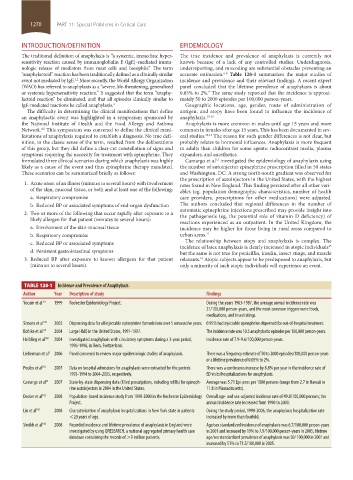
                 or systemic hypersensitivity reaction.” It suggested that the term ‘‘anaphy-  0.05% to 2%.  The same study reported that the incidence is approxi-
                                                                                 9
                 lactoid reaction’’ be eliminated, and that all episodes clinically similar to   mately 50 to 2000 episodes per 100,000 person-years.
                 IgE-mediated reactions be called anaphylaxis. 3         Geographic locations, age, gender, route of administration of
                   The difficulty in determining the clinical manifestations that define     antigen, and atopy have been found to influence the incidence of
                 an  anaphylactic  event  was  highlighted  in  a  symposium  sponsored  by     anaphylaxis. 10-13
                 the National Institute of Health  and the  Food Allergy and Asthma   Anaphylaxis is more common in males until age 15 years and more
                 Network.  This symposium was convened to define the clinical mani-  common in females after age 15 years. This has been documented in sev-
                        4,5
                 festations of anaphylaxis required to establish a diagnosis. No true defi-  eral studies. 13,14  The reason for such gender differences is not clear, but
                 nition, in the classic sense of the term, resulted from the deliberations   probably relates to hormonal influences. Anaphylaxis is more frequent
                 of this group, but they did define a clear-cut constellation of signs and   in adults than children for some agents: radiocontrast media, plasma
                 symptoms requiring the necessity for treatment with epinephrine. They   expanders, and anesthetics.
                 formulated three clinical scenarios during which anaphylaxis was highly   Camargo et al  investigated the epidemiology of anaphylaxis using
                                                                                   12
                 likely as a cause of the event and thus epinephrine therapy mandated.   the number of autoinjector epinephrine prescription filled in 50 states
                 These scenarios can be summarized briefly as follows:  and Washington, DC. A strong north-south gradient was observed for
                                                                       the prescription of autoinjectors in the United States, with the highest
                   1.  Acute onset of an illness (minutes to several hours) with involvement   rates found in New England. This finding persisted after all other vari-
                    of the skin, mucosal tissue, or both and at least one of the following:   ables (eg, population demographic characteristics, number of health
                    a.  Respiratory compromise                         care providers, prescriptions for other medications) were adjusted.
                    b.  Reduced BP or associated symptoms of end-organ dysfunction  The authors concluded that regional differences in the number of
                   2.  Two or more of the following that occur rapidly after exposure to a   automatic epinephrine injections prescribed may provide insight into
                                                                       the pathogenesis (eg, the potential role of vitamin D deficiency) of
                    likely allergen for that patient (minutes to several hours):   reactions experienced as an outpatient. In the United Kingdom, the
                    a.  Involvement of the skin-mucosal tissue         incidence may be higher for those living in rural areas compared to
                    b.  Respiratory compromise                         urban areas. 11
                                                                         The relationship between atopy and anaphylaxis is complex. The
                    c.  Reduced BP or associated symptoms              incidence of latex anaphylaxis is clearly increased in atopic individuals
                                                                                                                          15
                    d. Persistent gastrointestinal symptoms            but the same is not true for penicillin, insulin, insect stings, and muscle
                   3.  Reduced BP after exposure to known allergens for that patient    relaxants.  Atopic subjects appear to be predisposed to anaphylaxis, but
                                                                              10
                    (minutes to several hours).                        only a minority of such atopic individuals will experience an event.


                   TABLE 128-1    Incidence and Prevalence of Anaphylaxis.
                  Author    Year  Description of study                          Findings
                  Yocum et al 177  1999  Rochester Epidemiology Project.        During the years 1983-1987, the average annual incidence rate was
                                                                                21/100,000 person-years, and the most common triggers were foods,
                                                                                medications, and insect stings.
                  Simons et al 178  2002  Dispensing data for all injectable epinephrine formulations over 5 consecutive years. 0.95% had injectable epinephrine dispensed for out-of-hospital treatment.
                  Bohlke et al 179  2004  Large HMO in the United States, 1991-1997.  The incidence rate was 10.5 anaphylactic episodes per 100,000 person-years.
                  Helbling et al 180  2004  Investigated anaphylaxis with circulatory symptoms during a 3-year period,    Incidence rate of 7.9-9.6/100,000 person-years.
                                  1996-1998, in Bern, Switzerland.
                  Lieberman et al 9  2006  Panel convened to review major epidemiologic studies of anaphylaxis.  There was a frequency estimate of 50 to 2000 episodes/100,000 person-years
                                                                                or a lifetime prevalence of 0.05% to 2%.
                  Poulos et al 181  2007  Data on hospital admissions for anaphylaxis were extracted for the periods    There was a continuous increase by 8.8% per year in the incidence rate of
                                  1993-1994 to 2004-2005, respectively.         ED visits/hospitalizations for anaphylaxis.
                  Camargo et al 12  2007  State-by-state dispensing data (filled prescriptions, including refills) for epineph-  Average was 5.71 Epi-pens per 1000 persons (range from 2.7 in Hawaii to
                                  rine autoinjectors in 2004 in the United States.  11.8 in Massachusetts).
                  Decker et al 182  2008  Population-based incidence study from 1990-2000 in the Rochester Epidemiology  Overall age- and sex-adjusted incidence rate of 49.8/100,000 persons; the
                                  Project.                                      annual incidence rate increased from 1990 to 2000.
                  Lin et al 183  2008  Characterization of anaphylaxis hospitalizations in New York state in patients    During the study period, 1990-2006, the anaphylaxis hospitalization rate
                                  <20 years of age.                             increased by more than fourfold.
                  Sheikh et al 184  2008  Recorded incidence and lifetime prevalence of anaphylaxis in England were    Age/sex standardized incidence of anaphylaxis was 6.7/100,000 person-years
                                  investigated by using QRESEARCH, a national aggregated primary health care    in 2001 and increased by 19% to 7.9/100,000 person-years in 2005; lifetime
                                  database containing the records of >9 million patients.  age/sex standardized prevalence of anaphylaxis was 50/ 100,000 in 2001 and
                                                                                increased by 51% to 71.5/100,000 in 2005.


            section11.indd   1270                                                                                      1/19/2015   10:52:25 AM

